
Before You Order Slabs
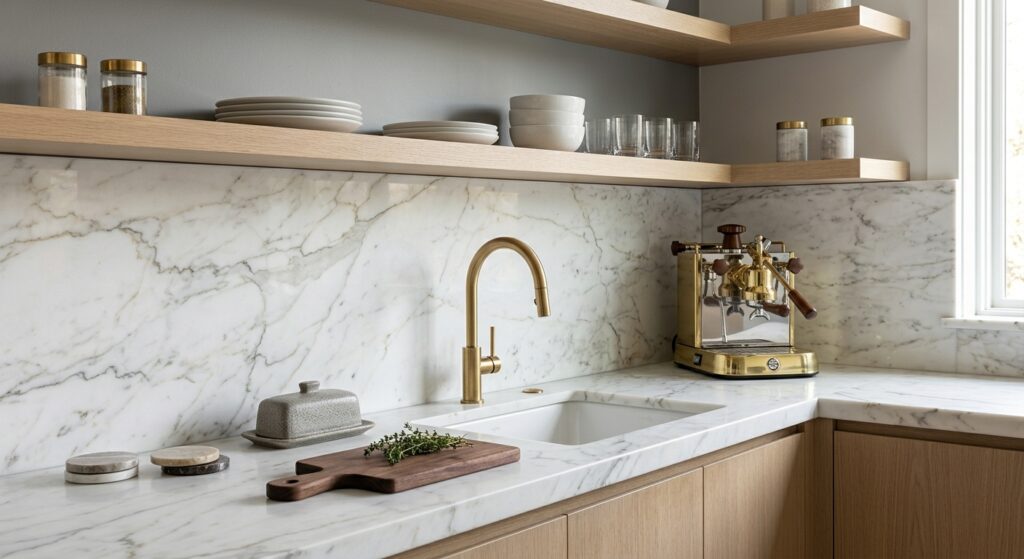
The smartest countertop and backsplash choices balance appearance, daily maintenance, installation requirements, and total budget before a single slab or box of tile is ordered. While many Kitchen remodels stall when homeowners fall in love with a tile sample before picking a slab, reversing that order keeps the entire room cohesive.
Starting with the countertop, and letting its color, veining, finish, and care requirements guide the backsplash, gives your kitchen a clear visual anchor and prevents costly compatibility mistakes later on.
Table of Contents
Choose the Countertop First
Countertops connect almost every working zone in a kitchen, meeting your cabinetry, sink, range, and walls at eye level. Selecting the countertop first establishes a clear direction for the rest of the room.
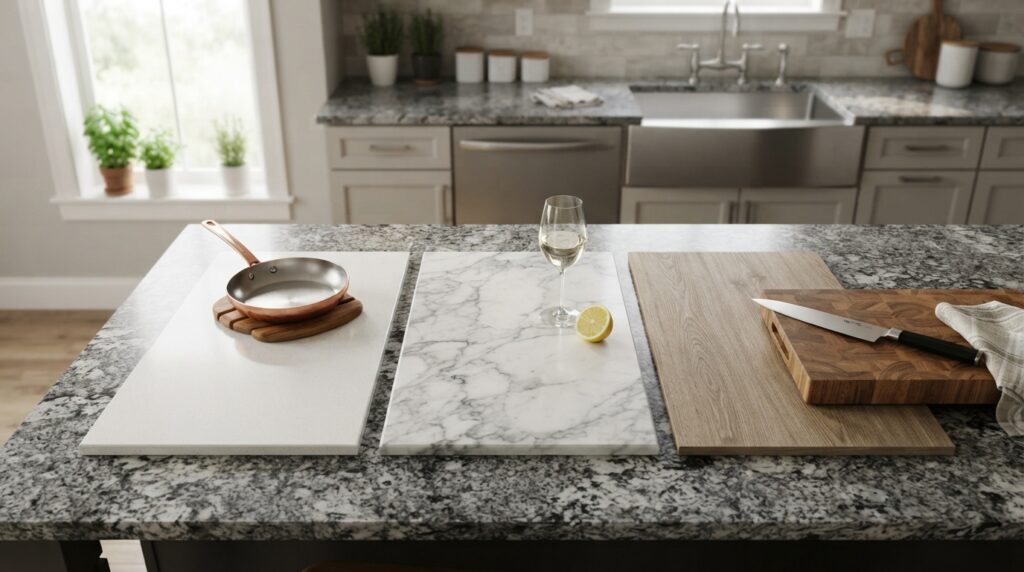
Before comparing colors or edge profiles, compare how each material behaves during everyday cooking:
| Material | Key Characteristic | Main Maintenance Check |
| Quartz | Engineered, nonporous surface with uniform patterns | Requires trivets for hot pans and cutting boards to prevent scratches |
| Granite | Natural igneous stone with high scratch and heat resistance | Verify whether the specific slab needs periodic sealing |
| Marble | Natural calcareous stone with soft, distinctive veining | Sensitive to acidic foods (lemon, vinegar, wine) and etches easily |
| Laminate | Budget-friendly layered surface with wide pattern variety | Needs strict protection from hot cookware, standing water at seams, and knives |
According to the Natural Stone Institute, granite is one of the harder dimension stones and offers strong resistance to everyday scratching. Even so, exact performance varies by quarry, finish, and fabrication, which is why no countertop material should ever be treated as completely indestructible.
Understand What “Low-Maintenance” Quartz Really Means
Engineered quartz remains one of the most popular kitchen countertops because it is nonporous and never requires sealing. However, low maintenance does not mean unlimited resistance to heat or harsh chemicals.
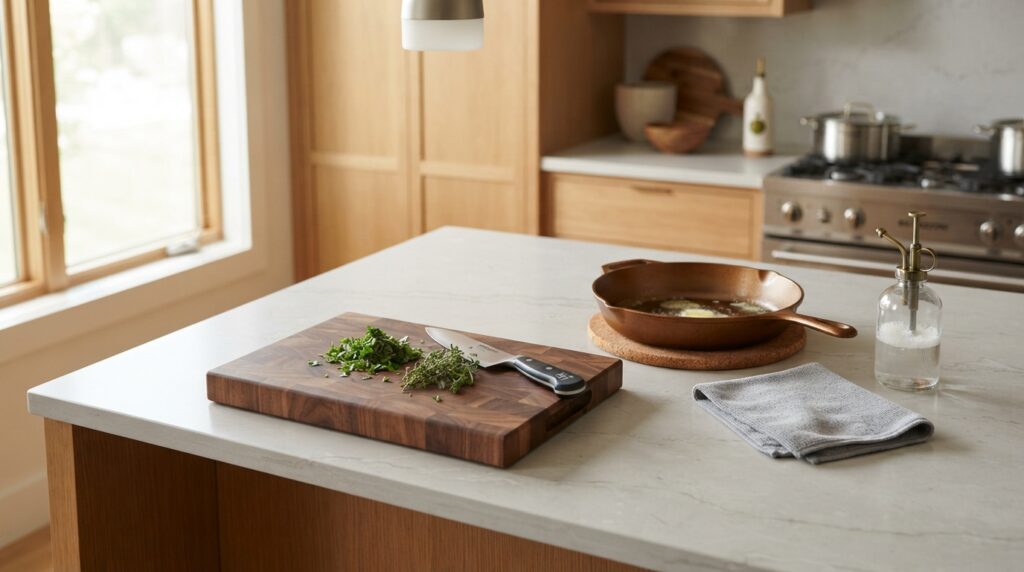
According to Caesarstone’s care and maintenance guidelines, quartz surfaces should be cleaned routinely with warm water and a mild detergent while avoiding harsh acids, strong alkalis, oxidizers, and abrasive scrubbers. Caesarstone also recommends using trivets or hot pads under hot cookware and cutting boards during food prep, as extreme heat or sharp blades can still damage the resin binders.
Additionally, surface finish affects daily upkeep: matte, honed, concrete, and textured quartz finishes tend to show fingerprints and grease more readily than standard polished slabs and require slightly more frequent wiping.
Know Your Natural Stone Before Sealing or Cleaning
Natural stone brings organic movement, mineral variation, and depth that manufactured slabs cannot fully replicate, but each stone family demands tailored care:
- Identify acid-sensitive stones: The Natural Stone Institute notes that calcareous stones, such as marble, limestone, and travertine, react with acidic liquids, leaving dull etch marks. Always use mild, ph-neutral, non-acidic cleaners on natural stone.
- Use trivets even on granite: While granite tolerates heat well, sudden localized temperature changes from a hot cast-iron skillet can create thermal stress capable of cracking the stone.
- Check whether sealing is actually necessary: Contrary to popular myth, not every natural stone needs routine sealing. The Natural Stone Institute explains that many dense granite countertops do not require sealing at all, though applying a compatible, food-safe sealer can add extra stain resistance depending on the specific stone’s porosity. Ask your fabricator for slab-specific guidance rather than sealing automatically.
Build the Backsplash Around the Countertop
Once your countertop slab is chosen, selecting a backsplash becomes far simpler. Look closely at the countertop’s veining, color undertones, finish, and visual weight, then decide whether the backsplash should quietly support it or introduce controlled contrast:
| Countertop Character | Recommended Backsplash Direction |
| Bold, dramatic veining or movement | Restrained, solid-colored tile with minimal pattern so surfaces don’t compete |
| Quiet, subtle, or solid-colored slab | Controlled texture, handmade tile variation, or subtle geometric patterns |
| Dark countertop (charcoal, black, deep green) | Lighter, warm neutral tile to keep the work area bright |
| Light countertop (white, cream, light gray) | Measured tonal contrast through finish (matte vs. glossy) or slightly deeper grout |
Choosing one dominant focal point, either a statement countertop or an expressive backsplash, creates a balanced visual hierarchy instead of making every surface compete for attention.
Popular Backsplash Materials and What They Require
Beyond color and pattern, the material you choose for your backsplash affects grout maintenance, splash resistance behind the stove, and installation cost:
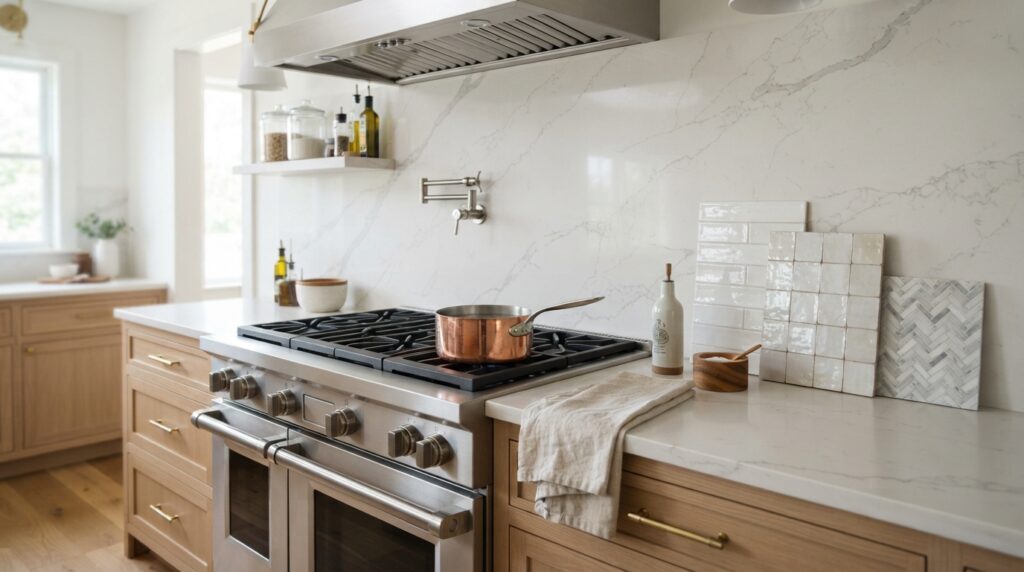
| Backsplash Material | Main Strength | Maintenance & Cleaning Reality |
| Ceramic or Porcelain Subway Tile | Budget-friendly, timeless, and easy to wipe down | Glazed tiles clean effortlessly; choose stain-resistant epoxy or sealed grout behind the range |
| Zellige or Handmade Clay Tile | Rich surface variation and organic texture | Uneven edges create wider, rustic grout lines that trap cooking grease if unsealed |
| Full-Height Slab (Quartz or Stone) | Seamless look with zero grout lines to scrub | Easiest surface to wipe clean, though material and fabrication costs are significantly higher |
| Natural Marble Mosaic | Classic, high-end visual depth | Porous stone and dense grout joints require regular sealing and ph-neutral cleaners |
Behind a high-heat range or cooktop, minimizing grout lines, either with larger-format tiles or a full-height slab splash, saves considerable scrubbing over the years.
Inspect Full Slabs and Finalize Measurements Before Fabrication
Small showroom samples are useful for narrowing down colors, but they rarely show the full movement of a natural stone or wide-veined quartz slab. A 4-inch square might look quiet while the full slab contains bold diagonal veining or mineral clusters. Whenever possible, inspect your actual slab at the stone yard and discuss where seams, sink cutouts, and corners will fall.
Before fabrication begins, make sure final laser or template measurements are taken after all base cabinets are permanently installed and leveled, and once your exact sink and range dimensions are on site. Even a quarter-inch shift in wall squareness or cabinet placement affects how the countertop and backsplash meet.
Compare Complete Installed Quotes, Not Just Slab Prices
Two countertop estimates with similar square-footage rates can end up thousands of dollars apart once fabrication details are added. Always compare itemized quotes across five categories:
- Material: Exact brand, stone name, slab thickness (typically 2 cm or 3 cm), and finish.
- Fabrication: Edge profiles, undermount sink cutouts, faucet holes, and seam placement.
- Installation: Delivery, templating, leveling, and structural support for overhangs.
- Backsplash: Tile or slab material, trim pieces, grout type, and wall prep.
- Demolition and Plumbing: Removal of existing counters and disconnecting/reconnecting the sink and faucet.
Common Countertop and Backsplash Mistakes to Avoid
Even well-planned kitchen updates can run into avoidable headaches during installation. Keeping four common pitfalls in mind helps protect both your budget and your finished look:
- Mixing Warm and Cool Undertones: Pairing a creamy, warm-veined marble or quartz slab with a stark, cool-blue white subway tile often makes the countertop look dingy or yellowed. Always compare samples side by side under your actual kitchen lighting, both in daylight and with your under-cabinet LEDs turned on.
- Skipping the 4-Inch Lip Removal: If you are installing a full tile backsplash, remove any short 4-inch matching countertop backsplash lip first. Stacking tile on top of a short stone lip creates a dated double-ledge look and interrupts the clean vertical transition.
- Choosing High-Maintenance Grout in Splash Zones: Bright white sanded grout directly behind a pasta-boiling or frying zone quickly absorbs tomato sauce and oil splatters. Opting for a soft warm gray, taupe, or stain-resistant grout keeps the backsplash looking fresh far longer.
- Forgetting Outlet and Switch Placement: Standard white plastic outlets can break up a clean stone or patterned tile backsplash. Planning under-cabinet power strips or color-matched outlets ahead of tile installation keeps the finished wall clean and uninterrupted.
A Quick Pre-Order Checklist
Before signing off on your countertop and backsplash order, run through five practical checks:
- Exact product and finish: Confirm the exact slab name and surface finish (polished, honed, or leathered).
- Actual slab approval: View the full slab in person or via high-resolution photos before cutting begins.
- Manufacturer care rules: Verify approved cleaners, heat limits, and whether sealing is recommended.
- Backsplash compatibility: Hold your tile and grout samples vertically against the countertop sample under your actual kitchen lighting.
- All-in installed budget: Confirm templating, cutouts, edge profiles, and installation labor are included in writing.
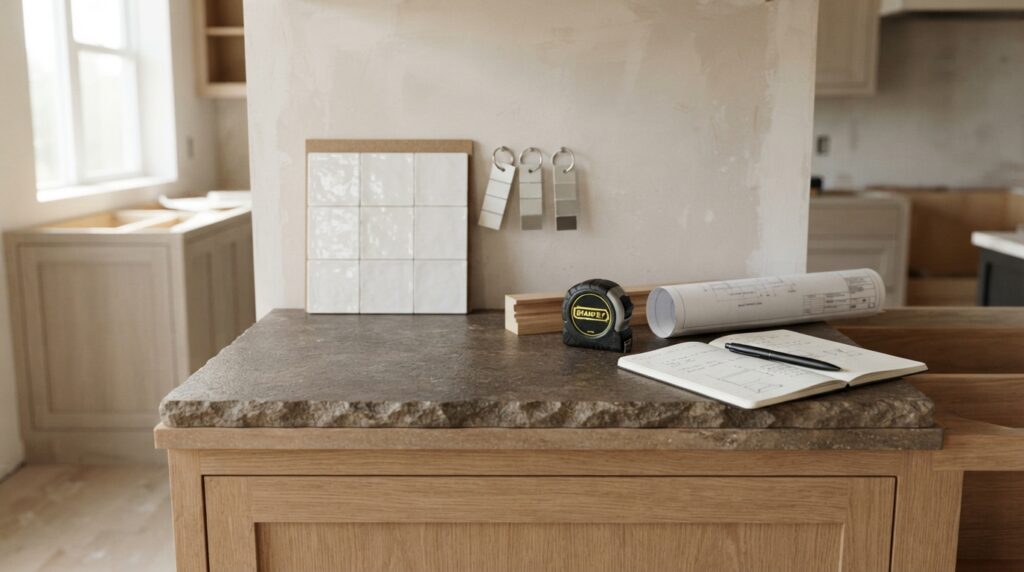
Choosing a countertop for how it performs in real life, and pairing it with a backsplash that complements its scale and finish, gives you a kitchen that looks cohesive on day one and stays easy to care for years down the road.