Fix Your Kitchen Without Tearing It Apart

If you want the short version: stop thinking about buying brand-new cabinets. Most storage problems get solved with pull-outs, drawer conversions, better hardware, and utilizing the vertical space you are currently ignoring. All of that costs hundreds of dollars, not thousands.
Cabinets usually eat the biggest slice of any kitchen budget, around a third of typical project costs by most industry estimates, so squeezing every ounce of life out of your existing boxes is where the smart money stays. Remodeling magazine’s Cost vs. Value report backs this up year after year: modest updates recover significantly more at resale than wholesale replacements.
Now for the longer version, including a few costly mistakes I’d like to save you from.
Table of Contents
Most “Bad” Cabinets Are Just Tired, Not Dead
Here is what I tell every client before they set foot in a showroom: your kitchen cabinets are probably fine.
Good cabinet boxes wearing ugly doors and suffering from terrible interiors make up nine out of ten kitchens I walk into. And those two problems are remarkably cheap to fix compared to a full replacement.
Before deciding anything, answer three questions honestly:
- Are the boxes structurally sound? (Open everything and check under the sink especially.)
- Does the overall layout actually work day to day?
- Is your real complaint just… how it looks?
If the boxes are solid and you simply hate the color or style, refacing or painting solves nearly everything. I learned this the hard way early in my career when I promised a client an upgrade plan without checking inside her cabinets first. One water-swollen base cabinet later, the entire budget shifted. Now I open every single door before making any promises, and you should too before buying a single supply.
| Option | Cost Level | Timeline | Makes Sense When |
| Organizer Inserts Only | Cheapest | A weekend | The style is fine, but the function isn’t |
| Paint + New Hardware | Low | 1–2 weekends | The boxes are good, but the color is dated |
| Refacing | Mid | 3–5 days installed | The doors are rough, but the boxes are excellent |
| Stock Replacement | High | 1–2 weeks | The layout is truly broken |
| Custom Builds | Painful | Weeks to months | You have weird spaces and it’s your “forever home” |
That middle row, painting, hardware, and smart inserts, is where most homeowners should live. Nobody tells them that in a showroom.
The Inside of Your Cabinets Is Where the Money Works Hardest
This is my favorite part of any project because the payoff-to-price ratio is absurd. Interior organizers retrofit into existing cabinets, install in under an hour each, and instantly change how the kitchen feels to use daily.
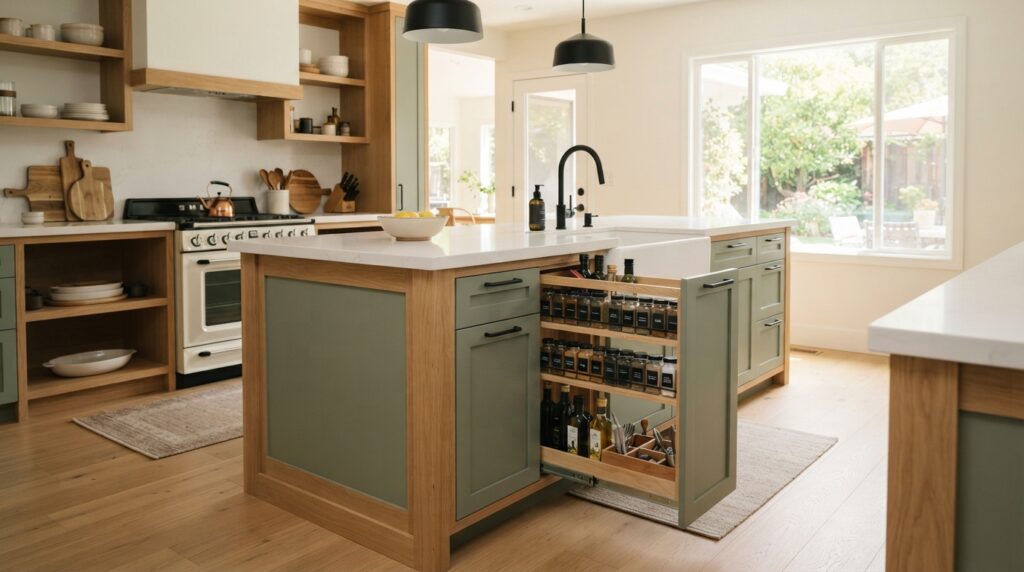
Start with pull-outs. Deep base cabinets and corner units are where food goes to die. Roll-out trays drag everything into the light instead. A few things I’ve picked up installing these:
- Measure the interior opening, not the door width.
- Hinges steal clearance, always account for them or your tray won’t close smoothly.
- Full-round Lazy Susans beat the pie-cut corner units, no contest.
Drawer conversions deserve their own paragraph. Swapping a base cabinet door for deep drawers costs more than sliding trays, but everyone who does it calls it their favorite upgrade afterward. Every single time. I’ve stopped being surprised by this.
Then look up. Most kitchens waste serious inches above the upper cabinets and inside tall units. Stacking shelf inserts double your capacity immediately, while under-shelf baskets create functional second layers. Door-mounted racks handle spices and lids for pocket change. We did exactly this across one rental unit in a weekend, adding inserts and door racks everywhere, and spent under $200 total. The tenant was convinced the kitchen had doubled in size. It hadn’t; it had just stopped hiding things.
Refacing: Legit, With One Big Catch
Refacing keeps your existing cabinet boxes and replaces everything visible: doors, drawer fronts, veneers on exposed sides, and hardware. Done well, guests genuinely cannot tell it from new cabinetry. Done badly, it peels. So vet installer portfolios hard.
The catch people always miss is that veneer bonds directly to your existing surfaces. If those surfaces are already delaminating or water-damaged, refacing fails right along with them. That brings us back to the non-negotiable inspection step.
Two more field notes:
- Thermofoil is fine for rentals, but wood veneer wears much better long-term.
- If you are refacing anyway, adding soft-close hinge adapters at the same time costs almost nothing extra. Do it. Quiet cabinets become weirdly addictive.
Hardware Is Still the Cheapest Trick in Renovation
Swapping pulls and knobs is an afternoon project that changes the entire room. Guests notice it instantly, and your wallet barely registers the expense.
One warning born of personal pain: check your hole spacing before ordering anything. Standard pulls come in common center-to-center distances, but when mine didn’t match, I spent two hours trying to fix drilled holes through finished cabinet faces. Match existing drilling whenever humanly possible.
Knobs need just one hole, standard bars run on 3-inch or 3¾-inch centers, and appliance pulls go bigger. Small spends yield loud results.
Open Shelving: Cool It With the Enthusiasm
People ask me constantly whether open shelving is timeless or a trend that will embarrass them later. My honest answer: it depends entirely on your discipline, not the shelf.
Shelves cost less than cabinets, open up small kitchens visually, and force you to stay organized. They also broadcast your clutter to every single guest. Nobody’s chaotic plastic container pile photographs charmingly.
What works is the hybrid approach: swap one upper run for shelves, keep enclosed storage elsewhere, anchor properly into studs (floating shelves fail from bad anchoring alone, drywall anchors don’t cut it), and keep the depth reasonable. Ten inches holds plates comfortably; deeper shelves just collect mess.
What Cabinets Are Actually Made Of, Minus the Marketing
Manufacturers love confusing terminology, so here is the plain version I explain to clients:
| Material | Durability | Hates Water? | Price Level |
| Plywood Boxes | Excellent | Handles it well | Higher |
| Furniture-Grade MDF | Good | Badly if soaked | Mid |
| Particleboard | Fair | Worst | Lowest |
Plywood earns its premium in humid spots and under sinks. Everywhere else, decent particleboard with a good laminate finish lasts decades, genuinely. Early in my career I burned hours agonizing over material grades for a dry rental galley. Years later, those mid-grade boxes were performing identically to the expensive ones. Match the material to moisture exposure, not to your ego.
Door styles follow the same logic. Shaker profiles have outlasted every design trend thrown at them. Flat slabs suit modern kitchens nicely. Ornate raised panels date themselves the fastest, that is simply history repeating itself.
Organization Habits That Outlast the Excitement
Fancy organizers fail when they fight how humans naturally behave. Systems stick when they follow behavior instead:
- Store things where you use them, not where they “belong” alphabetically.
- Use clear containers so you can see inventory at a glance, this quietly kills duplicate purchases.
- Use vertical dividers for cutting boards and baking sheets instead of sad, sliding stacks.
- Keep heavy items low and light items high.
- Label shelves during the first couple of weeks after reorganizing, then remove the labels once habits settle. It sounds fussy, but it works.
None of this costs real money, which is precisely why everybody skips it.
Where the Budget Actually Goes
Here are ballpark proportions, keeping in mind that local labor swings totals from city to city:
| Upgrade Type | Cost Level | DIY-Friendly? |
| Inserts & Trays | Very low | Yes |
| Hardware Swap | Low | Yes |
| Painting + Prep | Low–mid | Yes |
| Shelving Install | Low–mid | Sort of |
| Drawer Conversions | Mid | Sort of |
| Pro Refacing | High (below replacement) | No |
| Full Replacement | Highest | Rarely sensible |
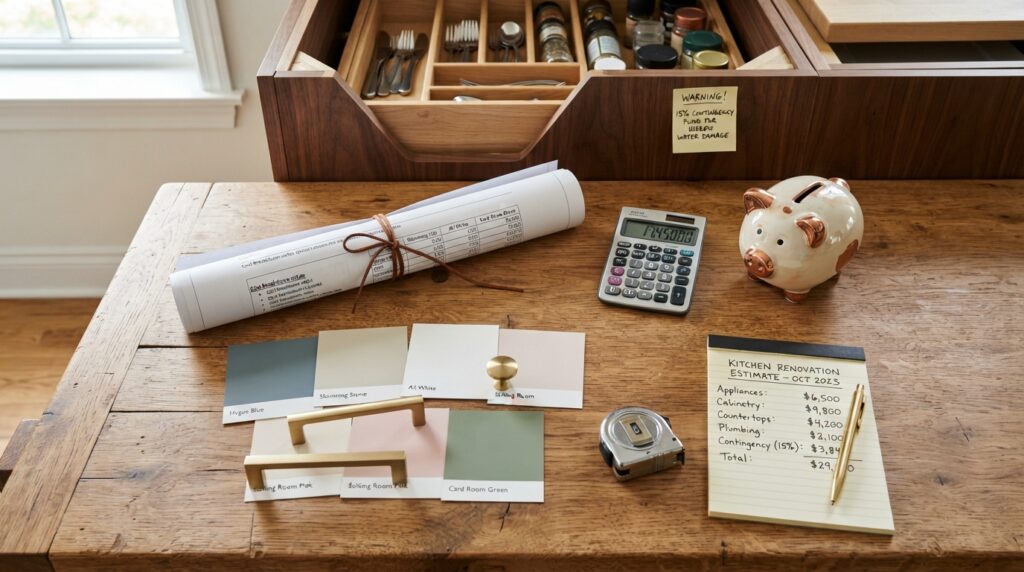
And always keep a 15% to 20% contingency fund whatever you do. Old cabinets love to hide water damage until you empty them out. It shows up far more often than anyone expects.
The Mistakes So You Can Skip Them
- Ordering organizers before measuring interiors: Return shipping will eat your savings.
- Painting over grease without degreasing: Guaranteed peeling, I’ve lived through it.
- Ignoring hinge types when buying new doors: Discovering mismatched drill holes halfway through is painful.
- Overloading floating shelves: Past what their wall anchors can hold leads to disaster.
- Trendy colors on permanent assets: The regret has a very short arrival time.
That paint mistake deserves extra emphasis. My rushed repaint chipped within months. The redone version, thoroughly degreased, sanded, bonding-primed, and then painted, has held up for years. Prep is boring, but prep is everything.
What I’d Actually Do This Week
Empty and inspect every box. Confirm your layout actually works, because cosmetic upgrades fix looks, not floor plans. Measure the interiors twice. Put pull-outs into your workhorse base cabinets first. Handle paint and hardware yourself; leave refacing to the pros. Anchor shelves properly or don’t hang them at all.
Start tonight with the worst cabinet in your kitchen. Empty it, measure the inside, and find one retrofit that fits. That’s it. Small correct moves, stacked patiently, that is how kitchens end up both better working and cheaper than anything sitting on a showroom floor.