Fix Your Kitchen Without Tearing It Apart

If you want the short version: stop thinking “new cabinets.” Most storage problems get solved with pull-outs, drawer conversions, better hardware, and using the vertical space you’re already ignoring. All of that costs hundreds, not thousands. Cabinets usually eat the biggest slice of any kitchen budget — around a third of typical project costs by most industry estimates — so squeezing every life out of your existing boxes is where the smart money stays. Remodeling magazine’s Cost vs. Value report backs this up year after year: modest updates recover more at resale than wholesale replacements.
Now the longer version, including a few mistakes I’d like to save you from.
Most “Bad” Cabinets Are Just Tired, Not Dead
Here’s what I tell every client before they set foot in a showroom: your cabinets are probably fine.
Good boxes wearing ugly doors and suffering terrible insides — that’s nine out of ten kitchens I walk into. And those two problems are cheap to fix compared to replacement.
Before deciding anything, answer three questions honestly:
- Are the boxes structurally sound? (Open everything. Check under the sink especially.)
- Does the layout actually work day to day?
- Is your real complaint just… how it looks?
If boxes are solid and you hate the color or style, refacing or painting solves nearly everything. I learned this the hard way — I promised a client an upgrade plan without checking inside her cabinets first. One water-swollen base cabinet later, the whole budget shifted. Now I open every single door before making any promises, and you should too before buying anything.
| Option | Cost Vibe | Timeline | Makes Sense When |
|---|---|---|---|
| Organizer inserts only | Cheapest | A weekend | Style’s fine, function isn’t |
| Paint + new hardware | Low | 1–2 weekends | Boxes good, color dated |
| Refacing | Mid | 3–5 days installed | Doors rough, boxes excellent |
| Stock replacement | High | 1–2 weeks | Layout truly broken |
| Custom builds | Painful | Weeks to months | Weird spaces, forever home |
That middle row is where most people should live. Nobody tells them that.
The Inside of Your Cabinets Is Where the Money Works Hardest
This is my favorite part of any project because the payoff-to-price ratio is absurd. Interior organizers retrofit into existing cabinets, install in under an hour each, and change how the kitchen feels daily.
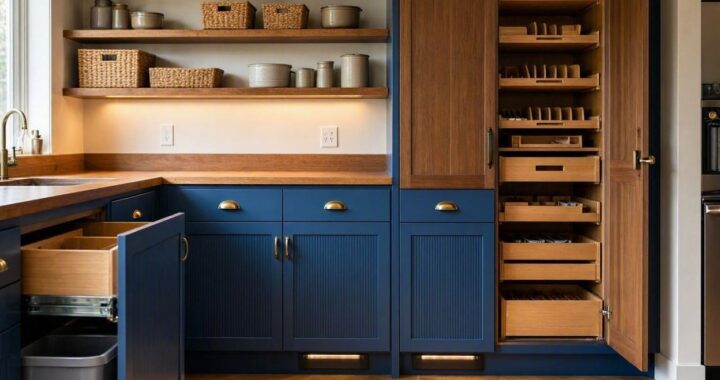
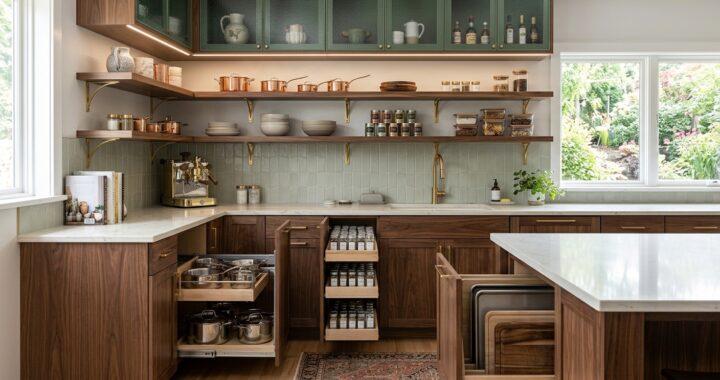
Pull-outs first. Deep base cabinets and corner units are where food goes to die. Roll-out trays drag everything into the light instead.
A few things I’ve picked up installing these:
- Measure the interior opening, not the door
- Hinges steal clearance — account for them or your tray won’t close
- Full-round Lazy Susans beat the pie-cut ones, no contest
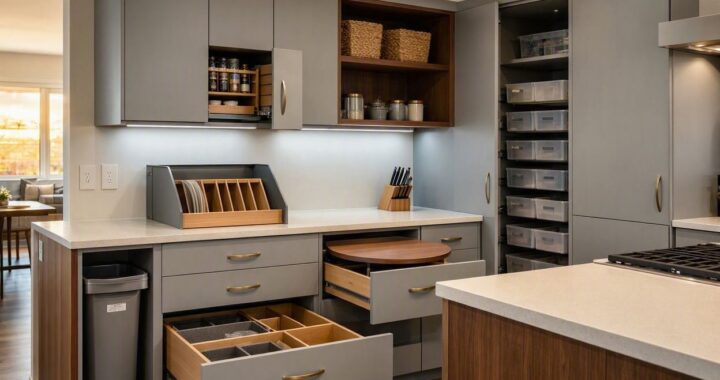
Drawer conversions deserve their own paragraph. Swapping a base cabinet door for deep drawers costs more than sliding trays, but everyone who does it calls it their favorite upgrade afterward. Every time. I’ve stopped being surprised by this.
Then look up. Most kitchens waste serious inches above the uppers and inside tall cabinets. Stacking shelf inserts double your capacity immediately. Under-shelf baskets create second layers. Door-mounted racks handle spices and lids for pocket change.
We did exactly this across one rental unit in a weekend — inserts and door racks everywhere — and spent under $200 total. The tenant was convinced the kitchen had doubled in size. It hadn’t. It had just stopped hiding things.
Refacing: Legit, With One Big Catch
Refacing keeps your and replaces everything visible — doors, drawer fronts, veneers on exposed sides, hardware. Done well, guests genuinely can’t tell it from new cabinetry.
Done badly, it peels. So vet installer portfolios hard.
The catch people miss: veneer bonds to your existing surfaces. If those surfaces are already delaminating or damaged, refacing fails right along with them. That’s the non-negotiable inspection step from earlier, again.
Two more field notes: thermofoil is fine for rentals but wood veneer wears better long-term, and if you’re refacing anyway, adding soft-close hinges at the same time costs almost nothing extra. Do it. Quiet cabinets become weirdly addictive.
Hardware Is Still the Cheatest Trick in RenovationSwapping pulls and knobs is an afternoon project that changes the whole room. Guests notice instantly. Your wallet barely registers it.
One warning born of personal pain: check your hole spacing before ordering anything. Standard pulls come in common center-to-center distances, but when mine didn’t match, I spent two hours trying to fix drilled holes through finished cabinet faces. It went about as well as it sounds. Match existing drilling whenever humanly possible.
Knobs need just one hole, standard bars run 3″ or 3¾” centers, appliance pulls go bigger. Soft-close hinge adapters also retrofit onto plenty of existing hinges for very little money. Small spends, loud results.
Open Shelving — Cool It With the Enthusiasm
People ask me constantly whether open shelving is timeless or a trend that will embarrass them later. My honest answer: it depends entirely on your discipline not the shelf.
Shelves cost less than cabinets, open up small kitchens visually, and force you to stay organized. They also broadcast your clutter to every guest. Nobody’s chaotic plastic container pile photographs charmingly.
What works is the hybrid: swap ONE upper run for shelves, keep enclosed storage elsewhere, anchor properly into studs (floating shelves fail from bad anchoring alone — drywall anchors don’t cut it), and keep depth reasonable. Ten inches holds plates. Deeper shelves just collect mess.
What Cabinets Are Actually Made Of, Minus the Marketing
Manufacturers love confusing terminology, so here’s the plain version I explain to clients:
| Material | Durability | Hates Water? | Price |
|---|---|---|---|
| Plywood boxes | Excellent | Handles it well | Higher |
| Furniture-grade MDF | Good | Badly if soaked | Mid |
| Particleboard | Fair | Worst | Lowest |
Plywood earns its premium in humid spots and under sinks. Everywhere else, decent particleboard with a good laminate finish lasts decades — genuinely. Early in my career I burned hours agonizing over material grades for a dry rental galley. Years later those mid-grade boxes were performing identically to the fancy ones. Match material to moisture exposure, not to ego.
Door styles follow the same logic. Shaker profiles have outlasted every trend thrown at them. Flat slabs suit modern kitchens nicely. Ornate raised panels date themselves fastest — that’s just history repeating.
Organization Habits That Outlast the Excitement
Fancy organizers fail when they fight how humans behave. Systems when they follow behavior instead:
Store things where you use them, not where they “belong” alphabetically. Clear containers so you can see inventory — this quietly kills duplicate purchases. Vertical dividers for cutting boards and lids instead of sad stacks. Heavy stuff low, light stuff high.
Label shelves during the first couple of weeks after reorganizing. Remove labels once habits settle. Sounds fussy, works anyway.
None of this costs real money, which is exactly why everybody skips it.
Where the Budget Actually Goes
Ballpark proportions, since local labor swings totals city to city:
| Upgrade | Rough Positioning | DIY-Friendly? |
|---|---|---|
| Inserts & trays | Very low | Yes |
| Hardware swap | Low | Yes |
| Painting + prep | Low–mid | Yes |
| Shelving install | Low–mid | Sort of |
| Drawer conversions | Mid | Sort of |
| Pro refacing | High, below replacement | No |
| Full replacement | Highest | Rarely sensible |
And keep 15–20% contingency whatever you do. Old cabinets hide water damage until you empty them. It shows up more often than anyone expects.
The Mistakes, So You Can Skip Them
- Ordering organizers before measuring interiors — return shipping eats your savings
- Painting over grease without degreasing — guaranteed peeling, I’ve lived it
- Ignoring hinge types when buying new doors, then discovering mismatched drill holes
- Overloading floating shelves past what their anchors hold
- Trendy colors on permanent assets — the regret has a short arrival time
That paint one deserves the emphasis. My rushed repaint chipped within months. The redone version — degreased, sanded, bonding primed, then painted — has held up for years. Prep is boring. Prep is also everything.
What I’d Actually Do This Week
Empty and inspect every box. Confirm the layout works, because upgrades fix looks, not floor plans. Measure interiors twice. Put pull-outs in the workhorse base cabinets first. Handle paint and hardware yourself; leave refacing to pros. Anchor shelves properly or don’t hang them.
Start tonight with the worst cabinet in your kitchen. Empty it, measure the inside, find one retrofit that fits. That’s itSmall correct moves, stacked patiently — that’s how kitchens end up both better working and cheaper than anything on a showroom floor.