Smart Ways to Organize a Small Kitchen

Small kitchens don’t need more stuff. They need better places for the stuff you already have.
That sounds obvious, but it’s surprisingly easy to fill a small kitchen with shelves, containers, organizers, and appliances until there’s barely room left to work.
The better approach is simpler: use the space you have more intelligently, keep everyday items within reach, and stop wasting valuable cabinet space.
I’ve seen this with small kitchens repeatedly. The problem usually isn’t a complete lack of storage. It’s storage that’s difficult to reach, poorly divided, or being used for things that don’t really belong there.
So before buying another organizer, take a fresh look at the kitchen itself.
Start With a Ruthless Storage Audit
Before changing anything, open every cabinet and drawer.
Not just the obvious ones. Check the awkward corner, the cabinet nobody likes opening, and that drawer where everything seems to disappear.
You may find more usable space than you expected.
When I reorganize a small kitchen, I usually start by removing everything from one storage area at a time. That makes the wasted space much easier to spot.
Houzz recommends a similar approach: empty cabinets and drawers first, sort what you have, and remove items you no longer need. Houzz
That first step matters because there is little value in organizing things you never use.
| Problem | Better approach |
|---|---|
| Cabinets feel full | Remove unused items first |
| Counters are crowded | Move rarely used items into storage |
| Deep cabinets are frustrating | Consider pull-out storage |
| Drawers become messy | Add simple internal dividers |
The trick is to resist the urge to buy anything immediately.
First, understand the problem.
Then solve it.
Turn Vertical Space Into Valuable Storage
When floor space is limited, look upward.
Walls and tall cabinets can provide useful storage without taking up another section of the floor.
However, that doesn’t mean covering every available wall with shelves.
Too much open storage can make a small kitchen look busier, especially when every shelf is packed with containers and equipment.
Instead, choose a few areas where vertical storage genuinely improves the layout.
Tall cabinets can be particularly useful. Houzz’s 2026 U.S. Kitchen Trends Study found that pantry cabinets were the most common built-in specialty feature among surveyed kitchen renovators, appearing in 47% of projects. Houzz
That doesn’t mean every small kitchen needs a full pantry.
The takeaway is simpler: vertical storage can make better use of limited kitchen space.
| Storage idea | Main advantage | Watch out for |
|---|---|---|
| Tall cabinet | Uses height efficiently | Difficult-to-reach upper areas |
| Wall shelf | Adds accessible storage | Visual clutter |
| Wall rail | Keeps selected tools accessible | Too many hanging items |
| Extra cabinet shelving | Creates another storage level | Crowding |
When I plan vertical storage, I like to keep frequently used items at comfortable heights.
Less frequently used items can go higher.
That small distinction makes the kitchen much easier to live with.
Make Deep Cabinets Work Harder
Deep cabinets are a classic small-kitchen headache.
They can hold plenty, but reaching the item at the back often means moving everything in front of it.
That isn’t really efficient storage.
It’s storage with an obstacle course.
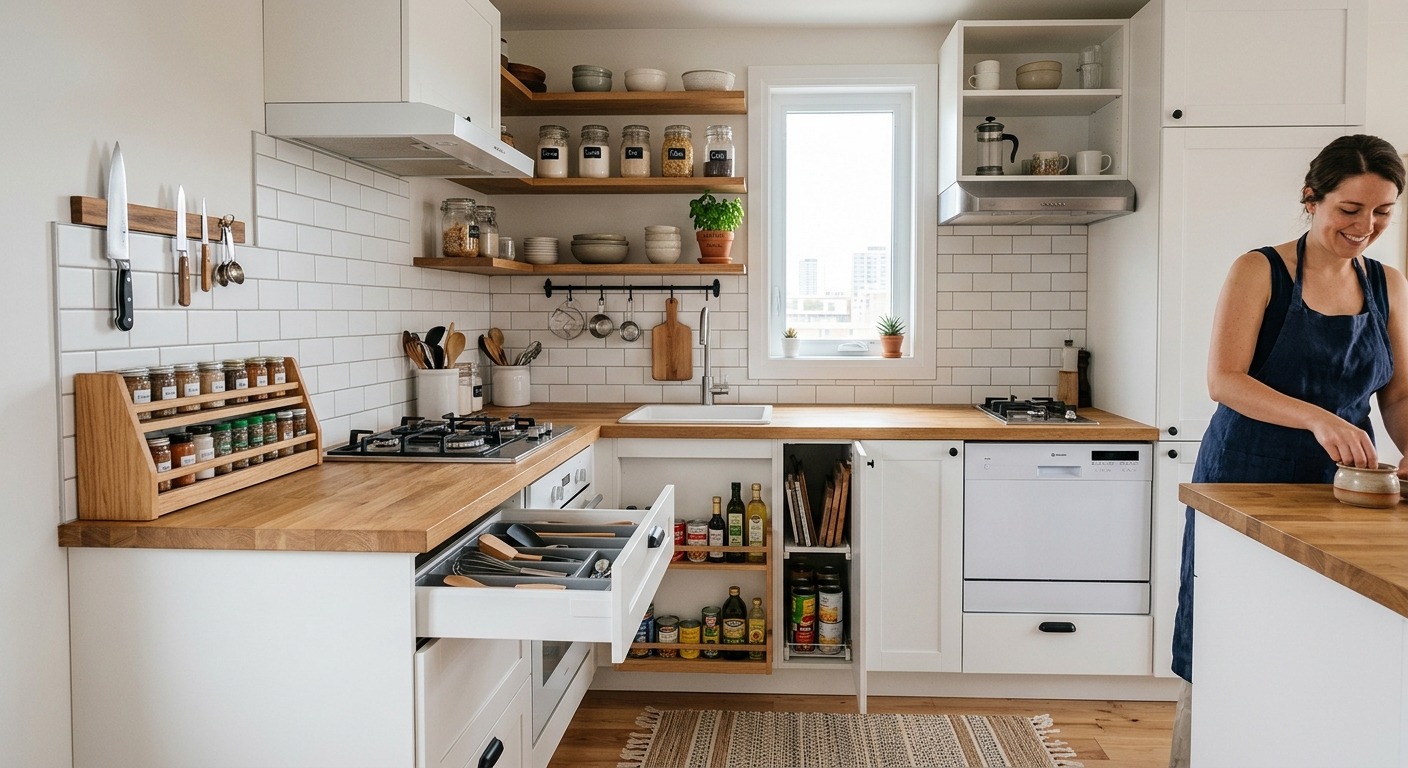
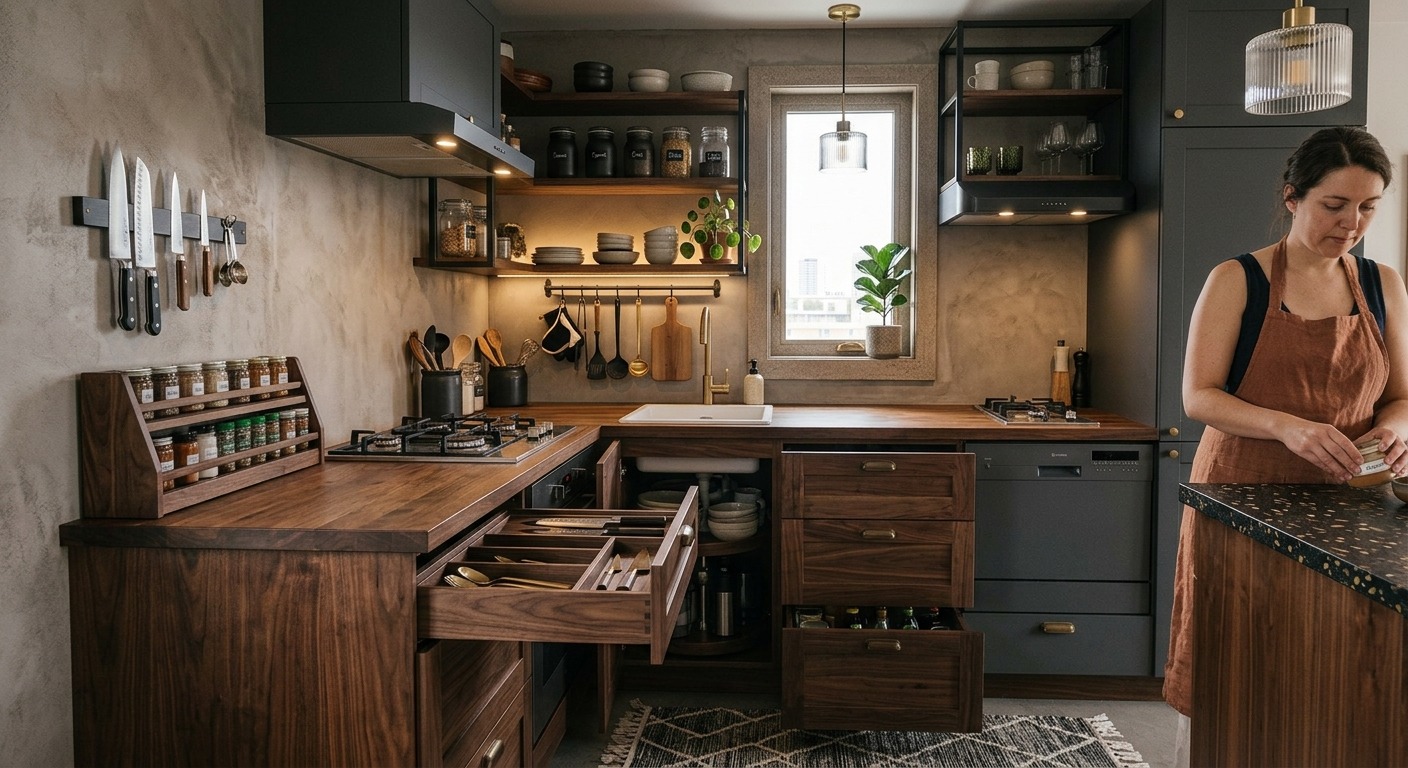
Pull-out shelves and internal drawers can help because they bring the contents toward you instead of making you reach into the cabinet.
Houzz reported that 34% of surveyed U.S. homeowners renovating kitchens used either revolving corner trays or pull-out shelves for hard-to-reach areas. The same study reported 34% using deep-drawer organizers. Houzz
Those figures come from renovation projects, so they aren’t a rule for every kitchen.
Still, they show how common access-focused storage has become.
The question I always ask is simple:
Can I reach the back of this cabinet without emptying the front?
If not, the cabinet probably needs a better system.
Give Your Countertops Some Breathing Room
A small kitchen can feel cramped surprisingly quickly when the countertop becomes permanent storage.
Coffee machines, appliances, paperwork, containers, utensils, and random objects gradually take over.
Before long, the work surface has disappeared.
The solution isn’t necessarily a completely empty countertop.
Instead, decide what genuinely deserves to stay there.
A 2018 Houzz study found that 75% of surveyed U.S. homeowners renovating kitchens were focused on decluttering their countertops. Houzz
That statistic is from an older study, so I wouldn’t present it as a current measurement.
Still, the underlying problem remains familiar.
When I look at a crowded small kitchen, I often start by imagining the counter completely clear.
Then I ask which objects need to return.
Usually, not everything does.
| Item | Consider |
|---|---|
| Daily-use appliance | Keep accessible |
| Occasional appliance | Store if possible |
| Decorative item | Keep only if space allows |
| Loose paperwork | Move elsewhere |
| Duplicate tools | Remove or relocate |
A clear worktop can make a small kitchen feel dramatically more usable without changing its actual dimensions.
That’s a pretty good return for a simple organization decision.
Build Drawers That Actually Make Sense
Drawers are excellent in small kitchens, but only when they’re organized around clear categories.
One large drawer containing cutlery, utensils, measuring tools, and miscellaneous gadgets isn’t organization.
It’s just a more attractive junk drawer.
Simple dividers can solve much of the problem.
You don’t necessarily need expensive inserts. The important thing is creating boundaries between different types of items.
Houzz’s 2026 UK Kitchen Trends Study reported that cutlery organizers appeared in 78% of surveyed kitchen renovation projects using specialty storage features. Houzz
Again, that figure describes a particular survey group rather than every kitchen.
Still, it reflects a useful principle: small compartments can make frequently used storage easier to manage.
When I organize drawers, I prefer categories that make sense immediately.
If you have to think about where something belongs every time you put it away, the system is probably too complicated.
Use Narrow Spaces Without Creating More Clutter
That narrow gap beside a cabinet can look useless.
Sometimes, though, it can become valuable storage.
Slim pull-out cabinets can make use of narrow spaces, particularly when the kitchen layout leaves enough room for the cabinet and its door or mechanism.
But don’t buy a narrow organizer simply because there’s a gap.
Measure first.
This is one of those lessons that’s easy to learn the expensive way.
The first time I tried fitting an organizer without carefully checking the internal measurements, the dimensions looked right on paper.
The door clearance told a different story.
Measure:
- Internal width
- Internal depth
- Clear height
- Door opening
- Hinges and other obstructions
- Available clearance
Then choose the storage solution.
Not the other way around.
Make Cabinet Doors Work for You
Cabinet doors can offer another layer of storage.
Small door-mounted organizers, hooks, or slim racks can sometimes hold lightweight kitchen items without taking additional cabinet space.
But there is a catch.
The door still has to close.
That sounds ridiculous until you’ve installed something that technically fits but hits the shelf every time you shut the cabinet.
So check the clearance before installing anything.
| Door storage | Check first |
|---|---|
| Slim rack | Shelf clearance |
| Small hooks | Door movement |
| Pocket organizer | Available depth |
| Mounted container | Weight and hinges |
I think of door storage as an extra layer rather than the foundation of the kitchen.
The main storage should still work without it.
That keeps the whole system simpler.
Attack Awkward Kitchen Corners
Corners are where kitchen organization gets interesting.
Standard cabinets can leave surprisingly deep spaces that are difficult to access.
That is why corner storage deserves special attention in a small kitchen.
Depending on the cabinet design, options can include revolving trays, pull-out mechanisms, or other purpose-built organizers.
Houzz’s 2026 U.S. research specifically identifies revolving corner trays and pull-out shelves among solutions homeowners use for difficult-to-reach storage. Houzz
But don’t assume one solution will work for every corner.
Cabinet dimensions vary.
Measure the cabinet first, identify what is blocking access, and then choose the mechanism.
That order can save a lot of frustration.
Borrow the Best Ideas From Pantry Organization
You don’t need a separate pantry to organize your kitchen like one.
The basic idea is simply to group similar items together and give each group a defined place.
A tall cabinet can work this way.
So can a section of shelving or a dedicated cabinet.
The goal isn’t to create a picture-perfect pantry.
It’s to stop similar items from being scattered across five different cabinets.
For example, if you have several areas containing food-storage containers, consolidating them can immediately make the kitchen easier to navigate.
The same principle works for cookware, baking equipment, serving pieces, and other categories.
One category. One home. Fewer decisions.
That is much easier to maintain.
Choose Organization Products Carefully
This is where small-kitchen organization can go wrong.
There are countless clever products promising to transform a cabinet overnight.
Some are genuinely useful.
Others simply give you another object to manage.
Before buying an organizer, ask whether it solves a specific problem.
Does it fit?
Will you actually use it?
Can you reach everything after installing it?
If the answer isn’t clear, don’t buy it yet.
| Before buying | Ask yourself |
|---|---|
| Shelf organizer | Do I need another level? |
| Drawer divider | Are categories currently mixed? |
| Pull-out shelf | Is access genuinely difficult? |
| Door organizer | Will the door still close? |
I’ve wasted money on organization products that looked brilliant online but solved problems my kitchen didn’t actually have.
That experience changed how I approach storage.
Measure first. Shop second.
Create a System You Can Maintain
A kitchen doesn’t stay organized because you spent a Saturday rearranging it.
It stays organized because putting something away is easy.
That’s why simple systems usually beat complicated ones.
If a drawer has a clear purpose, returning something to it takes seconds.
If every item has to be moved around before another item can be stored, the system won’t last.
Houzz recommends grouping similar items and storing them near the areas where they’re used. Houzz
That idea is practical because it reduces unnecessary movement.
When I reorganize a kitchen, I think about the next time the kitchen gets used, not just how good it looks immediately afterward.
A storage system should make tomorrow easier.
Otherwise, it’s decoration.
The Best Small Kitchen Solutions Are Usually Simple
A small kitchen doesn’t need a dozen clever gadgets.
It needs storage that fits the room, supports the way the space is used, and makes everyday items easy to find.
Start by removing things that don’t deserve valuable storage.
Then improve the difficult cabinets.
After that, look at vertical space, drawers, corners, cabinet doors, and narrow gaps.
Finally, rethink the countertop.
Current Houzz research shows strong interest in built-in storage features, including pantry cabinets, pull-outs, and other specialty storage solutions. Houzz
But you don’t need to copy a renovation trend to create a better kitchen.
The smartest solution is the one that solves your actual storage problem.
I’ve found that small kitchens become much easier to manage when every space has a clear job.
Not every cabinet needs an organizer.
Not every wall needs a shelf.
Not every countertop needs an appliance.
Sometimes, the biggest improvement comes from removing one thing instead of adding another.
And that’s probably the most useful small-kitchen organization rule of all:
Before you look for more storage, make sure you’ve made the storage you already have work harder.