The 85% Rule and Other Secrets to Cabinets That Stay Organized
Want kitchen cabinets and drawers that stay organized? Zone your kitchen by task, double your shelf space with risers, and give every drawer one dedicated job. Put daily-use items within easy reach, push seasonal stuff up high, and stop organizing by category — organize by how you cook.
I’ve torn apart a lot of kitchens over the years — mine, friends’, and enough client projects to spot the patterns. The kitchens that feel effortless almost always come down to a handful of smart decisions, not expensive renovations.
Here’s what actually matters.
Why Most Cabinet Organization Fails
Most people organize their kitchen by category.
Pots go somewhere. Spatulas get tossed in whichever drawer is closest. Six months later, you’re elbow-deep behind three colanders hunting for one lid.
The fix sounds simple, but it changes everything: instead of asking “where should this live?” ask “where do I use this?”
That second question reshapes your whole kitchen around zones:
- Prep zone — knives, cutting boards, mixing bowls
- Cooking zone — pans, spatulas, oils, spices
- Cleaning zone — soap, towels, trash bags
- Storage zone — containers, wraps, foils
Store things where they’re used. Not where they photograph well.
Start With an Audit, Not a Shopping Trip
Before buying a single organizer, empty your cabinets. All of them.
Skipping this step costs you twice — I’ve watched it happen. Organizers bought blind rarely fit anyone’s actual belongings, so they end up donated within a year.
Work cabinet by cabinet:
- Empty one at a time (trust me, don’t empty everything at once)
- Sort into keep, donate, toss
- Measure the empty interior — width, depth, height
- Now shop for organizers
You’ll probably find duplicates you forgot you owned. Everyone does. Four whisks, two measuring tapes, a juicer nobody remembers buying — let them go.
Drawers: Where Small Wins Add Up Fast
Drawers turn chaotic faster than anything else in the kitchen. Fortunately, they’re also the cheapest to fix.
Give Deep Drawers Structure
Deep drawers hold a ton — and swallow just as much. Things disappear into the back and never come back out.
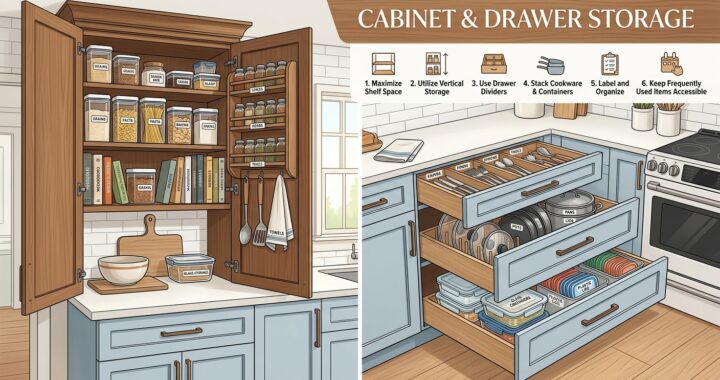
Three fixes that pull their weight:
| Best For | Rough Cost | |
|---|---|---|
| Tiered dividers | Utensils, gadgets | 15–15–15–40 |
| Vertical dividers (store items like files) | Baking sheets, cutting boards | 10–10–10–25 |
| Stackable bins inside the drawer | Snacks, linens, backups | 8–8–8–20 |
One Drawer, One Job
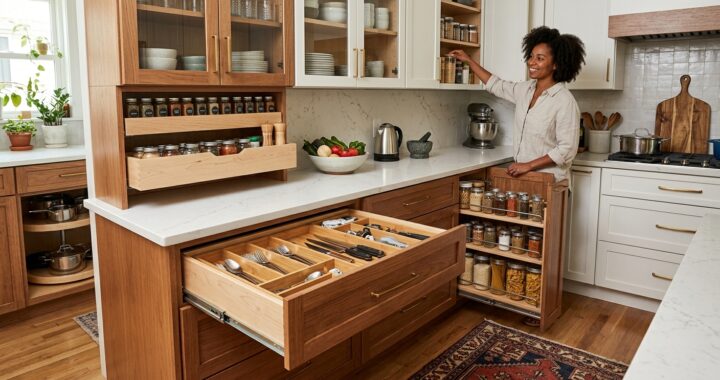
Cooking utensils live together. Serving utensils live together. Gadgets earn their own drawer or go to donation.
Adjustable bamboo dividers beat fixed trays because your needs will shift over time — yours should adapt with them.
Store Knives Safely (and Keep Them Sharp)
Loose knives in a drawer dull quickly and bite fingers. An in-drawer knife block or a magnetic strip solves both problems and frees up counter space while it’s at it.
Cabinets: Think Vertically
Cabinets waste more usable space than anything else in the average kitchen. Most of that waste is vertical.
Shelf Risers Are the Cheapest Upgrade You Can Make
For about $20, a riser creates a second level inside a cabinet where only one existed. Mugs on top and bottom. Plates stacked properly instead of leaning towers.
It’s the single best cost-to-impact trade in kitchen storage.
| Cabinet Problem | Best Fix | Why It Works |
|---|---|---|
| Wasted vertical space | Shelf risers | Instant second level |
| Pots buried under pots | Pull-out organizers | Everything comes to you |
| Corner dead zones | Lazy Susans | Rotates hidden items into reach |
| Lids everywhere | Lid rack or vertical dividers | One lid, visible, grabbable |
Pull-Outs Change How You Cook
Slide-out shelves or baskets transform deep base cabinets. of crouching and digging, you pull and everything presents itself.
Renting or watching your budget? Tension-rod dividers and slim rolling carts get you most of the benefit with zero installation.
Corners Aren’t Hopeless
Corner cabinets eat space when ignored. A Lazy Susan fixes most of them cheaply. For blind corner cabinets, purpose-built pull-out systems exist for that awkward swing space — pricier, but genuinely transformative if that’s where your pots ended up.
Door Backs Are Free Real Estate
Adhesive hooks and slim racks on the inside of doors hold measuring cups, pot lids, cutting boards, oven mitts. Just check the door still closes clearance-wise before drilling anything.
Food Containers: End the Lid Avalanche
Almost every kitchen hides a container avalanche waiting for its moment.
Two rules end it:
- Match sets. No lid? It goes.
- Nest by size, and store lids upright in a divider — filed vertically, they take a fraction of the space and you can grab what you need at a glance.
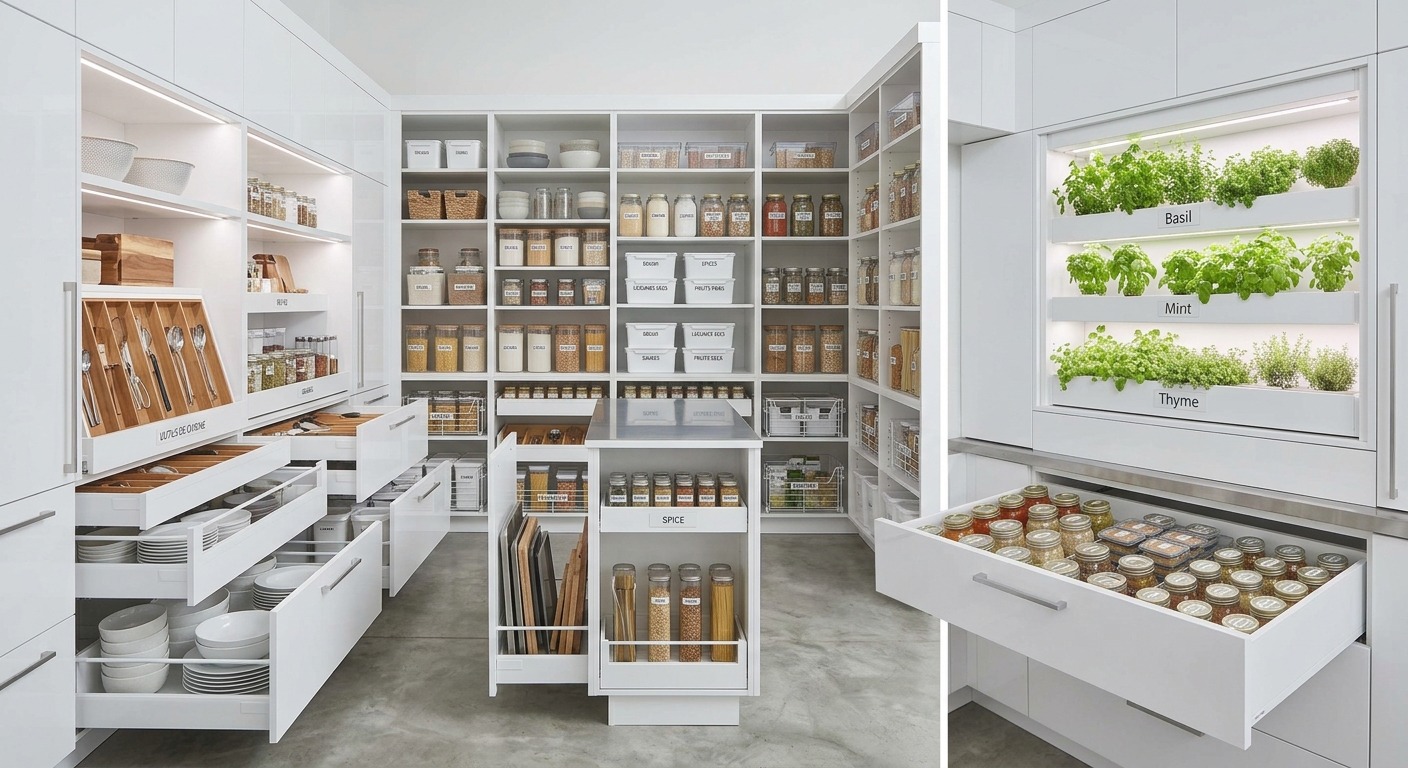
If you want to go further, decant dry goods into clear stackable canisters. Seeing your inventory cuts food waste, which adds up faster than most people realize.
Under the Sink: Handle With Care
This cabinet fights moisture, pipes, and weird geometry all at once.
What holds up here:
- Stackable drawers that fit around plumbing
- Wire grids hung from the cabinet ceiling for spray bottles
- Turntables for cleaning supplies
- Waterproof bins under anything that might leak
Skip cardboard entirely down there. Moisture plus cardboard equals regret.
Small Kitchen? Go Up, Not Out
Tight kitchens need creativity, not compromise:
- Shelf risers inside existing cabinets
- Door-back organizers on every door
- Magnetic strips inside cabinet walls for spice tins
- Clear, labeled stackable bins
- Tension rods creating extra shelf layers
In small kitchens, frequency of use matters even more. Daily items get prime real estate. Everything else goes higher or deeper.
Quick Reference Tables
Plan your zones:
| Zone | Items Stored | Top Organizer |
|---|---|---|
| Cooking | Pans, utensils, oils | Pull-outs + utensil dividers |
| Prep | Knives, boards, bowls | Vertical dividers + knife insert |
| Cleaning | Soaps, towels, bags | Waterproof stacking bins |
| Pantry | Dry goods, cans | Clear canisters + turntables |
Keep it maintained:
| Frequency | Task | Time Needed |
|---|---|---|
| Weekly | Reset drawers to assigned homes | 5 minutes |
| Monthly | Quick declutter sweep | 15 minutes |
| Seasonally | Full audit + donation run | 1–2 hours |
Spend Where It Counts
You don’t need premium everything. Start cheap, then upgrade only whatever keeps frustrating you:
| Item | Budget Option | When Premium Is Worth It |
|---|---|---|
| Drawer dividers | Adjustable bamboo (~$15) | Honestly, never — budget wins |
| Pull-out shelves | Slide-out baskets (~$30) | Custom pull-outs in a forever home |
| Spice storage | Small turntable (~$10) | Magnetic in-cabinet systems |
| Container sets | Sorted mismatched sets | Full decanting system you’ll commit to |
The budget version usually solves 80% of the problem anyway.
Mistakes to Skip
These show up in nearly every struggling kitchen:
- Buying organizers before decluttering — you’ll just organize clutter beautifully
- Choosing looks over function — pretty labels on wrong-zone items relocate frustration, not fix it
- Filling cabinets past ~85% — systems need breathing room to survive
- Ignoring your household’s real habits — design forgiving systems, not perfect ones
And label generously. Labels remove guesswork, which is exactly what kills organization systems.
The 30-Day Check-In
Every system drifts. That’s normal, not failure.
Book a quick review a month in. Walk through each zone and ask what’s already migrated from its home. Whatever drifted needs a better home — not stricter discipline. Systems should bend to real behavior, never the other way around.
Usually it’s a ten-minute fix done mid-dinner-prep.
Your Next Step
Don’t start with a plan for the whole kitchen. Start with one drawer tonight: empty it, sort it, divide it, finish it.
Momentum handles the rest. Kitchens change drawer by drawer — no renovation required. And when someone opens that perfectly organized utensil drawer and says “whoa,” you’ll understand why people get obsessed with this stuff.