Smarter Kitchen Organization That Actually Works
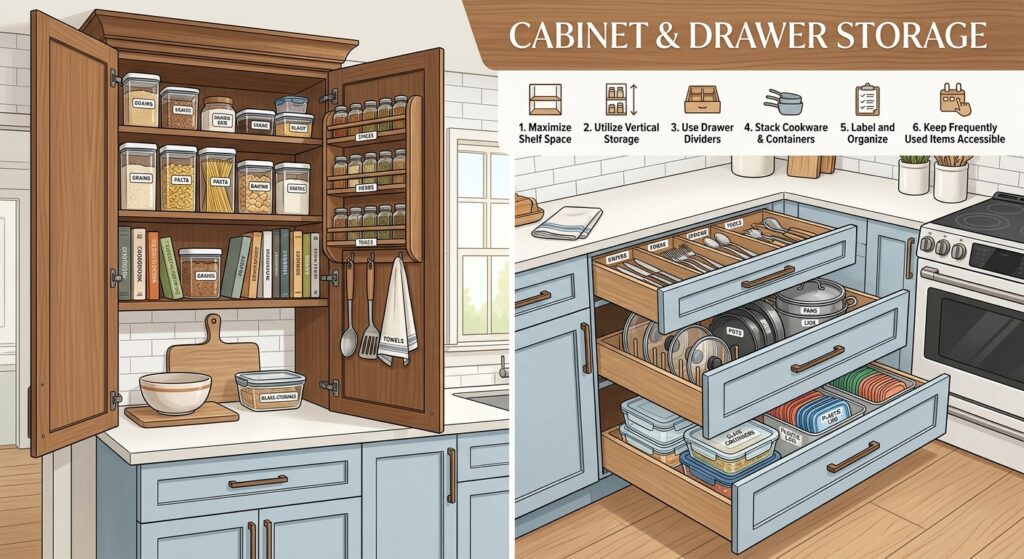
Cabinet and drawer storage works best when every shelf, drawer, and corner earns a clear purpose.
Instead of adding more containers, start by improving access, visibility, and capacity inside the cabinetry you already have.
For entrepreneurs planning kitchens, designing cabinetry, or selling organization solutions, that distinction creates a sharper value proposition.
The strongest storage strategy is simple: store more intelligently, reach items faster, and waste less cabinet space.
Why Powerful Storage Starts With the Cabinet
Cabinet storage is no longer just about hiding kitchen equipment behind doors.
Instead, modern kitchen organization increasingly depends on specialized drawers, pull-outs, pantry cabinets, and interior organizers.
Houzz reported that 94% of U.S. kitchen renovators integrated specialty storage features into upgraded cabinetry in 2026 (Houzz, 2026).
That figure matters because it shows storage has become a design priority, not merely an afterthought.
Also, Houzz found that 84% of renovating homeowners upgraded their cabinets in the same 2026 U.S. study (Houzz, 2026).
Therefore, cabinet organization deserves attention before decorative details consume the planning process.
When I test a cabinet layout, I first look for wasted depth, awkward corners, and unnecessary vertical gaps.
Those problems usually reveal more opportunity than simply buying another storage bin.
The Winning Cabinet Storage Framework
A practical system should separate storage by access, visibility, frequency, and cabinet geometry.
However, the goal is not to force every cabinet into a specialized configuration.
Instead, match the storage mechanism to the physical problem each cabinet presents.
| Cabinet challenge | Stronger storage direction | Main planning priority |
|---|---|---|
| Deep base cabinet | Deep drawers or pull-outs | Visibility |
| Narrow vertical space | Vertical organizer | Separation |
| Corner cabinet | Revolving or pull-out solution | Accessibility |
| Tall cabinet | Adjustable shelves | Flexibility |
This framework keeps the design focused.
Meanwhile, it gives product teams and kitchen professionals a simple language for explaining why one storage feature deserves investment.
Powerful Drawers Beat Buried Shelves
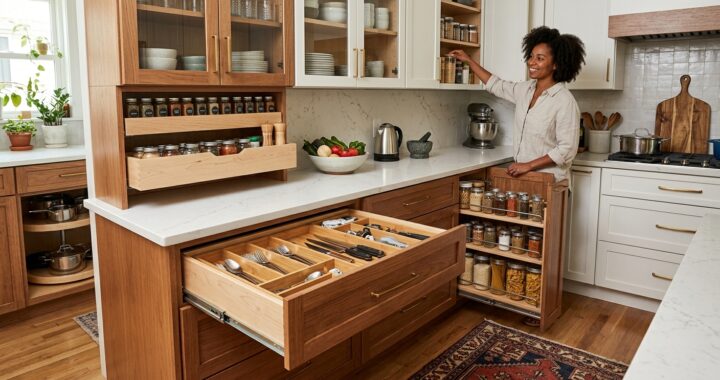
Drawers change the access equation because they bring stored items toward the user.
That advantage becomes especially compelling when conventional shelves create hidden rear zones.
Houzz reported that 40% of renovating U.S. homeowners chose deep drawers when upgrading cabinets in 2022 (Houzz, 2022).
Similarly, the 2026 Houzz study reported 55% added cabinet or drawer storage for cookie sheets or trays (Houzz, 2026).
Therefore, drawers can become a strategic upgrade rather than a purely aesthetic choice.
When I test drawer layouts, I compare usable depth before choosing drawer height.
A deeper drawer is not automatically better if its contents become difficult to separate.
Sharp Drawer Rules
Use drawer design to create order without turning every compartment into a puzzle.
- Choose depth according to the objects being stored.
- Add dividers where movement creates clutter.
- Keep frequently accessed contents in the easiest-to-reach zones.
- Reserve specialized inserts for genuine organization problems.
Also, avoid over-segmenting drawers.
Too many fixed compartments can reduce flexibility when storage needs change.
High-Impact Cabinet Features Worth Considering
Not every organizer deserves equal attention.
Instead, prioritize features that solve difficult access problems or make frequently used storage easier to manage.
Houzz’s 2026 U.S. study found 64% of renovating homeowners added pull-out waste or recycling bins (Houzz, 2026).
The same study found 41% added spice storage and 38% added cutlery storage (Houzz, 2026).
Those figures point toward a useful principle: solve repeated friction first.
| Storage feature | What it improves | Planning question |
|---|---|---|
| Deep drawers | Front-to-back access | Is depth genuinely useful? |
| Pull-out bins | Containment and access | Does the cabinet location support easy removal? |
| Spice storage | Small-item visibility | Can labels remain visible? |
| Cutlery drawers | Separation | Are compartments adjustable enough? |
However, these percentages describe surveyed renovation choices, not universal design rules.
That distinction keeps the marketing accurate.
Ruthless Corner Storage Without the Dead Space
Corner cabinets often create difficult geometry.
Consequently, storage solutions should focus on bringing the inaccessible area forward.
Houzz reported that 34% of U.S. renovating homeowners selected pullout or swing-out drawers in its 2026 study (Houzz, 2026).
The same research reported 34% selected revolving corner trays or pullout shelves for hard-to-reach spaces (Houzz, 2026).
Therefore, corner storage should be evaluated by access, not merely capacity.
When I test a corner solution, I check whether the stored area becomes genuinely reachable.
If the mechanism still requires awkward movement, the cabinet has gained hardware without gaining enough usability.
Strategic Pantry Storage That Protects Capacity
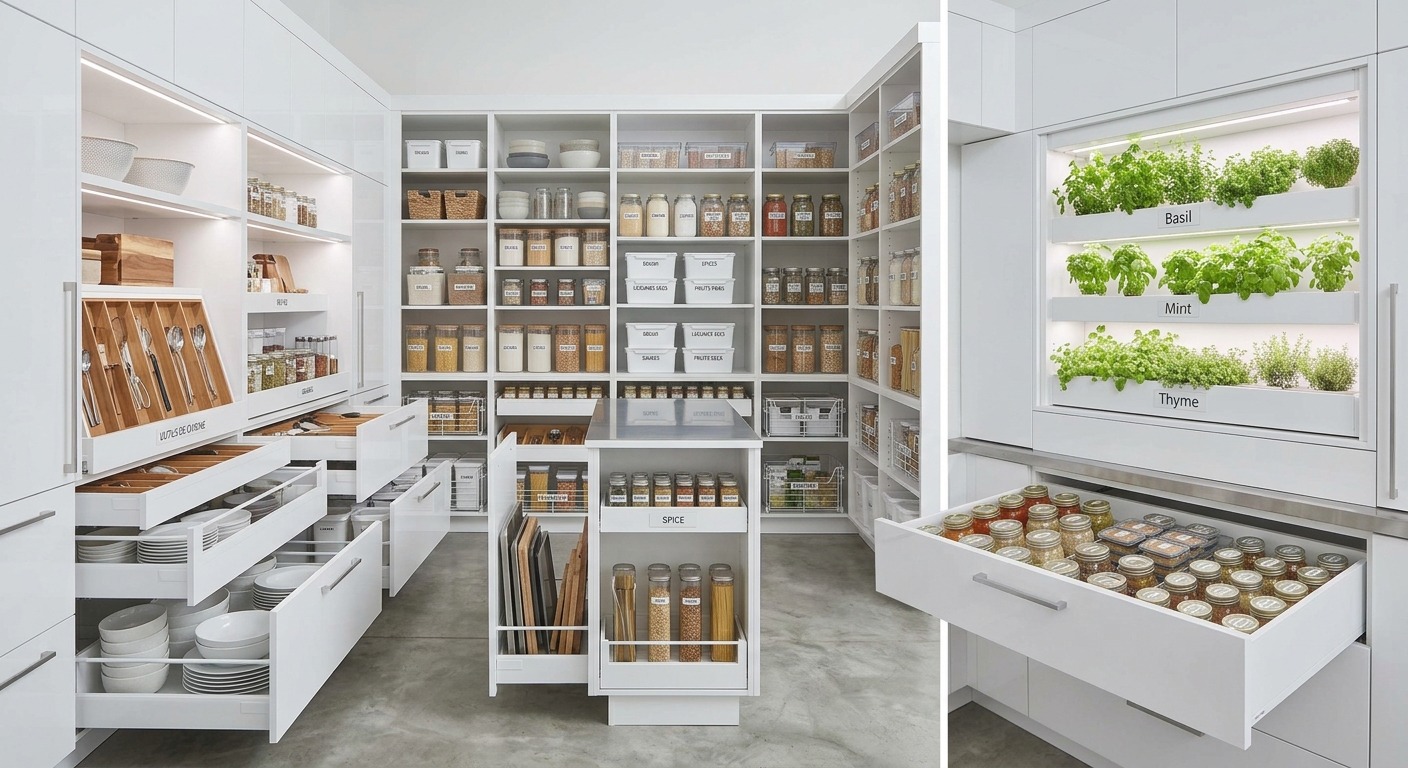
Tall pantry cabinets can create valuable vertical storage.
However, vertical capacity becomes less useful when shelves are too deep or poorly spaced.
Houzz reported that 47% of renovating U.S. homeowners upgraded pantry cabinets in 2026 (Houzz, 2026).
The same report found 16% added walk-in pantries (Houzz, 2026).
Those figures show strong demand for dedicated storage, although they do not prove one pantry format is superior.
Instead, evaluate shelf depth, adjustability, visibility, and access before choosing the configuration.
| Pantry decision | Better question | Why it matters |
|---|---|---|
| Shelf depth | Can stored items remain visible? | Visibility prevents buried storage |
| Shelf height | Can spacing change later? | Needs evolve |
| Door storage | Can small items stay accessible? | It uses otherwise limited space |
| Vertical layout | Is the full height reachable? | Capacity needs practical access |
Clever Cabinet Planning Starts Before Installation
Strong organization begins during measurement, not after the cabinet boxes arrive.
First, document cabinet widths, depths, heights, openings, and obstructions.
Next, identify where drawers, shelves, doors, and pull-outs can physically operate.
Then, compare the required hardware clearance against the available cabinet dimensions.
The first time I test a layout, I look for conflicts before thinking about finishes.
That sequence reduces the risk of designing beautiful storage that cannot operate correctly.
A Cleaner Planning Sequence
Use a simple workflow before ordering components.
- Measure the cabinet opening and interior dimensions.
- Identify obstructions, hinges, plumbing, and fixed hardware.
- Match each storage mechanism to the available geometry.
- Confirm manufacturer specifications before finalizing the design.
Also, keep manufacturer documentation attached to every product decision.
That creates a cleaner audit trail when dimensions, installation requirements, or compatibility questions appear later.
Bold Organization Without Overbuilding
More storage hardware does not automatically create better organization.
Instead, excessive inserts can consume space and restrict future changes.
Houzz’s 2023 U.S. Kitchen Trends Study found 53% of renovators added cookie-sheet or tray storage (Houzz, 2023).
It also found 36% added deep-drawer storage, while 29% added pots-and-pans storage (Houzz, 2023).
Those choices demonstrate demand for specialized organization, but they still require careful planning.
Therefore, the strongest design usually combines flexible storage with a limited number of targeted organizers.
A High-Value Storage Mix
For entrepreneurs, the commercial opportunity is not simply selling more cabinet accessories.
Instead, it is selling a clearer storage outcome.
A strong offer can connect cabinet geometry, access, organization, and installation requirements.
| Customer priority | Storage response | Marketing angle |
|---|---|---|
| Easier access | Drawers and pull-outs | Bring storage forward |
| Better visibility | Dividers and adjustable shelves | Make contents easier to scan |
| Difficult corners | Revolving or pull-out hardware | Recover awkward space |
| Vertical capacity | Pantry cabinetry | Build upward without clutter |
This approach also avoids exaggerated promises.
You are selling a measurable design improvement rather than claiming that one organizer will transform every kitchen.
Powerful Questions That Sharpen the Design
Before recommending cabinet storage, ask questions that expose the actual constraint.
Which cabinets are deepest?
Which areas are hardest to reach?
Where does fixed shelving create unnecessary dead space?
Which storage zones require flexibility?
Also, which organizers genuinely improve access rather than simply adding hardware?
These questions produce stronger recommendations than generic lists of “must-have” accessories.
Precision Storage That Sells Better
Storage becomes easier to sell when the benefit is concrete.
Instead of describing “premium organizers,” describe smoother access, clearer visibility, or better use of difficult cabinet space.
That language gives entrepreneurs a stronger commercial story without relying on inflated performance claims.
When I test a product description, I remove adjectives until the storage benefit remains obvious.
Then, I replace vague promises with a specific design characteristic.
For example, “deep drawer” describes the product, while “full-depth access” explains the value.
That small shift makes marketing clearer without making the claim larger than the evidence.
Practical Quality Checks Before You Publish
Before publishing storage advice, verify every percentage against its original study.
Also, identify the survey population, geography, and renovation period behind each statistic.
That prevents a U.S. homeowner survey from being presented as a universal consumer fact.
| Verification point | What to confirm |
|---|---|
| Statistic | Exact percentage and wording |
| Source | Original research publisher |
| Audience | Who was surveyed |
| Timing | Survey or study period |
Finally, separate research findings from professional judgment.
A statistic can show what renovators selected, while design guidance explains how to evaluate that choice.
That distinction builds credibility because readers can see where evidence ends and informed recommendations begin.
The Final Cabinet Storage Standard
Great cabinet organization should make storage easier to see, reach, separate, and adapt.
Therefore, prioritize cabinet geometry before accessories.
Then, prioritize access before visual complexity.
Finally, choose specialized storage only where it solves a documented problem.
When I review a cabinet plan, I trust measurements and operating clearances more than trendy labels.
That mindset also keeps recommendations defensible.
The strongest kitchen organization strategy is not the one with the most accessories.
Instead, it is the one that turns available cabinet volume into practical, accessible storage.
And for entrepreneurs, that is the message worth selling: better storage is not more stuff—it is smarter space.