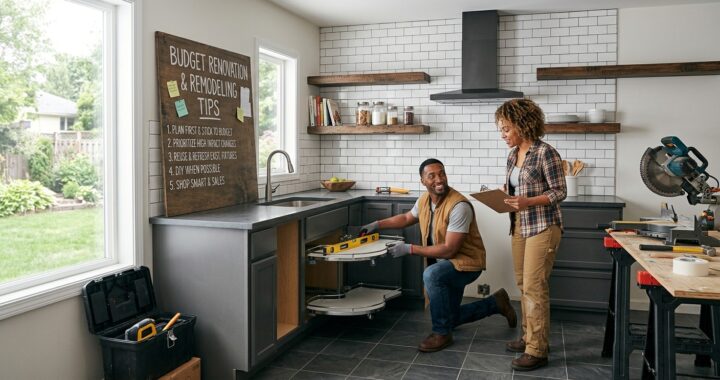
How to Save Money on a Kitchen Renovation: A Practical Budget-First Guide

The best budget kitchen renovation is rarely about hunting down the cheapest materials. Instead, it comes down to knowing which upgrades genuinely deserve your money, and which expensive changes you can skip without hurting function or style.
Keeping a layout that already works, repairing structurally sound cabinets, and spending intentionally on the surfaces people see and touch every day will protect your budget far better than bargain-hunting every finish. According to Houzz kitchen remodel research, major U.S. kitchen renovations typically carry a median spend between $55,000 and $60,000 (rising toward $75,000 for kitchens of 250 square feet or larger). Those numbers are helpful industry benchmarks, not targets you have to match, your actual spend depends on scope, labor rates, and what you choose to leave untouched.
Table of Contents
1. Set Budget Tiers Before Any Demolition Begins
Before browsing tile samples or comparing faucets, establish your hard spending ceiling and divide the money into four clear priority tiers:
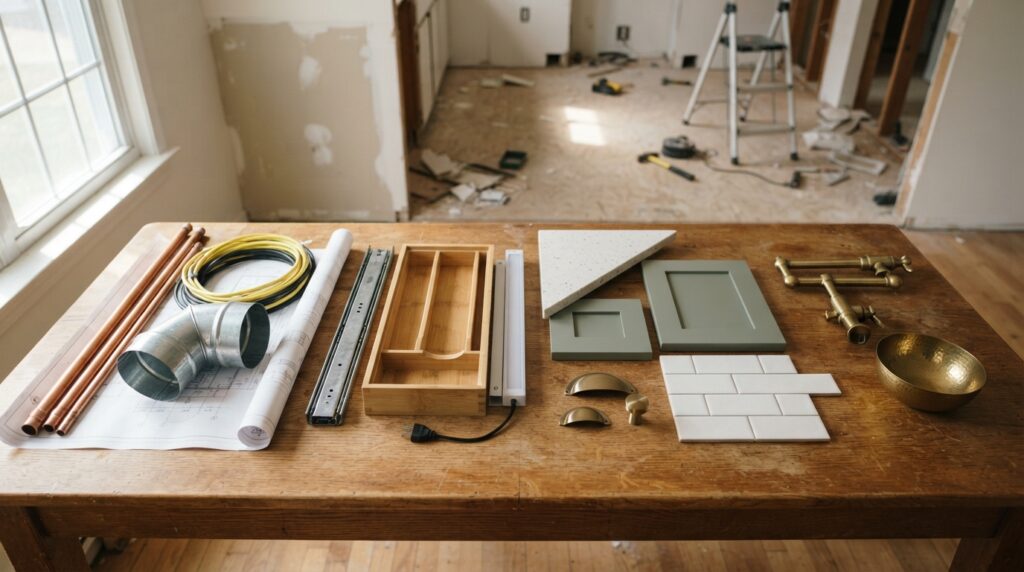
| Priority Tier | Focus Areas | Why It Matters |
| Critical | Plumbing leaks, electrical safety, ventilation, structural repairs | Protects your home and prevents mid-project shutdowns |
| Functional | Task lighting, cabinet storage inserts, broken drawers or hinges | Improves how the kitchen actually works every day |
| Visual | Cabinet paint, hardware, backsplash, countertops | Delivers the biggest aesthetic transformation |
| Optional | Decorative trim, specialty gadgets, luxury extras | Easy to postpone or cut if quotes run high |
Handle safety and mechanical issues first, functional improvements second, and cosmetic finishes third. Defining the scope before shopping for materials keeps emotional impulse buys from derailing the budget.
2. Keep Your Existing Layout Whenever Possible
Moving a sink, gas range, or load-bearing wall rarely stops at cabinet costs, it triggers plumbing reroutes, electrical rewiring, subfloor patching, and permit delays. In Houzz’s 2026 Kitchen Renovation research, 68% of renovating homeowners kept their kitchen roughly the same size, reflecting how much money can be saved by working within the existing footprint.
Before paying to relocate plumbing or walls, ask five practical questions:
- Does the current triangle between the sink, stove, and refrigerator work smoothly?
- Is storage genuinely too small, or simply poorly organized inside the cabinets?
- Would brighter under-cabinet and ceiling lighting fix dark prep zones without moving fixtures?
- Does relocating a sink or appliance solve a real daily bottleneck?
If your current layout functions well, leaving plumbing and electrical lines where they are frees up thousands of dollars for visible finishes.
3. Rescue Sound Cabinets Instead of Replacing Everything
Cabinetry routinely eats up the largest share of a kitchen remodel, yet older kitchens often have sturdy hardwood or plywood cabinet boxes hidden behind dated doors. Inspect construction quality before ordering brand-new boxes:
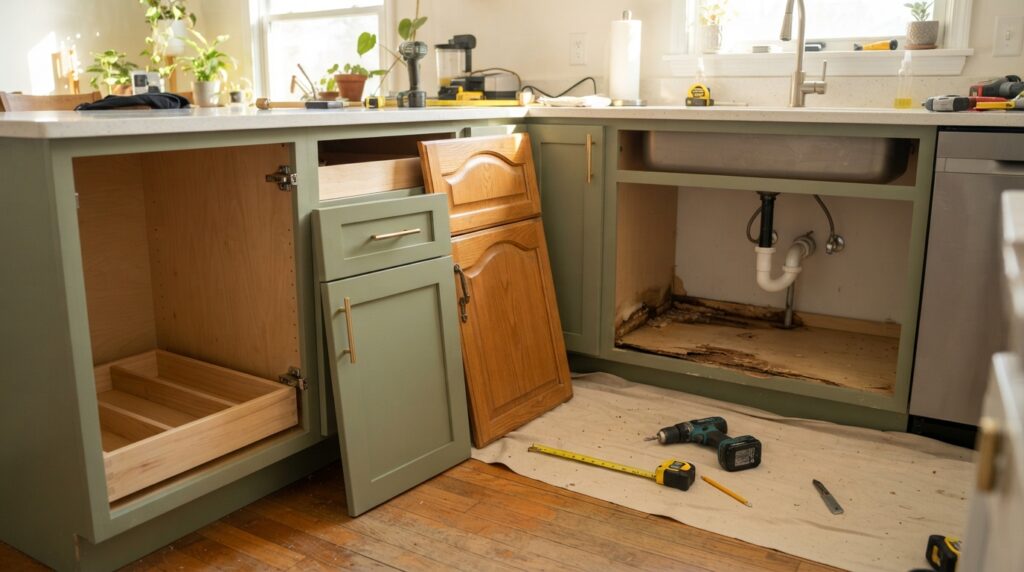
| Cabinet Condition | Best Budget Move | What to Check First |
| Structurally sound boxes, worn finish | Repaint or professionally refinish | Existing surface adhesion and hinge alignment |
| Sturdy boxes, outdated door style | Replace doors and drawer fronts (refacing) | Exact opening measurements and hinge hardware |
| Minor scuffs or loose joints | Repair targeted sections | Underlying cause of wear or loose fasteners |
| Cluttered, hard-to-reach interiors | Add pull-out trays and dividers | Interior box depth and width |
| Swollen, water-damaged, or sagging boxes | Replace affected cabinets | Active plumbing or roof leaks before installing new units |
Cosmetic paint will never rescue particleboard boxes swollen by water damage, so check structural integrity around the sink and dishwasher first.
4. Focus Visual Spending on High-Impact Surfaces
You do not need to replace every single element to make a kitchen look completely renewed. Coordinating three or four visible surfaces, countertops, backsplash, cabinet color, and hardware, creates a cohesive look without stretching your budget across a dozen smaller upgrades:
| Surface Upgrade | Visual Impact | Smart Budget Strategy |
| Cabinet & Wall Paint | Transforms overall brightness and mood | Invest in thorough degreasing, sanding, and primer |
| Cabinet Hardware | Instantly modernizes doors and drawers | Match existing screw-hole spacing to avoid filling holes |
| Backsplash | Creates a clean focal point behind counters | Compare installed square-foot prices; tile remains the most popular choice (selected by 72% of homeowners in Houzz’s 2026 survey) |
| Countertops | Anchors the entire room’s style | Compare installed costs across quartz, butcher block, and modern laminates |
| Flooring | Unifies the workspace foundation | Refinish existing hardwood or repair damaged planks when feasible |
A kitchen with three well-coordinated finishes looks far more intentional, and expensive, than one crowded with competing textures.
5. Fix Task Lighting Before Buying Decorative Fixtures
Lighting is one of the easiest places to get high impact for relatively little money, yet homeowners often spend heavily on decorative pendants while leaving prep counters in shadow. According to ENERGY STAR, certified LED lighting products use up to 90% less energy and last up to 25 times longer than traditional incandescent bulbs.
Plan your lighting from the countertop up:
- Light primary prep zones first with continuous under-cabinet LED strips or well-placed recessed lights.
- Eliminate shadows over the sink and cooktop.
- Balance ambient room lighting with dimmable ceiling fixtures.
- Add decorative pendants last, once functional visibility is solved.
6. Compare Appliances by Installed Cost, Not Showroom Hype
Appliance packages can quietly double a mid-range renovation budget when you pay for Wi-Fi screens or commercial-grade features you rarely use. Look at core reliability, dimensions, and energy efficiency instead, for instance, ENERGY STAR notes that certified dishwashers are on average 20% more energy efficient and 30% more water efficient than standard models.
| Appliance | Top Buying Priority | Check Before Ordering |
| Refrigerator | Exact width, height, and door-swing clearance | Counter-depth fit and doorway delivery path |
| Dishwasher | Noise rating (dBA) and water efficiency | Existing water supply and drain hookup |
| Range / Cooktop | Burner layout and oven capacity | Electrical amperage or gas line compatibility |
| Range Hood | Proper CFM airflow and ducting | Exterior venting path and mounting height |
Always calculate the total installed price, including delivery, haul-away, power cords, water lines, and any cabinet modifications, rather than comparing sticker prices alone.
7. Choose a Faucet for Reach, Clearance, and Flow Rate
A new pull-down kitchen faucet updates the sink area immediately, provided it fits your basin properly. Check spout reach, swivel arc, and backsplash clearance before falling in love with a finish. Under federal EPA guidelines, standard kitchen faucets have a maximum flow rate of 2.2 gallons per minute (gpm), while many water-saving models operate at 1.5 to 1.8 gpm (and states like California enforce stricter local limits). Confirm local code requirements and mounting-hole counts first, then pick your finish.
8. Expose Hidden Quote Exclusions Before Signing
A lower contractor estimate is not a bargain if it leaves out essential tasks that a competing quote includes. Before signing any agreement, confirm in writing who is responsible for:
- Demolition and dumpster disposal
- Appliance delivery, unboxing, and haul-away
- Rough plumbing and electrical adjustments
- Building permits and municipal inspections
- Drywall patching and trim touch-ups
- Daily site cleanup and written change-order pricing
9. Evaluate Contractor Quotes Like a Project Manager
Houzz’s 2025 renovation study found that 86% of homeowners hired a professional for their kitchen remodel. When comparing bids from contractors, look closely at how clearly each proposal defines the work:
| Quote Element | Strong, Reliable Bid | Warning Sign |
| Scope of Work | Detailed line-by-line task list | Vague one-line room descriptions |
| Materials | Specific brands, models, or clear allowances | Open-ended “builder grade” placeholders |
| Labor Responsibilities | Clear split between trades (plumbing, tile, electrical) | Unclear who coordinates subcontractors |
| Exclusions | Explicitly lists what is not included | No mention of permits, painting, or disposal |
| Change Orders | Written approval required before extra charges | Verbal “we’ll figure it out later” agreements |
10. Spend Carefully Where Mistakes Are Expensive to Undo
Smart renovation budgeting is not about cutting every line item, it is about knowing where cheap shortcuts backfire:
- Spend carefully behind the walls: Plumbing connections, electrical wiring, waterproofing, and range-hood ducting are expensive to tear open and fix later.
- Save on easy-to-swap items: Pendant shades, cabinet knobs, barstools, and decorative accessories can be upgraded any weekend without opening a wall.
11. Avoid Four Common Renovation Budget Traps
- Changing scope mid-project: Swapping tile or cabinet sizes after orders are placed triggers restocking fees and labor delays.
- Adding custom millwork late: Custom spice pull-outs and decorative panels add cost quickly when tacked on after framing.
- Replacing working appliances out of habit: If your refrigerator or range is under seven years old and works reliably, keep it and allocate that money to countertops or lighting.
- Expanding square footage without a clear need: While Houzz’s 2026 research noted that 32% of renovating homeowners expanded their kitchen footprint, structural additions multiply foundation, roofing, and flooring costs. Treat an expansion as a major construction decision rather than an automatic step.
12. Filter Every Item Through “Keep, Refresh, or Replace”
Before purchasing anything, sort every major kitchen component into three buckets:
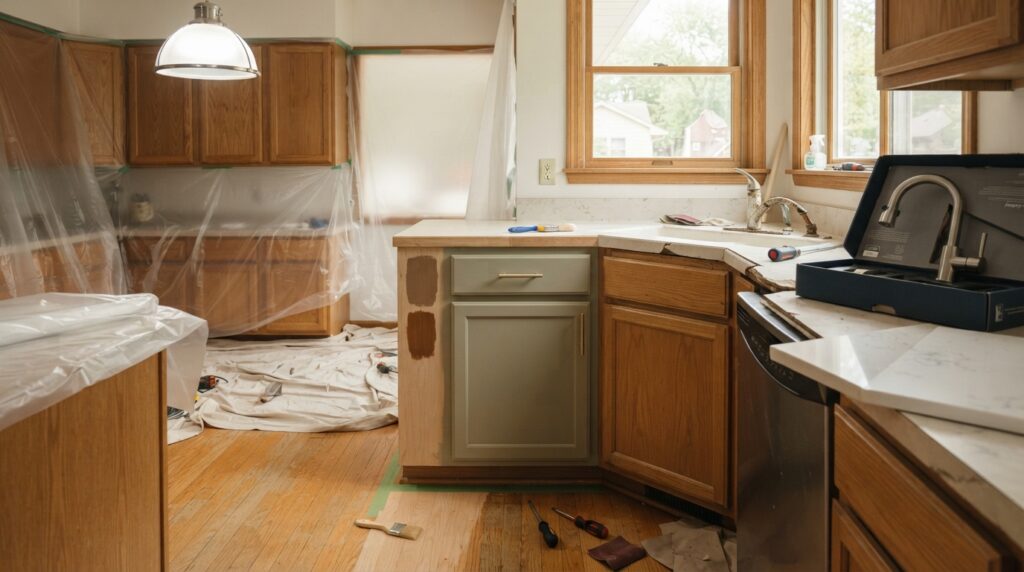
| Kitchen Component | Keep As-Is | Refresh | Replace |
| Cabinets | Solid boxes, clean finish | Solid boxes, dated color or doors | Water-damaged or failing boxes |
| Countertops | Chip-free, functional surface | Minor dullness or dated edge | Cracked, stained, or heat-damaged |
| Flooring | Level, durable, undamaged | Scuffed hardwood ready to refinish | Warped, cracked, or water-damaged |
| Faucet & Sink | Leak-free, comfortable reach | Dated finish on a standard mount | Leaking valves or poor basin fit |
| Lighting | Bright, well-placed fixtures | Outdated shades or warm bulbs | Dark prep zones or failing wiring |
For every item in the Refresh or Replace column, ask what specific problem it solves. Separating genuine functional fixes from pure impulse upgrades keeps spending disciplined.
13. Maximize Existing Storage Before Adding Cabinets
Before paying for additional cabinetry or knocking down a wall for a bigger pantry, audit how efficiently your current shelves work. In recent Houzz research, 76% of renovating homeowners added built-in organizational features to their kitchens, such as deep drawer dividers, pull-out waste bins, tray dividers, and roll-out pantry shelves. Reclaiming dead corner space and vertical shelf height often solves storage frustration at a fraction of the cost of new cabinetry.
14. Lock the Order of Renovation Decisions
Many costly renovation mistakes happen simply because products are ordered out of sequence. Follow a strict six-step order:
1. Scope → 2. Exact Measurements → 3. Contractor Quotes → 4. Product Selection & Compatibility → 5. Installation → 6. Final Styling
Never order a sink before verifying base-cabinet interior width, and never buy lighting fixtures before confirming junction-box locations and ceiling height.
15. Protect a 10% to 15% Contingency Reserve
Every kitchen remodel, especially in older homes, risks uncovering outdated wiring, uneven subfloors, or hidden plumbing wear once surfaces come off. Set aside 10% to 15% of your total budget as a dedicated contingency fund, and treat it strictly as protection for genuine surprises rather than a slush fund for upgraded tile or hardware.
Sample Kitchen Renovation Budget Allocation
Even when your total budget is smaller than national averages, using a realistic percentage breakdown keeps one category, like high-end countertops or custom cabinetry, from starving the rest of the project:
| Budget Category | Typical Share of Total Budget | What It Covers |
| Cabinetry & Hardware | 25% – 30% | Cabinet refacing, painting, new doors, pull-outs, and pulls |
| Installation & General Labor | 20% – 25% | Carpentry, demolition, drywall, tile setting, and haul-away |
| Appliances & Ventilation | 15% – 20% | Refrigerator, range, dishwasher, microwave, and range hood |
| Countertops & Backsplash | 10% – 15% | Slab fabrication, installation, tile, grout, and trim |
| Plumbing, Electrical & Lighting | 10% – 15% | Faucet, sink, under-cabinet LEDs, outlets, and hookups |
| Contingency Reserve | 10% – 15% | Dedicated buffer for hidden repairs uncovered during work |
If you are keeping your existing cabinet boxes and layout, your cabinetry and labor shares drop significantly, allowing you to redirect funds toward better countertops, lighting, or upgraded appliances.
High-Impact Material Swaps That Cut Costs Without Looking Cheap
Often, two materials deliver nearly identical durability and visual polish while sitting in completely different price brackets:
- Standard-Grade Quartz vs. Exotic Veined Slabs: Entry-level and mid-tier quartz designs in solid whites, soft grays, or subtle marble-look patterns offer the exact same non-porous durability as designer book-matched slabs at 30% to 40% less per square foot.
- Classic Ceramic Subway or Square Tile vs. Intricate Mosaics: Simple 3×6 ceramic tiles or 4×4 zellige-look tiles cost a fraction of handmade stone mosaics, and take half the labor hours to cut and grout cleanly.
- Butcher Block on an Island vs. All-Stone Counters: Pairing durable quartz or laminate along the wet sink perimeter with warm solid-wood butcher block on an island or baking station lowers total stone fabrication costs while adding warmth.
- Stock Shaker Doors vs. Custom Millwork Profiles: Standard Shaker-style replacement doors are widely stocked, easy to paint or wipe clean, and far less expensive than custom inset or ornate routed profiles.
Smart DIY Tasks vs. Work Best Left to Licensed Pros
Taking on selective prep and finishing work yourself can trim thousands off labor invoices, provided you draw a clear line around technical trades:

- Safe, High-Return DIY Tasks: Removing old cabinet hardware, clearing out cabinets before demolition, painting walls after trades finish, assembling flat-pack pantry organizers, and installing new drawer pulls.
- Work Best Left to Licensed Professionals: Moving gas lines, adding dedicated 20-amp small-appliance circuits, rerouting drain vents, templating heavy stone countertops, and waterproofing wet zones.
Make Every Renovation Dollar Earn Its Place
A budget-smart Kitchen Renovation does not look compromised, it looks focused. By keeping a layout that already works, rescuing solid Cabinet Boxes, upgrading task lighting and high-visibility surfaces, and comparing quotes by true installed scope, you put your money where you will see and use it every day. Before approving any expense, ask whether it meaningfully improves safety, daily function, durability, or visual cohesion, and cut anything that fails that test.