Kitchen Storage Design: How to Make Every Inch of Your Cabinets Work Harder

Good cabinet and drawer storage can make a kitchen feel bigger, calmer, and easier to use. The trick is not adding more storage. It is making better use of the space you already have.
When I look at a kitchen storage plan, I usually start with one question: Can you reach what you need without fighting the cabinet?
That simple question catches a surprising number of design problems.
A cabinet can look beautiful from the outside and still be frustrating inside. Deep shelves, awkward corners, and poorly planned drawers can quickly turn useful space into wasted space.
So, before choosing organizers, think about how the cabinets will actually work.
Make Every Cabinet Inch Work Harder
Cabinet organization starts with the basic structure.
You need enough room, sensible access, and an interior layout that makes sense for the things being stored. After that, organizers can make the system even better.
The National Kitchen & Bath Association’s kitchen planning guidelines recommend considering functional storage solutions for corner cabinets when those cabinets are part of the kitchen layout.
That makes sense.
Corners are notorious for becoming difficult-to-reach storage areas. A cabinet may technically hold plenty, but that does not mean the space is easy to use.
When I review cabinet layouts, I pay attention to what happens at the back of the cabinet.
If reaching something requires moving three other things first, the storage design needs another look.
The Four Things I Check First
| Storage factor | What I look for | Why it matters |
|---|---|---|
| Access | Can the contents be reached easily? | Better access means less frustration |
| Space | Is the cabinet sized appropriately? | Prevents wasted interior volume |
| Organization | Can contents stay separated? | Keeps the cabinet easier to manage |
| Movement | Can doors and drawers open freely? | Prevents annoying conflicts |
These details might not sound exciting.
Still, they are the difference between a cabinet that simply holds things and one that genuinely works.
Give Drawers a Bigger Role
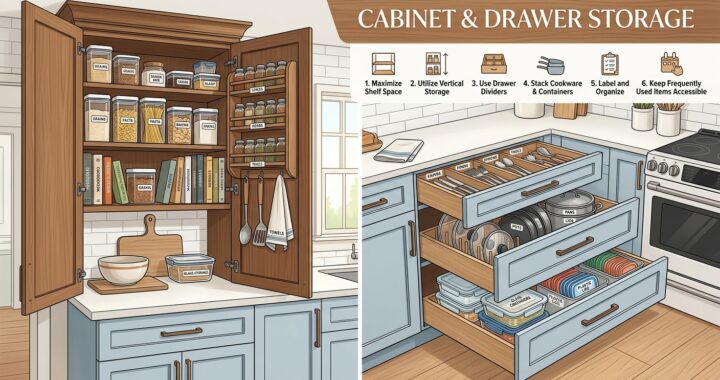
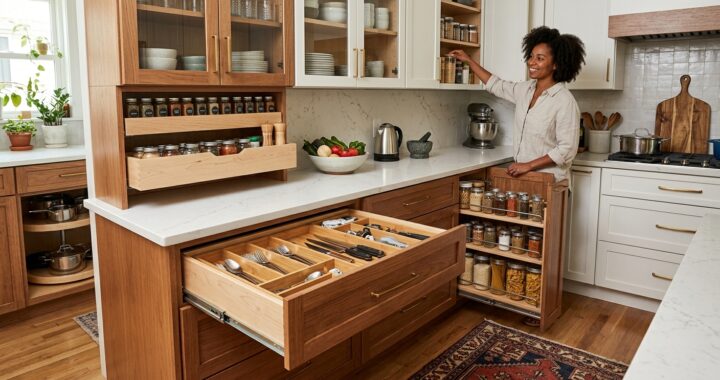
Drawers are one of my favorite ways to improve base-cabinet storage.
Why?
You can pull the contents toward you instead of reaching deep into the cabinet.
The NKBA has specifically discussed deep drawers as an alternative to traditional base-cabinet shelving, particularly where accessibility matters. NKBA guidance on pull-out and deep storage
That does not mean every cabinet should become a drawer.
The better approach is to choose drawer dimensions based on the storage requirements.
A drawer that is too shallow wastes vertical space. One that is unnecessarily deep can become difficult to keep organized.
So, the question is not simply, “Can we fit a drawer here?”
Ask instead, “What drawer size makes the most sense for this cabinet?”
Think About the Drawer Before the Hardware
| Drawer feature | Question to ask |
|---|---|
| Height | What will the drawer need to hold? |
| Width | Is the construction suitable for the opening? |
| Depth | Can the contents remain accessible? |
| Hardware | Is the mechanism appropriate for the load? |
The NKBA’s cabinetry guidelines recommend full access to the drawer box as part of cabinet planning. NKBA Cabinetry & Casework Planning Guidelines
That detail is easy to overlook during a design discussion.
It matters, though.
A drawer can look impressive in a showroom while still being awkward if the opening does not provide practical access.
Add Dividers Where They Actually Help
Once the cabinet and drawer layout is right, then I start thinking about internal organization.
Dividers, partitions, and adjustable inserts can help keep a cabinet from turning into one large pile of miscellaneous items.
There is also evidence that homeowners value this kind of flexibility.
According to the NKBA’s 2024 Kitchen Design Trends report, 90% of respondents agreed that homeowners want better cabinet storage with configurable drawer dividers and partitions.
That is a significant preference.
But I would not add dividers simply because there is an empty drawer.
The organizer should have a reason to exist.
I’ve seen projects where too many fixed compartments actually made storage less flexible. The cabinet looked organized, but the organization was designed around one specific arrangement.
Adjustable solutions can make more sense when storage needs are likely to change.
A Simple Way to Think About Interior Organization
| Storage option | Flexibility | Best planning approach |
|---|---|---|
| Fixed shelf | Low | Keep the arrangement simple |
| Adjustable shelf | Medium | Allow for changing contents |
| Drawer divider | High | Separate changing categories |
| Adjustable partition | High | Create flexible compartments |
The goal is not to fill the cabinet with accessories.
The goal is to make the interior easier to understand and easier to change.
Don’t Waste the Corner
Corner cabinets deserve special attention because they can be some of the hardest areas to access.
The NKBA’s kitchen planning guidance recommends a functional storage device for at least one corner cabinet when corner cabinets are included. NKBA Kitchen Planning Guidelines
That does not mean there is one perfect corner solution.
The right choice depends on the cabinet construction, available dimensions, and the storage system being designed.
Compare the Main Corner Options
| Option | Main advantage | Main consideration |
|---|---|---|
| Fixed shelves | Simple construction | Rear access can be limited |
| Pull-out system | Brings contents forward | Requires suitable clearance |
| Rotating system | Improves access around the corner | Needs appropriate cabinet geometry |
| Drawer configuration | Direct access | Requires compatible cabinet construction |
When I plan corner storage, I would rather solve the access problem first and worry about the accessory second.
That usually produces a cleaner result.
Choose Cabinet Hardware With Care
Hardware is easy to treat as a finishing detail.
I think that is a mistake.
The hardware determines how the storage actually feels when someone opens, closes, pulls, or reaches into it.
The NKBA recommends cabinet hardware that avoids excessive wrist twisting and does not require a tight grasp. NKBA Cabinetry & Casework Planning Guidelines
The same guidelines also address potential conflicts between drawers, doors, and nearby fixtures.
That is why hardware should be considered during cabinet planning rather than after everything else has been decided.
Check These Details Before Installation
- Drawer opening clearance
- Door and drawer interaction
- Handle placement
- Interior accessibility
These are small details, but they can have a big effect on how the finished kitchen feels.
The first time I review a storage design, I tend to look at movement before appearance.
A beautiful cabinet that cannot open properly is still a poorly designed cabinet.
Design Storage Around Real Accessibility
Accessible storage is not only relevant to specialist kitchen projects.
Good access benefits almost everyone.
Research indexed by PubMed examined the ergonomic suitability of kitchen furniture and found that storage height and depth can affect accessibility and kitchen-task ergonomics.
The research identified an optimal storage zone between 800 and 1100 millimeters within its study context.
I would not treat that number as a universal rule.
People have different heights, mobility levels, reach ranges, and physical requirements.
Instead, use ergonomic research as a starting point and then consider the actual person using the kitchen.
The NKBA also provides guidance covering accessible kitchen storage and reach requirements. NKBA Planning Guidelines
That approach makes more sense than designing around a single measurement.
Keep the Storage Plan Simple
There is a temptation to make kitchen storage complicated.
More drawers. More inserts. More mechanisms. More accessories.
But more does not automatically mean better.
When I plan storage, I prefer a simple sequence:
| Stage | Question |
|---|---|
| 1. Measure | What physical space is available? |
| 2. Plan access | How should the contents be reached? |
| 3. Select cabinets | Which cabinet configuration works? |
| 4. Organize interiors | What needs separation or adjustment? |
| 5. Check movement | Does everything open and operate properly? |
This process keeps the important decisions in the right order.
I wasted plenty of time in early projects thinking about accessories before checking the cabinet itself.
The lesson was simple: fix the foundation before decorating the interior.
Make Storage Part of the Design Story
For kitchen businesses, cabinet storage is also a selling point.
Customers may not know the technical difference between one drawer system and another, but they can quickly understand whether a kitchen feels easy to use.
That gives you an opportunity to explain the thinking behind the design.
For example, the NKBA’s 2024 trends research found that 43% of respondents agreed homeowners like clean cabinet surfaces with push-to-open technology. NKBA 2024 Kitchen Design Trends
The same report found that 32% agreed homeowners like open, visible storage for frequently used items. NKBA 2024 Kitchen Design Trends
Those numbers show that storage preferences are not one-dimensional.
Some people want clean, concealed cabinetry.
Others prefer storage that keeps selected items visible.
Neither approach is automatically better.
The smarter choice depends on the design and the person using it.
Build a Cabinet System That Makes Sense
Good kitchen organization rarely comes from one clever product.
It usually comes from several small decisions being made correctly.
The cabinet dimensions need to work. The drawers need suitable access. Corners need a solution. Dividers should have a purpose. Hardware needs to operate comfortably.
Then, everything needs to work together.
That is where good storage planning separates itself from simply buying organizers.
When I look at a finished kitchen, the best compliment is usually not, “That’s a clever drawer.”
It is something simpler:
“Everything has a place, and everything is easy to reach.”
That is what cabinet and drawer storage should ultimately achieve.
Not more stuff.
Not more complicated hardware.
Just a kitchen that works better because the storage was thought through from the beginning.