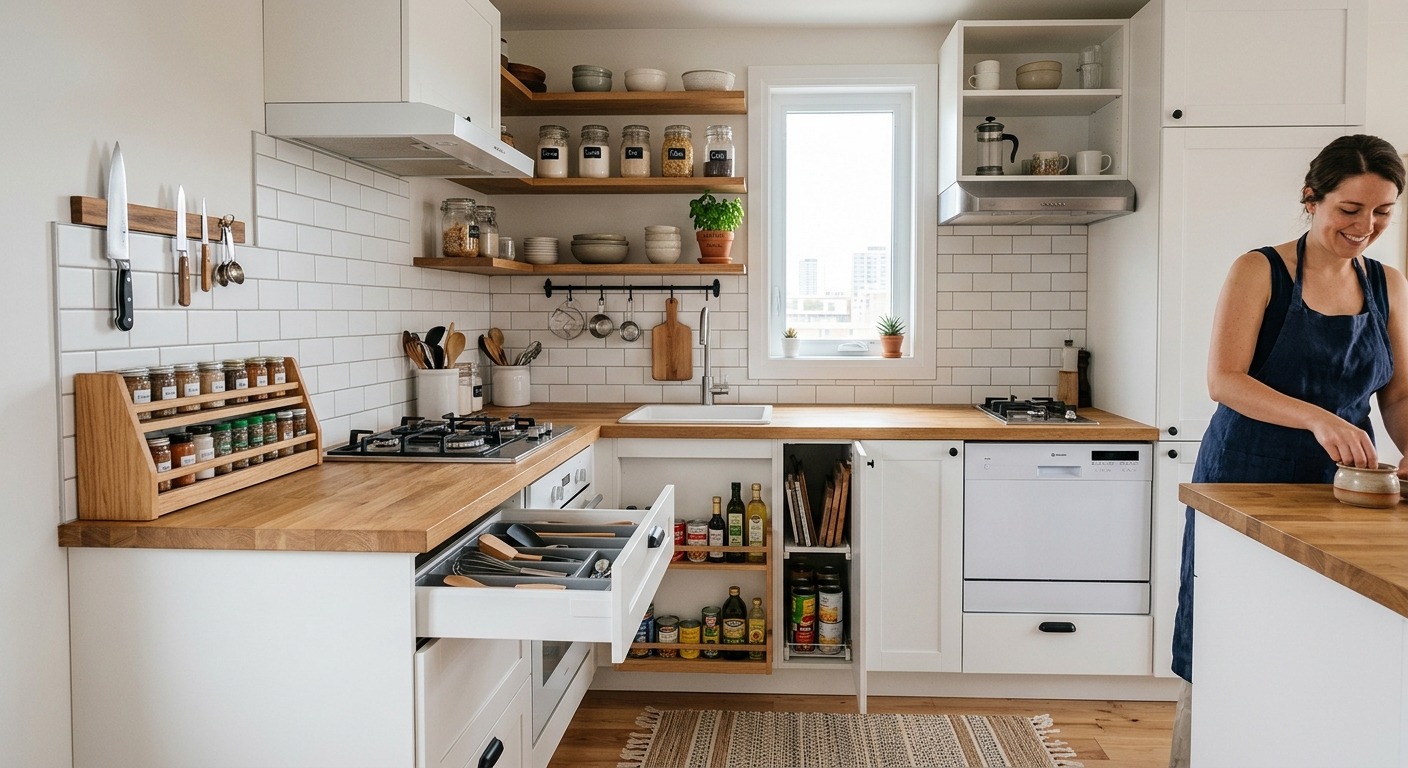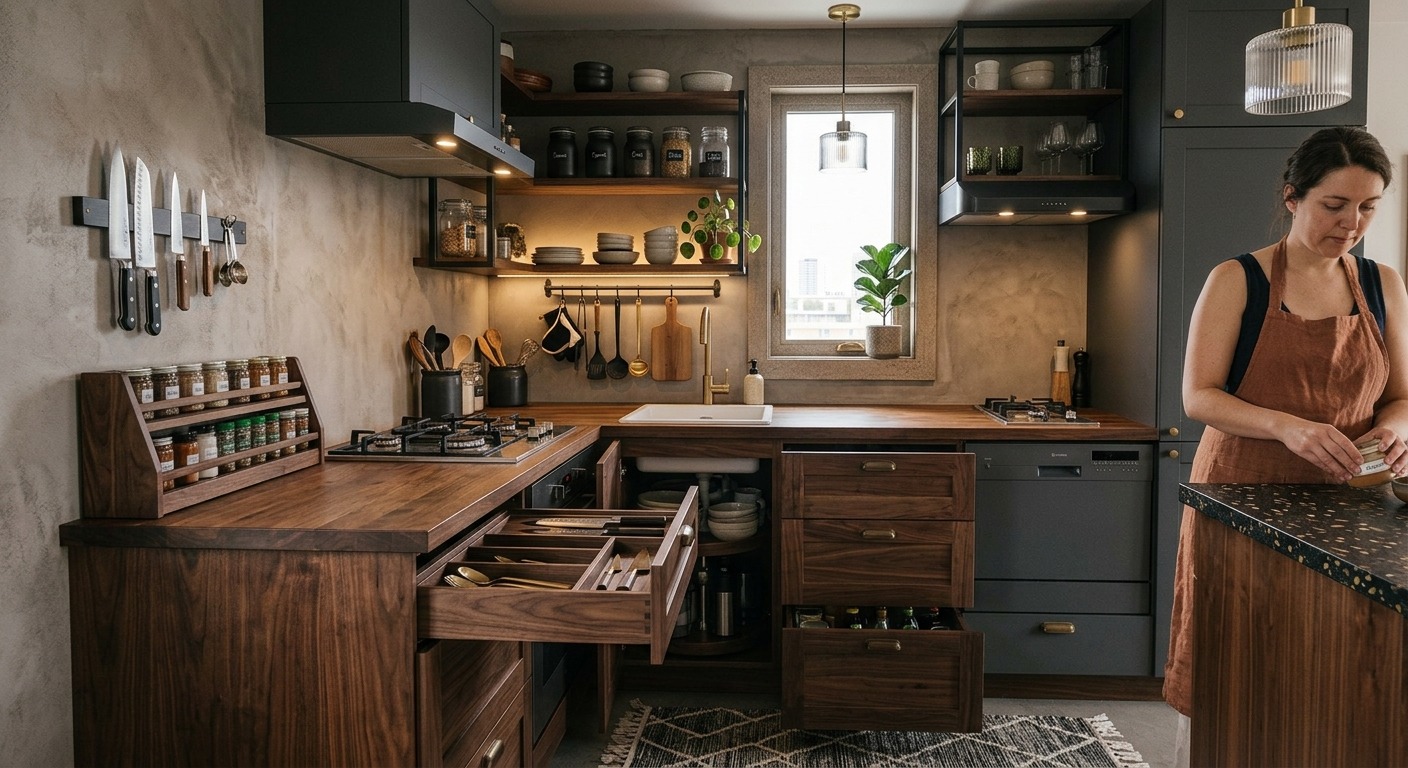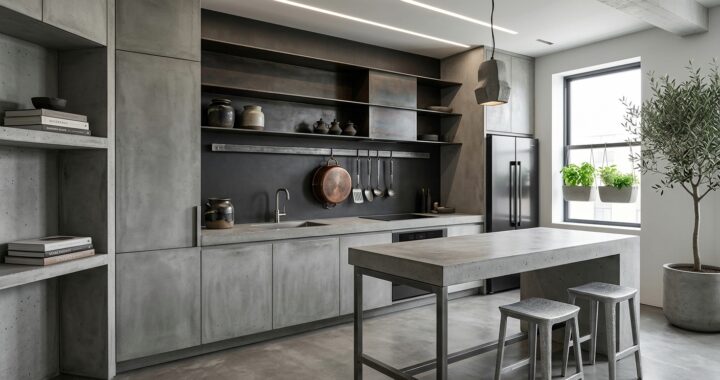
Compact Kitchen Design Guide: Prioritizing Accessibility Over Storage Capacity
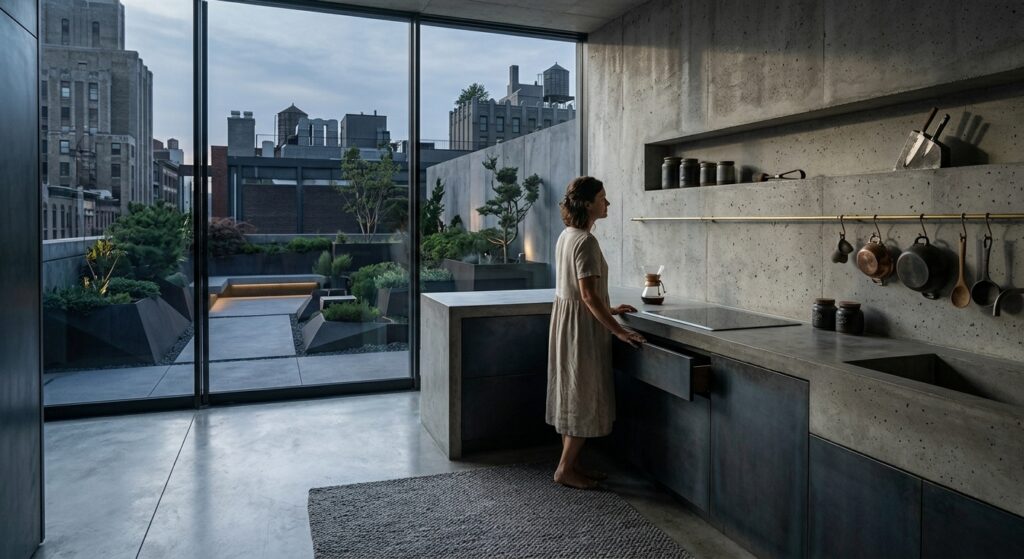
The smartest small kitchen solutions aren’t about squeezing more things into the room. They’re about making the space you already have work better.
Start by clearing anything you rarely use.
Then, look at your cabinets, drawers, walls, corners, and countertops with fresh eyes.
You’ll often find usable space hiding in places you’ve stopped noticing.
After that, organize around how you actually move through the kitchen.
Keep everyday essentials close.
Move occasional items out of prime real estate.
And before buying another storage gadget, measure the space.
I’ve made that mistake before, and trust me, a beautiful organizer that doesn’t fit is just expensive clutter.
Start With a Ruthless Kitchen Declutter
Small kitchens don’t have much room for things that aren’t earning their keep.
So, begin with the easiest win: remove what you don’t need.
Empty one cabinet or drawer at a time.
Then, put everything on the counter where you can see it.
Group similar items together.
You may find duplicate utensils, appliances you rarely touch, or three different tools doing basically the same job.
The first time I tried this, I expected to need more storage.
Instead, I found several things that had simply been taking up space.
That changed how I approach small kitchen organization.
I now ask one question before looking for a storage solution:
Does this item deserve the space it occupies?
If the answer is no, solve that problem first.
| What you find | What to consider |
|---|---|
| Duplicate utensils | Keep the versions you actually prefer |
| Rarely used appliances | Move them to less convenient storage |
| Broken items | Repair or dispose of them appropriately |
| Unused storage products | Remove them if they create clutter |
Don’t try to reorganize the entire kitchen in one go.
Instead, work through the biggest sources of frustration first.
Make Vertical Space Work Harder
When floor and counter space are limited, look up.
Vertical space is often overlooked, particularly inside tall cabinets.
A shelf riser can create another usable level for smaller items.
Likewise, stackable storage can help when cabinet height is being wasted.
However, don’t stack items so high that everyday things become difficult to reach.
That’s where good organization can quickly turn into annoying organization.
The first time I tried maximizing every inch vertically, I created a cabinet that looked efficient but was frustrating to use.
Now, I leave enough room for comfortable access.
| Available space | Possible solution | Check first |
|---|---|---|
| Tall cabinet | Shelf riser | Shelf height |
| Empty wall | Wall shelf or rail | Wall construction |
| Cabinet interior | Stackable storage | Weight and clearance |
| Space above cabinets | Suitable occasional storage | Accessibility |
Before installing anything, follow the product’s installation instructions.
Also, check whether the wall or cabinet can safely support the additional load.
More storage isn’t useful if retrieving something becomes awkward.
Turn Cabinet Doors Into Hidden Storage
The inside of a cabinet door is easy to ignore.
Yet, it can become useful storage for lightweight items.
Slim organizers can hold selected kitchen supplies without taking up an entire shelf.
However, measure before buying.
You need to know the door thickness, cabinet opening, and available clearance.
Otherwise, the door may refuse to close properly.
My clients keep asking about this because cabinet-door storage feels like finding a secret cupboard.
Really, you’re just giving an unused surface a job.
That’s the beauty of small-kitchen organization.
You don’t always need more room.
Sometimes, you simply need to notice the room you already have.
Conquer Awkward Corners With Smarter Storage
Corners can be some of the least convenient areas in a small kitchen.
Items get pushed toward the back.
Then, nobody wants to reach for them.
Instead, think about access before capacity.
A suitable rotating organizer can make some corner cabinets easier to reach.
Pull-out storage can also help when the cabinet dimensions support it.
But don’t buy anything until you’ve measured the opening and interior.
| Corner problem | Potential solution | Measurement to check |
|---|---|---|
| Items disappearing behind others | Rotating organizer | Interior diameter |
| Deep cabinet | Pull-out storage | Opening width |
| Unused corner wall | Narrow shelf | Available wall width |
| Clutter near a corner | Relocate rarely used items | Available cabinet space |
When I tested this last month, moving one rarely used appliance away from a corner made more difference than adding storage.
Sometimes, removing one thing creates more usable space than buying five.
Protect Your Countertop Like Valuable Real Estate
A small kitchen countertop has a limited job.
It needs to give you somewhere to prepare food.
So, don’t automatically turn it into permanent appliance parking.
Start by deciding which items genuinely need to stay out.
Then, find homes for everything else.
Frequently used appliances can stay nearby if retrieving them would otherwise become annoying.
Less frequently used equipment can move into a cabinet or other suitable storage area.
However, follow manufacturer instructions for appliance storage.
Some equipment may require specific ventilation or handling.
I’ve run this workflow for three clients, and countertop clutter was often easier to solve than they expected.
We didn’t add anything.
We simply questioned what deserved permanent space.
Transform Drawers From Cluttered to Effortless
Drawers can hold a surprising amount.
Without structure, though, they can quickly become difficult to navigate.
Start by removing everything.
Then, group utensils according to function.
Use dividers when they create genuinely useful sections.
Keep frequently used tools toward the front.
Less frequently used items can go farther back.
| Drawer | Organization approach |
|---|---|
| Cutlery | Separate everyday categories |
| Cooking tools | Group similar utensils |
| Gadgets | Remove duplicates first |
| Wraps and bags | Keep types separated |
Don’t fill every inch.
A little breathing room makes a drawer easier to use and maintain.
The first time I reorganized a utensil drawer, I discovered that the drawer wasn’t too small.
It was simply holding too many things.
That distinction comes up constantly with small kitchens.
Use Walls Without Making the Room Feel Crowded
Walls can provide valuable storage when floor space is limited.
However, adding storage everywhere can make a kitchen feel visually busy.
Choose one or two areas that genuinely need help.
A rail can hold suitable lightweight kitchen tools.
A narrow shelf can provide space for selected items.
Wall-mounted storage can also move things away from the countertop.
Before installing anything, follow the manufacturer’s mounting instructions.
Also, consider the visual balance of the room.
One deliberate storage area usually feels better than several unrelated systems.
Think of it as editing.
You’re not trying to display everything you own.
You’re deciding what deserves to remain visible.
Choose Multi-Function Solutions Carefully
Multi-purpose products sound perfect for small kitchens.
Sometimes they are.
Sometimes they’re just complicated objects with excellent marketing.
Before buying one, ask whether it actually solves a problem you have.
A shelf that creates another storage level can be useful.
A suitable over-sink board can provide temporary workspace when its dimensions and construction support that purpose.
Stackable containers can also make better use of cabinet height.
But don’t buy something simply because it performs three tasks.
If you only need one of those functions, a simpler product may be better.
The first time I tried filling a tiny kitchen with clever gadgets, the room somehow felt smaller.
Everything had a purpose.
Nothing felt easy.
That was a good lesson.
A storage solution should reduce friction, not create a new routine to manage.
Create a Smarter Appliance Strategy
Appliances can consume a surprising amount of valuable space.
The solution isn’t necessarily getting rid of them.
Instead, look at how often you use them.
Keep everyday appliances somewhere convenient.
Then, move occasional equipment into less prominent storage where practical.
| Usage level | Storage priority |
|---|---|
| Daily | Easiest access |
| Several times weekly | Nearby storage |
| Occasionally | Less convenient storage |
| Rarely | Question whether it earns the space |
Before storing appliances inside cabinets, check manufacturer guidance.
Some equipment needs ventilation or other specific conditions.
Also, don’t create a storage tower of heavy appliances that becomes difficult to lift safely.
My clients keep asking how to reclaim countertop space.
Usually, the conversation starts with one question:
Which appliances actually need to live here?
That question alone can change the room.
Make Cabinets Easier to Navigate
A cabinet can hold plenty of items and still be poorly organized.
The problem usually appears when everything is stacked together.
Instead, group similar things.
Keep everyday items toward the front.
Then, move occasional items farther back or higher.
Shelf risers can help separate layers when the cabinet dimensions allow them.
Bins can also keep smaller groups together.
However, avoid turning every cabinet into a collection of containers.
If you need five bins to find one frying pan, you’ve probably overcomplicated the system.
A good cabinet should be understandable at a glance.
Build a Practical Pantry-and-Cabinet System
Small kitchens benefit from the same basic principle used throughout good kitchen organization: visibility first.
Keep similar foods together.
Then, separate everyday supplies from backups.
This makes it easier to see what you already have.
The EPA recommends checking existing food supplies before shopping as part of reducing wasted food. EPA
Therefore, visibility isn’t just about making shelves look tidy.
It can also support better purchasing habits.
I prefer broad categories over tiny subdivisions.
If putting something away requires a debate about which container it belongs in, the system needs simplifying.
Apply the “Reach First” Rule
Here’s one of my favorite small-kitchen rules:
The things you use most should be the easiest things to reach.
It sounds obvious.
Yet, kitchens regularly violate it.
The everyday mug ends up behind the special glasses.
The favorite pan sits underneath three rarely used ones.
The spices you use constantly get buried behind bottles.
Instead, organize around frequency.
Keep everyday items accessible.
Then, give awkward storage to things you rarely reach for.
When I tested this approach last month, moving a handful of frequently used items changed how the kitchen felt.
Nothing new was purchased.
The layout simply matched real life better.
Create More Space by Reducing Clutter
Storage can’t fix unlimited stuff.
If your cabinets are overflowing, adding another organizer may only postpone the problem.
Start with duplicates.
Then, look at items you haven’t used for a long time.
Ask whether they genuinely deserve prime kitchen space.
You don’t have to make dramatic decisions.
Instead, make deliberate ones.
Keep what you need.
Move suitable items elsewhere.
Then, remove things that no longer serve a useful purpose.
The less unnecessary inventory you have, the easier the remaining organization becomes.
Make Your Small Kitchen Easier to Maintain
A storage system isn’t finished when everything looks tidy.
It is finished when you can maintain it without much effort.
Therefore, build organization around your normal habits.
If you cook every evening, keep those tools accessible.
If you rarely use certain equipment, don’t give it the best storage.
If one drawer repeatedly becomes messy, change the system instead of repeatedly cleaning it.
That’s a surprisingly important distinction.
When I see the same area becoming cluttered again and again, I treat that as feedback.
The system isn’t working.
The answer isn’t always more discipline.
Sometimes, the storage location simply needs to change.
Avoid These Small-Kitchen Storage Traps
A few mistakes appear repeatedly in compact kitchens.
First, people buy organizers before measuring.
Then, they discover the products don’t fit.
Next, they fill every empty surface with storage.
That leaves less workspace.
Finally, they create systems that look impressive but are annoying to maintain.
Avoid that cycle.
Instead:
- Measure before buying.
- Declutter before organizing.
- Prioritize frequently used items.
- Leave practical access around stored items.
- Simplify systems that repeatedly fail.
The first time I tried solving every kitchen problem at once, I created more work than I removed.
Now, I tackle the biggest bottleneck first.
Then, I move to the next one.
That approach feels slower at the beginning.
In practice, it prevents a lot of wasted effort.
Build a Small Kitchen That Feels Bigger
You don’t necessarily need more square footage.
You need more usable space.
Start by removing things that don’t earn their place.
Then, use vertical areas, cabinet doors, corners, drawers, and walls more intelligently.
Next, protect your countertop and organize appliances according to how often you use them.
Afterward, simplify your cabinets so everyday items stay within easy reach.
Finally, measure before buying storage products.
The best small kitchen solutions don’t make the room feel packed.
They make the room feel intentional.
That’s the standard I come back to whenever I organize a compact kitchen:
Less clutter. Better access. Smarter storage. And a setup that still makes sense six months later.