Organize Your Fridge by Temperature, Not by Space
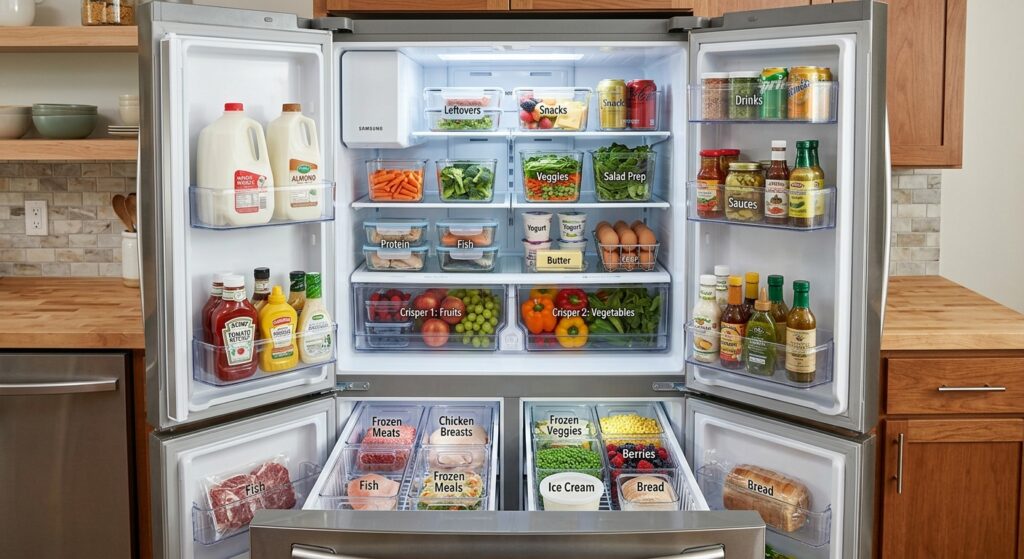
Here’s the system in one breath: store food by temperature zone — condiments in the door, dairy on the middle shelf, raw meat on the bottom, produce in the right crisper setting. Keep the fridge at 40°F or below, the freezer at 0°F, put new groceries behind old ones, and give every week a ten-minute reset. That’s it. No renovation, no matching container sets required.
I’ve organized enough fridges over the years — mine very much included — to know the truth about them.
It’s not that people are messy. It’s that fridges have zones, and almost nobody uses them.
Why Your Fridge Fights You Every Week
Think about how most of us load a fridge. Things go wherever there’s space at that moment.
Leftovers slide behind jars and disappear for nine days. Produce dies in a drawer nobody opens. You buy a second block of cheese because the first one is hiding somewhere in the back.
That hiding has a price. The USDA estimates 30–40% of the US food supply goes to waste, and households carry a big share of that through spoilage and forgotten food.
Your fridge is ground zero for a lot of it. Which also means it’s your best opportunity.
Check the Temperature First — Seriously
Before moving a single item, check your settings. Because here’s the thing: fridge dials lie.
The FDA recommends keeping your refrigerator at 40°F (4°C) or below and your freezer at 0°F (–18°C). Plenty of fridges run warmer than that straight out of the box, and those “1 through 7” dial numbers tell you roughly nothing.
A pair of cheap appliance thermometers costs about $10. They’ve caught warm-running fridges more than once in kitchens I’ve worked on, including one that was running near 46°F while everyone assumed all was fine.
Fix temperature before tidiness. Tidy bins don’t make unsafe food safe.
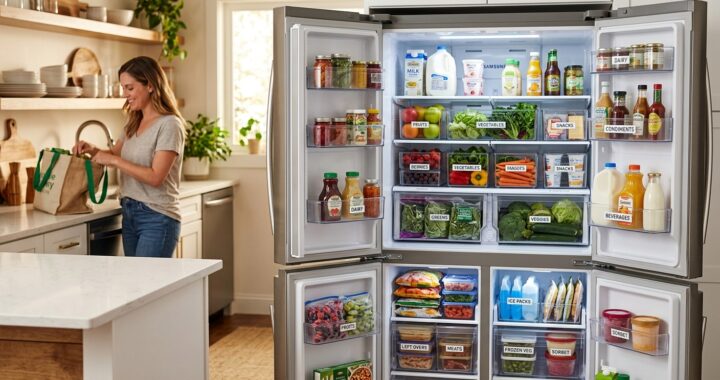
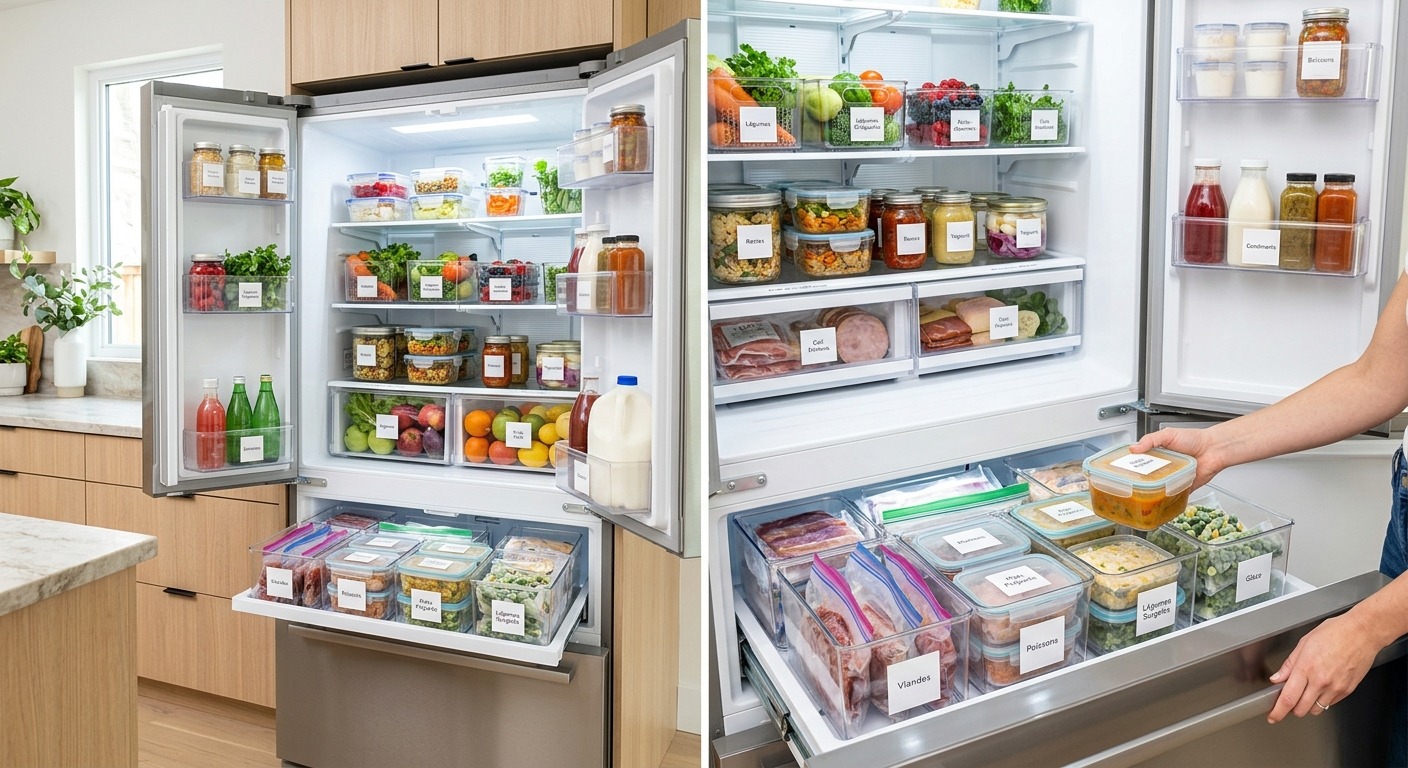
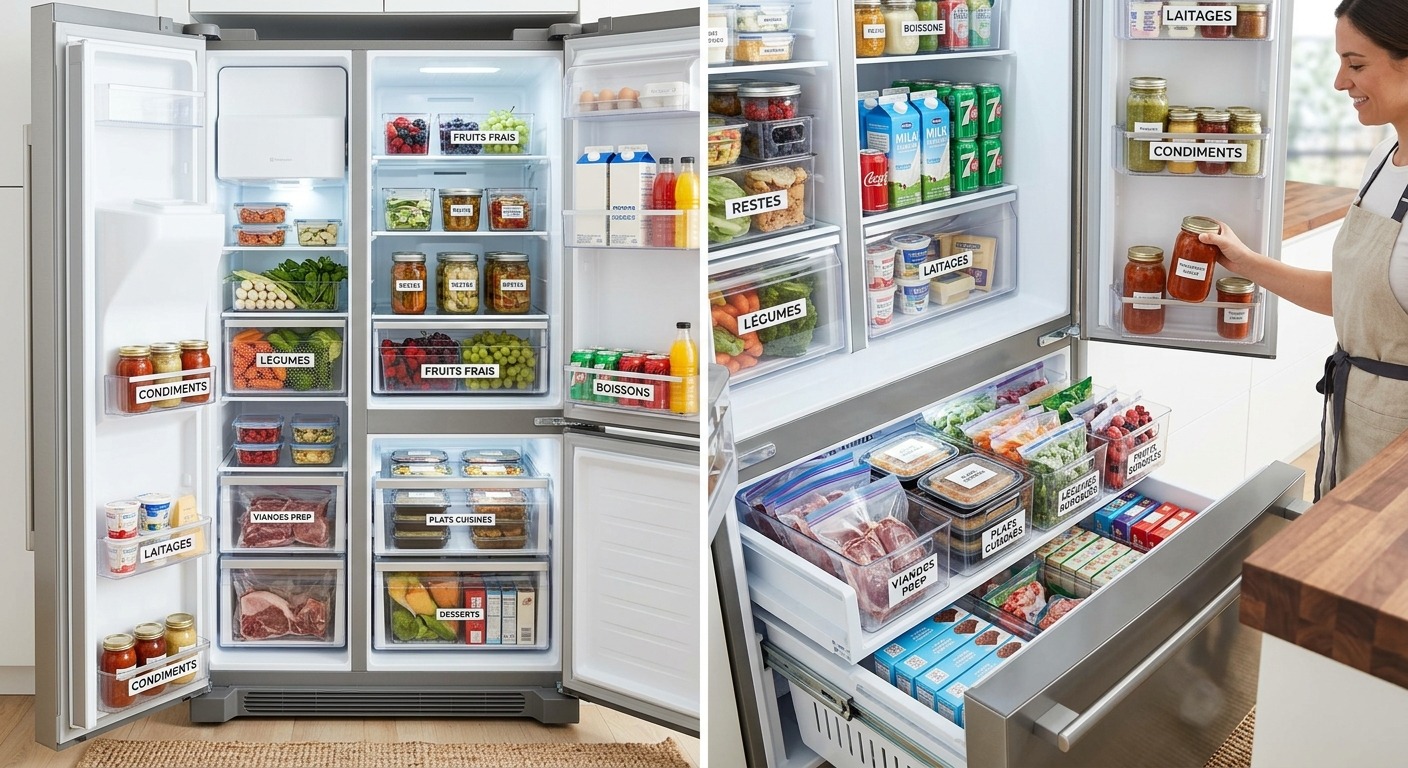
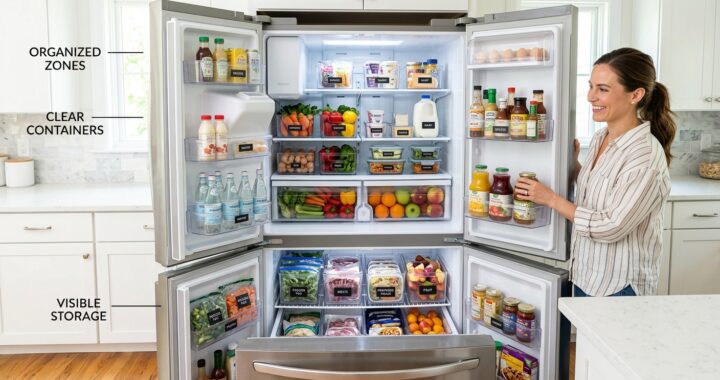
Zone It: Let Physics Do the Organizing
Cold air isn’t distributed evenly inside a fridge — some spots sit near freezing while the door swings warm every time someone opens it. Smart placement respects that map instead of fighting it.
| Zone | What It’s Actually Like | What Belongs There |
|---|---|---|
| Door | Warmest, constant temp swings | Condiments, juices, butter |
| Upper shelves | Fairly stable | Leftovers, drinks, ready-to-eat food |
| Middle shelves | Stable and visible | Dairy, eggs |
| Bottom shelf | Coldest spot | Raw meat and fish, kept on a tray |
| Crisper drawers | Humidity-controlled | Fruits and vegetables |
The raw-meat-on-the-bottom rule comes straight from food safety guidance — USDA advice puts raw proteins low precisely so drips can’t land on anything you’ll eat without cooking.
Notice what falls out of this layout: milk belongs in the middle, not the door. Ready-to-eat stuff lives where eyes find it first. Nothing risky ever sits above food eaten as-is.
Small changes. Big difference in how long your groceries last.
The Crisper Drawers Nobody Understands
Those little sliding vents on your drawers control humidity — they’re not decorative, even though most of us treated them that way for years.
One setting per type of produce:
- High humidity (vent closed): things that wilt — leafy greens, herbs, broccoli, carrots
- Low humidity (vent open): things that rot — apples, pears, avocados, stone fruit
In plain English: wilting plants want their moisture kept in, while rot-prone fruit gives off ethylene gas that needs to escape.
I ran my own drawer test with two identical bunches of greens, one in each setting. The difference after a week was almost embarrassing. Same fridge, same greens, different vent position — completely different outcomes.
Thirty seconds to set this correctly once. Weeks of longer-lasting produce afterward.
Clear Bins Are the Whole Secret
Fridge organizers get marketed as aesthetic upgrades. Forget aesthetics. Their actual job is visibility and grouping — keeping small items from migrating into the back black hole.
Four bins cover nearly everything:
- “Eat first” bin — front and center, holding whatever’s close to turning
- Leftover bin — one home, never scattered across shelves
- Snack bin — kid height if kids raid your fridge
- Deep lower-shelf bin — pull forward instead of reaching back
Label them if several people share the fridge. Labels do the nagging so no human has to.
Total damage: about $60, ninety minutes on a Saturday afternoon. The part people always mention afterward isn’t how it looks — it’s finally seeing what they own.
Rotate Stock Like a Grocery Store Does
Grocers rotate for a reason: First In, First Out means new groceries go behind old stock, so the oldest items sit up front where they’re actually used.
Pair rotation with a weekly triage:
| Item State | Action |
|---|---|
| Leftovers past 3–4 days | Toss them — per USDA guidance (3–4 days max) |
| Produce going soft | Move to “eat first,” cook or freeze tonight |
| Unopened extras | Bring forward to eye level |
| Mystery containers | Open and decide. No exceptions |
That leftover rule deserves its own sentence: the 3-to-4-day window is a safety guideline, not a suggestion. Past it, food goes out. Not “smell test first.” Out.
I learned why households need a hard rule here after watching one mystery container survive three weeks because everyone assumed someone else would deal with it. A labeled bin plus a deadline ended that standoff for good.
Freezers: Label Everything or Regret Everything
Freezers turn food anonymous. Anything frozen solid without a label becomes archaeology.
Three habits fix most freezers:
- Date and label everything. Mask tape plus marker — pennies.
- Freeze flat. Soups, sauces, and ground meat frozen flat in bags stack like books and thaw twice as fast.
- Group by type, ideally in labeled bins: meats together, vegetables together, breads together.
Rotation matters more in freezers, weirdly, because nothing visibly spoils. Oldest stock sits front and center; newest goes behind or underneath.
| Food | Best-Freezer Practice |
|---|---|
| Soup & sauce | Freeze flat in bags, file vertically like books |
| Bread | Slice first; toast straight from frozen |
| Raw meat | Portion into meal-size amounts before freezing |
| Berries | Tray-freeze first, then bag — no clumping |
Flat-freezing alone will change how you feel about your freezer. Stacked slabs beat lumpy boulders every single time.
Ten Minutes a Week Beats an Annual Deep Clean
Nobody wants to scrub a refrigerator four times a year. Good news: light weekly upkeep beats occasional heroics anyway.
Attach it to grocery day, while bags are already open on the counter:
- Scan for expired items while unloading — toss immediately
- Rotate new stock behind old
- Wipe one shelf or drawer, rotating through weekly
- Send strays back to their assigned bins
Ten minutes, done before the milk hits the shelf. When I compared this rhythm against monthly deep sessions, weekly won without a contest — small efforts stick around, marathons never do.
Save the full clean-out for before a big grocery trip, when the fridge is naturally empty.
Mistakes That Undo Everything
After opening a lot of struggling fridges, the same offenders keep showing up:
- Overfilling. Cold air needs to circulate; packed shelves create warm pockets.
- Milk in the door. Warmest zone, shortest life. Middle shelf, please.
- Raw meat above ready-to-eat food. Drip risk. Bottom shelf. Always.
- Treating best-before dates as expiration dates. Most indicate peak quality, not danger.
- Skipping the thermometer. Dials lie. Thermometers don’t.
And the big one — buying organizers before emptying anything. Declutter first, measure second, shop third. Same order as cabinets and pantries, every time.
What It Costs
Not much, if you stage it right:
| Item | Budget Route | Upgrade Worth Considering |
|---|---|---|
| Thermometers | Basic dial pair (~10)∣Digital( 10) | Digital (~10)∣Digital( 15–$20) |
| Clear bins | Dollar-store versions (3–3–3–5) | Stackable handled bins (~$10+) |
| Labels | Masking tape + marker | Erasable clip labels |
| Turntable | Basic lazy Susan (~$10) | Two-tier version |
Start with thermometers and four clear bins — call it $40. Live with it two weeks. Add pieces only where something still genuinely annoys you.
Buying less and observing longer has saved me from plenty of organizer regret. It’ll save you too.
Start Tonight, Before Dinner
Skip the grand plan. Do this in fifteen minutes tonight:
Open the fridge. Pull everything expired. Wipe the gap it left. Set an “eat first” bin front and center, loaded with whatever needs using soonest.
That single bin shifts behavior within days — softening vegetables get noticed, leftovers get claimed, the mystery-container era quietly ends.
Then spread the rest out: zones next weekend, freezer the one after. One focused session each, finished before dinner.
Six years of watching this play out has left me with one belief worth repeating: you don’t need a cleverer system than this.
You need this system, running, starting today.