Stop Losing Food: The Ultimate Fridge & Freezer System
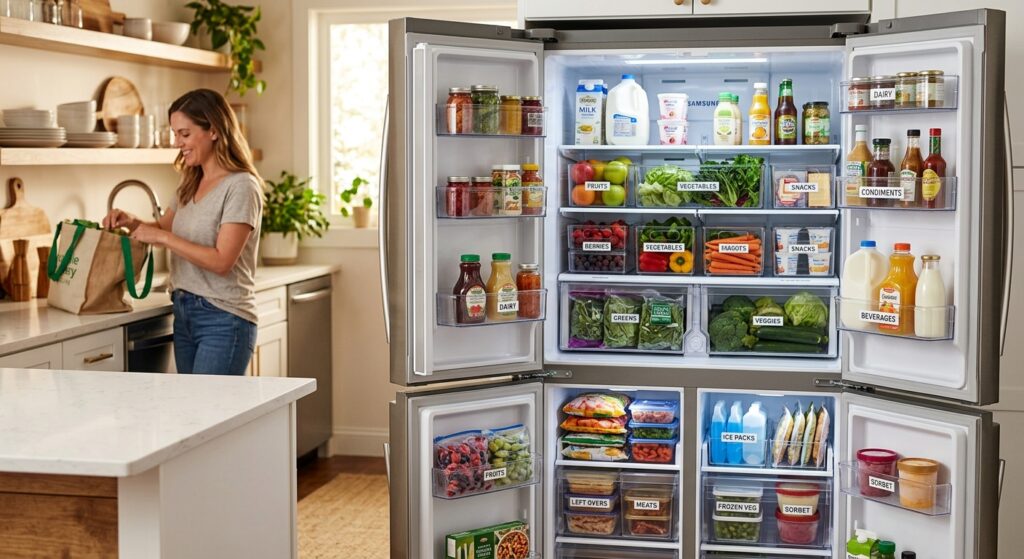
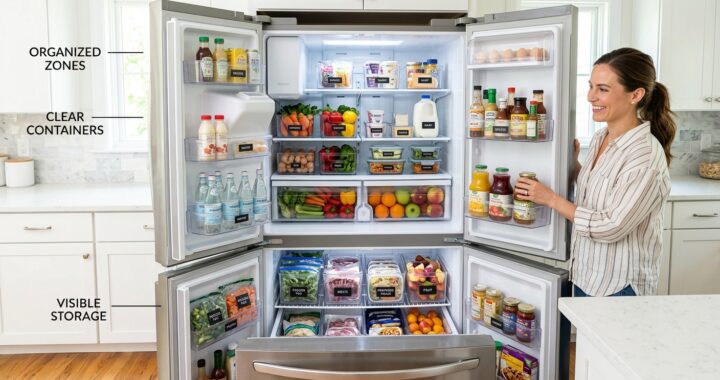
A well-organized refrigerator and freezer should make food easier to see, store, rotate, and reach without creating another chore.
Start with temperature and food safety.
Then, give every category a sensible home.
Finally, create a simple reset habit that keeps the system working.
You do not need a refrigerator that looks like a showroom.
You need one that makes sense when you open the door after a long day.
That means fewer hidden containers, fewer mystery packages, and less digging through cold shelves.
Start With a Clean, Powerful Reset
Before buying bins, turn your attention to what is already inside.
Work through one shelf or drawer at a time.
Take everything out, group similar foods, and check packaging as you go.
This gives you a much clearer picture of the space.
It also prevents one of the most common organization mistakes: buying storage products before understanding the inventory.
Check containers for leaks, damaged packaging, or obvious spoilage.
For questionable food, do not rely on organization tricks to make the decision for you.
The FDA recommends keeping refrigerators at 40°F (4°C) or below. FDA refrigerator thermometer guidance provides the official recommendation.
The freezer should remain at 0°F (-18°C).
Therefore, temperature comes before labels, bins, and aesthetics.
Give Every Shelf a Job
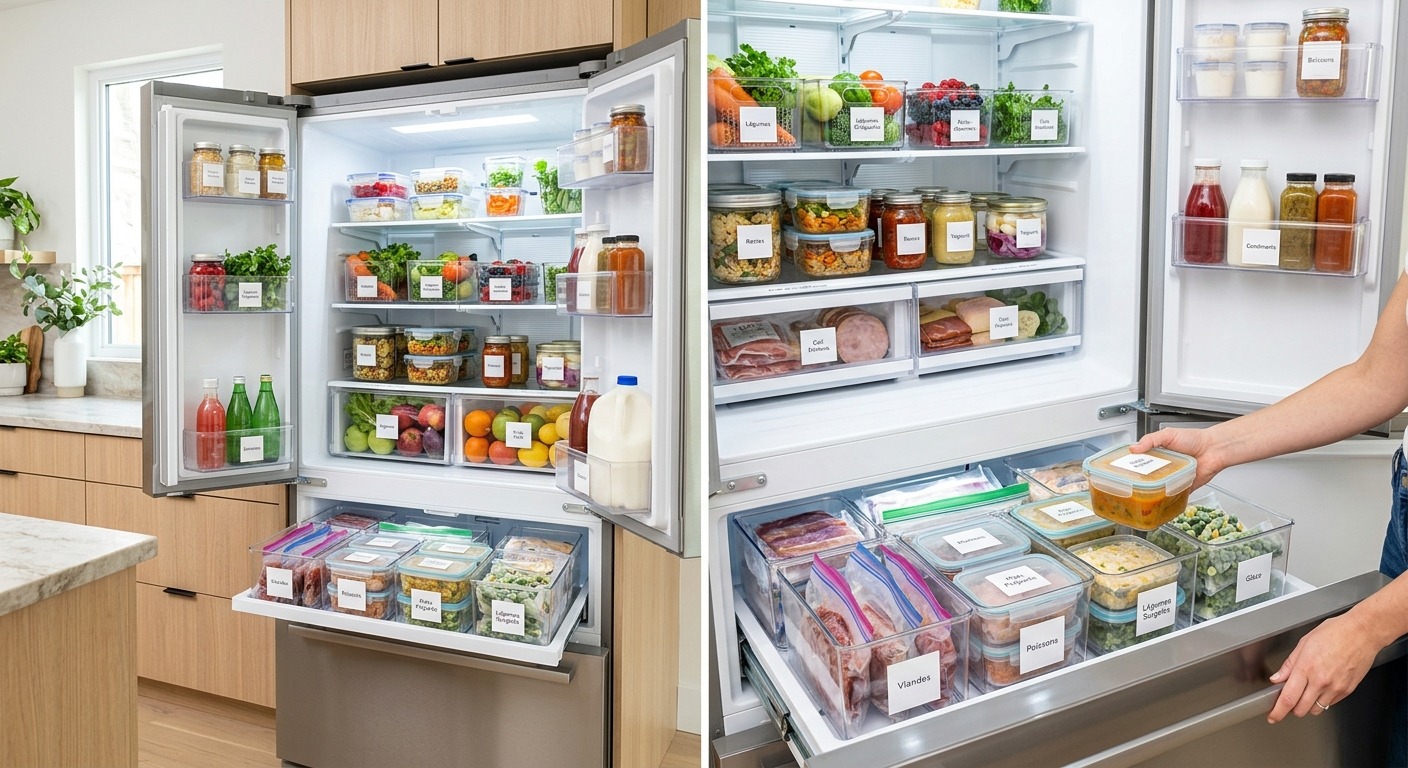
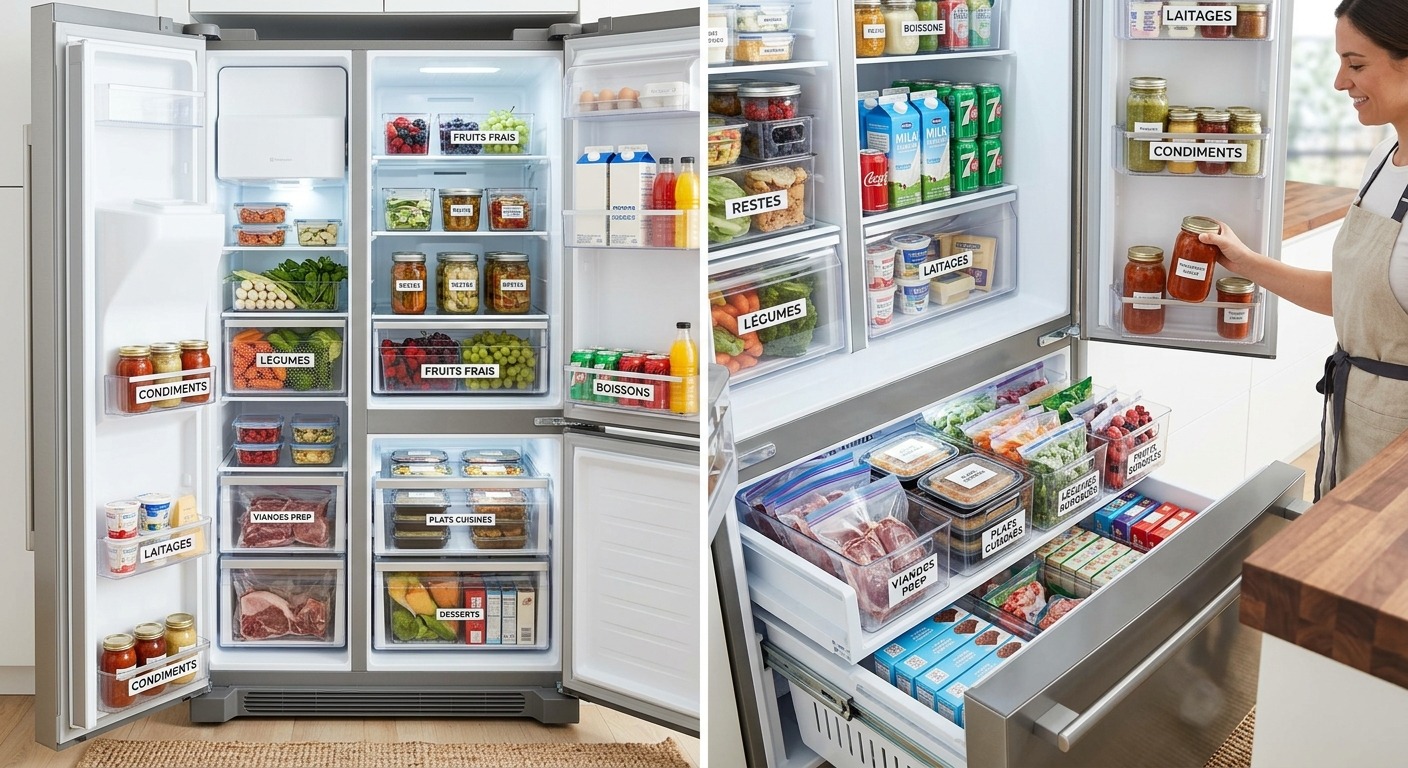
A refrigerator becomes easier to manage when each area has a purpose.
Your exact layout will depend on the appliance.
Still, broad zones can make the contents much easier to understand.
| Zone | Suitable focus | Organization goal |
|---|---|---|
| Upper shelves | Ready-to-eat foods and prepared items | Easy visibility |
| Lower shelves | Raw ingredients and foods needing colder storage | Separation |
| Drawers | Produce or designated foods | Category control |
| Door shelves | Suitable drinks and condiments | Convenient access |
| Leftover zone | Prepared foods | Fast rotation |
| Freezer | Frozen food categories | Clear inventory |
Do not force your refrigerator to copy someone else’s layout.
Instead, work with the shelves, drawers, and compartments you actually have.
Protect Cold Air With Smarter Placement
A refrigerator is not a cupboard with a cooling system.
Air needs to circulate around the food.
The FDA advises against packing a refrigerator so tightly that air cannot circulate effectively. FDA refrigerator guidance explains this point.
So, resist the urge to fill every empty corner.
Some empty space is useful.
It gives you room to see what is there and makes products easier to move.
That matters because organization should improve access rather than simply maximize capacity.
Stop Treating Every Shelf the Same
Different parts of a refrigerator can have different purposes.
However, your appliance manufacturer’s instructions should always take priority.
Keep frequently accessed products where they are easy to reach.
Then, use less convenient areas for products you rarely need.
Also, avoid creating huge stacks that hide everything underneath.
When the bottom container becomes invisible, the system has already started working against you.
Create a High-Visibility “Use Soon” Zone
One of the smartest refrigerator organization ideas is also one of the simplest.
Give foods that need attention soon a clearly visible location.
The FDA recommends creating a designated space for foods that may spoil within a few days. FDA food-waste guidance supports this approach.
That space does not need an expensive organizer.
A clearly defined shelf area can be enough.
The point is to make those foods harder to overlook.
This is especially useful for leftovers and opened products.
Instead of discovering them after everything else has been moved around, you see them immediately.
Make Your Inventory Easy to Read
Think of the refrigerator as a small inventory system.
Every item should tell you something about itself.
You should be able to see what it is, where it belongs, and whether it needs attention.
| Position | Meaning | What to do |
|---|---|---|
| Front | Needs attention soon | Check first |
| Middle | Normal inventory | Monitor |
| Back | Newer stock | Rotate later |
| Dedicated zone | Use-soon food | Review regularly |
Keep the system obvious.
If someone needs to ask what a particular bin means, the organization is probably too complicated.
Separate Raw Foods From Ready-to-Eat Foods
Refrigerator organization also has a food-safety job.
Raw meat, poultry, and seafood should be kept separate from ready-to-eat foods.
The FDA recommends preventing raw juices from contacting other foods. FDA meat, poultry, and seafood guidance provides the relevant safety advice.
Therefore, storage should reduce the chance of leaks reaching other products.
Sealed containers can help contain raw foods when appropriate.
Also, clean spills promptly.
The FDA recommends wiping refrigerator spills immediately and cleaning refrigerators regularly. FDA Listeria prevention guidance supports that practice.
A clean refrigerator is easier to organize, too.
Once spills and forgotten containers start accumulating, visibility disappears quickly.
Give Leftovers a Stronger System
Leftovers are easier to manage when they have a predictable home.
Instead of scattering containers across several shelves, create one recognizable area.
Then, use containers that make the contents easy to identify.
Large quantities of leftovers should be divided into shallow containers.
The FDA recommends shallow containers for quicker cooling. FDA refrigerator and food-safety guidance provides this recommendation.
Afterward, place the containers somewhere visible.
The USDA recommends using refrigerated leftovers within three to four days or freezing them for longer storage. USDA leftovers guidance provides that timeframe.
So, a visible leftover zone can make that timeline easier to manage.
Make Leftovers Impossible to Forget
Clear containers can help, but labels can matter just as much.
If you cannot immediately identify the contents, label the container.
Adding a date can also make rotation easier.
| Problem | Simple fix | Why it works |
|---|---|---|
| Mystery container | Label contents | Faster identification |
| Large quantity | Use shallow containers | Supports quicker cooling |
| Older leftovers | Place visibly forward | Easier rotation |
| Scattered containers | Create one zone | Less searching |
You do not need elaborate labels.
A simple description and date can be enough.
Organize Your Freezer Like Inventory
Freezers have one particular weakness: everything looks permanent.
A package pushed to the back can disappear for months.
Then, another package gets added.
Before long, you have a frozen pile instead of an inventory.
The solution is to create recognizable freezer categories.
Group similar foods together.
Then, organize packages vertically when your freezer design allows it.
This makes individual products easier to identify.
Build Clear Freezer Zones
| Freezer section | Suggested category | Organization priority |
|---|---|---|
| Section one | Prepared foods | Visibility |
| Section two | Meat and poultry | Separation |
| Section three | Frozen vegetables | Easy grouping |
| Section four | Frozen fruit | Quick access |
| Section five | Ingredients | Inventory control |
| Section six | Long-term items | Clear labeling |
The exact categories are up to you.
The principle stays the same: similar products should be easy to find together.
Label Frozen Food Before It Disappears
Freezer organization becomes dramatically easier when packages remain identifiable.
Label homemade frozen food with the contents.
Add the date when it helps you manage rotation.
Then, keep labels facing outward whenever possible.
The USDA states that food kept continuously frozen at 0°F (-18°C) remains safe indefinitely, although quality can decline over time. USDA freezer-storage guidance explains the difference between safety and quality.
That distinction is useful.
Freezing does not mean quality remains unchanged forever.
Therefore, good organization should help you manage both safety and quality.
Rotate Before You Add
When new frozen products arrive, resist the instinct to push older items deeper.
Bring older packages forward instead.
Then, place newer products behind them.
That creates a simple rotation system without requiring complicated software or inventory sheets.
The first time I tried organizing a freezer this way, the biggest improvement came from seeing everything at once.
The freezer stopped feeling like storage space and started behaving like organized inventory.
Make the Refrigerator Door Work Harder
The door is convenient, but convenience does not make every food suitable for door storage.
Follow your appliance manufacturer’s instructions.
Then, use door shelves for products appropriate to that location.
Keep temperature-sensitive foods in suitable interior areas.
This is another reason not to copy a refrigerator organization photo blindly.
The appliance design matters.
So does the food.
A beautiful arrangement is irrelevant if it ignores storage requirements.
Create a Lean Weekly Reset
A refrigerator does not need a massive monthly makeover.
Instead, create a short reset that catches problems before they pile up.
Start by scanning the shelves.
Then, check the use-soon zone.
Next, rotate older products.
Afterward, return misplaced items.
Finally, wipe visible spills.
The FDA recommends checking refrigerators regularly to keep track of food and what should be used. FDA food-waste guidance supports regular inventory checks.
Use a Simple Reset Framework
| Step | Question | Action |
|---|---|---|
| Scan | What needs attention? | Move it forward |
| Check | What do I already have? | Identify duplicates |
| Rotate | What is older? | Bring it forward |
| Clean | Is anything leaking? | Clean promptly |
| Reset | Does everything have a home? | Reposition it |
| Review | What should be used soon? | Keep visible |
The reset should be short.
If it feels like another household project, simplify it.
Avoid These Expensive Organization Mistakes
Some refrigerator organization ideas create more work than they remove.
First, do not pack shelves so tightly that visibility disappears.
Second, do not buy organizers before measuring the available space.
Third, do not hide leftovers behind tall containers.
Fourth, do not create a complicated category system nobody follows.
Finally, do not confuse a beautiful refrigerator with an effective one.
A refrigerator can look minimal while still being frustrating to use.
Meanwhile, a slightly imperfect refrigerator can work extremely well.
The difference is whether the system makes food easy to find.
Keep Food Safety at the Center
Organization cannot compensate for an unsafe temperature.
Keep the refrigerator at 40°F (4°C) or below.
Keep the freezer at 0°F (-18°C).
The FDA recommends using appliance thermometers because refrigerator controls may not show the actual internal temperature. FDA thermometer guidance explains why independent temperature monitoring matters.
Also, refrigerate or freeze perishables, prepared foods, and leftovers within two hours.
The FDA recommends reducing that window to one hour when temperatures exceed 90°F (32°C). FDA chilling guidance provides the official guidance.
These rules belong at the foundation of your organization system.
Keep the Core Rules Visible
| Storage point | Recommended standard | Priority |
|---|---|---|
| Refrigerator | 40°F / 4°C or below | Monitor |
| Freezer | 0°F / -18°C or below | Monitor |
| Perishables | Refrigerate promptly | Limit room-temperature exposure |
| Leftovers | Use within recommended timeframe | Track storage |
Temperature should never become an afterthought.
A beautifully organized refrigerator still needs to keep food safely cold.
Turn Cold Storage Into Better Kitchen Operations
A refrigerator is more than a place where food waits.
It is where groceries arrive, leftovers accumulate, ingredients move through the kitchen, and forgotten products eventually become waste.
That makes visibility valuable.
The FDA estimates that 30% to 40% of food in the United States goes uneaten. FDA food-loss and waste information provides the national estimate.
That number does not prove organization alone prevents food waste.
However, the FDA recommends regular refrigerator checks and designated spaces for food that needs attention. FDA food-waste guidance supports those practical habits.
So, organization can play a useful role without promising more than the evidence supports.
Build Around Six Strong Principles
| Principle | Practical rule |
|---|---|
| Visibility | Keep food easy to identify |
| Temperature | Monitor refrigerator and freezer temperatures |
| Separation | Keep raw foods away from ready-to-eat foods |
| Rotation | Move older products forward |
| Cleanliness | Address spills promptly |
| Maintenance | Reset the system regularly |
These principles are simple deliberately.
A system that requires constant explanation is unlikely to remain useful.
Finish With a Refrigerator System That Stays Sharp
Refrigerator and freezer organization works best when it follows real kitchen behavior.
Start with temperature.
Then, create broad and recognizable zones.
Next, separate raw foods from ready-to-eat products.
Afterward, give leftovers and soon-to-expire foods a visible home.
Finally, rotate inventory during a short regular reset.
The best question to ask is simple:
Can you understand what is inside within a few seconds of opening the door?
If you can, the organization is working.
You do not need another collection of matching bins.
Instead, you need clear zones, visible inventory, sensible rotation, and safe temperatures.
That is the real payoff.
Your refrigerator should make the kitchen easier to run, not give you another system to manage.