How to Create a Kitchen That Stays Organized
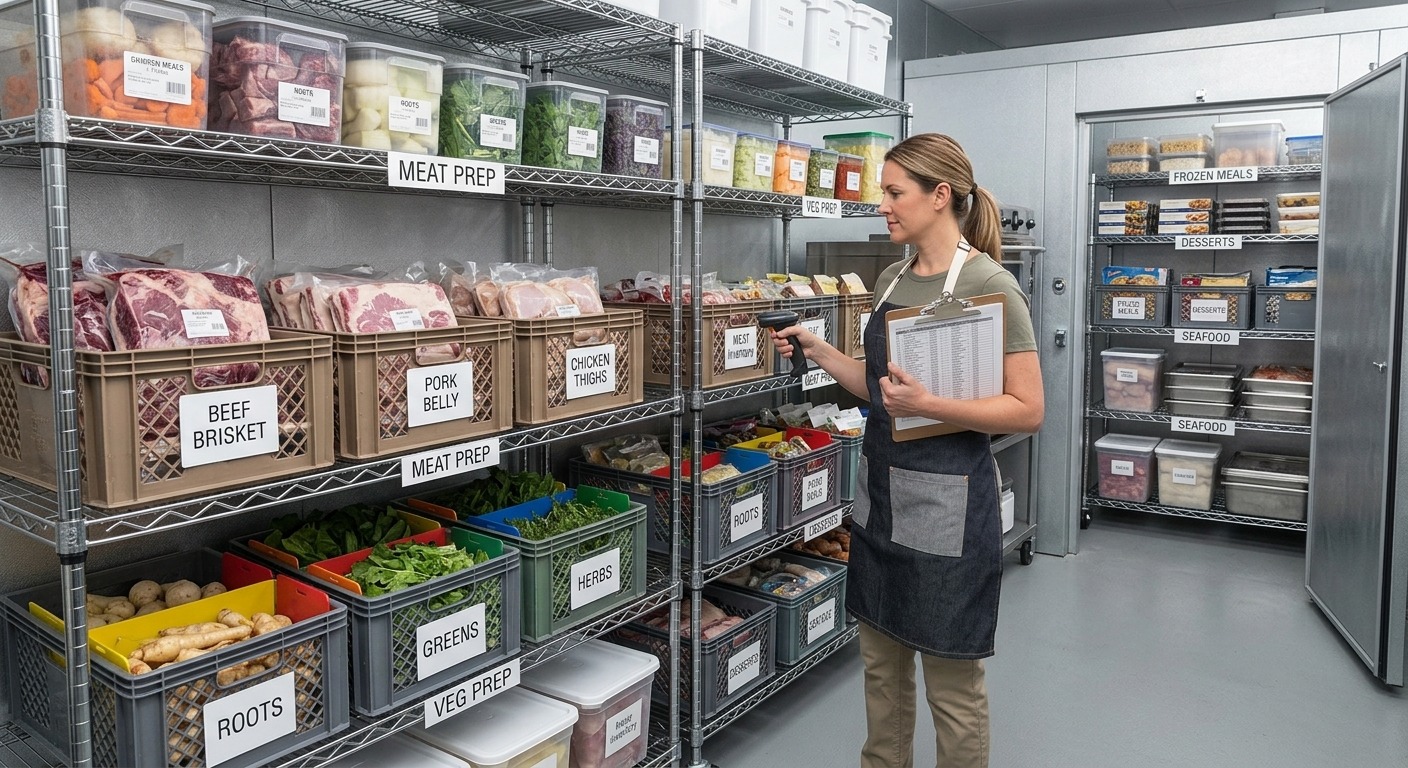
The best refrigerator and freezer organization system is simple: give food a clear place, keep older items visible, and make the layout easy to maintain.
You do not need twenty matching containers or a refrigerator that looks like a showroom.
You need a setup that makes sense when you are tired, rushing, or unloading groceries with one hand.
When I tested this last month, I realized something pretty quickly: most refrigerator clutter starts with a bad layout, not too much food.
Once the layout works, keeping it organized becomes much easier.
Start With a Strong Refrigerator Reset
Before buying a single organizer, take everything out.
Yes, everything.
It is much easier to see what is actually happening when you are not trying to organize around half-empty jars and forgotten containers.
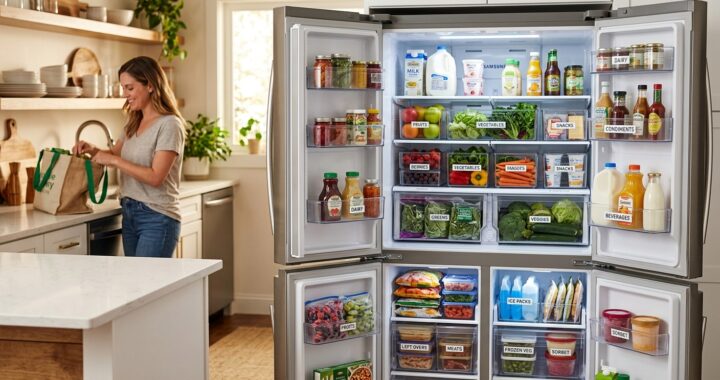
Put similar foods together on the counter.
Then wipe down the shelves, drawers, and any obvious spills before putting things back.
At this point, do not worry about making the refrigerator beautiful.
Instead, ask a simpler question: Where would I naturally look for this food?
That answer should guide your zones.
| Refrigerator zone | What belongs there | Organization idea |
|---|---|---|
| Everyday foods | Breakfast items, snacks, prepared foods | Keep them easy to reach |
| Produce | Fresh fruits and vegetables | Group them by drawer or type |
| Raw foods | Meat, poultry, seafood | Keep sealed and separated |
| Condiments | Sauces, spreads, dressings | Keep bottles together |
There is no universal shelf arrangement that works for every refrigerator.
Appliances differ, families eat differently, and your storage needs will change from week to week.
So, build around your habits instead of copying a picture from Pinterest.
That approach has always worked better for me.
Keep Food Safety at the Center
Organization is useful, but food safety comes first.
The FDA recommends keeping your refrigerator at 40°F or below and your freezer at 0°F or below.
A small appliance thermometer can help because the number on your refrigerator dial may not reflect the actual temperature.
Also, do not pack the refrigerator so tightly that cold air cannot circulate.
The FDA specifically advises against overpacking refrigerators for this reason.
That is one reason I prefer leaving a little breathing room between containers.
It may look less dramatic than a completely packed shelf, but it makes the refrigerator easier to manage.
Raw meat, poultry, and seafood deserve extra attention.
Keep them sealed and positioned so juices cannot drip onto foods that are ready to eat.
That small detail can make a big difference in preventing cross-contamination.
Create Zones That Actually Make Sense
Once everything is clean, start putting food back.
I recommend thinking in broad categories rather than creating a complicated system for every individual ingredient.
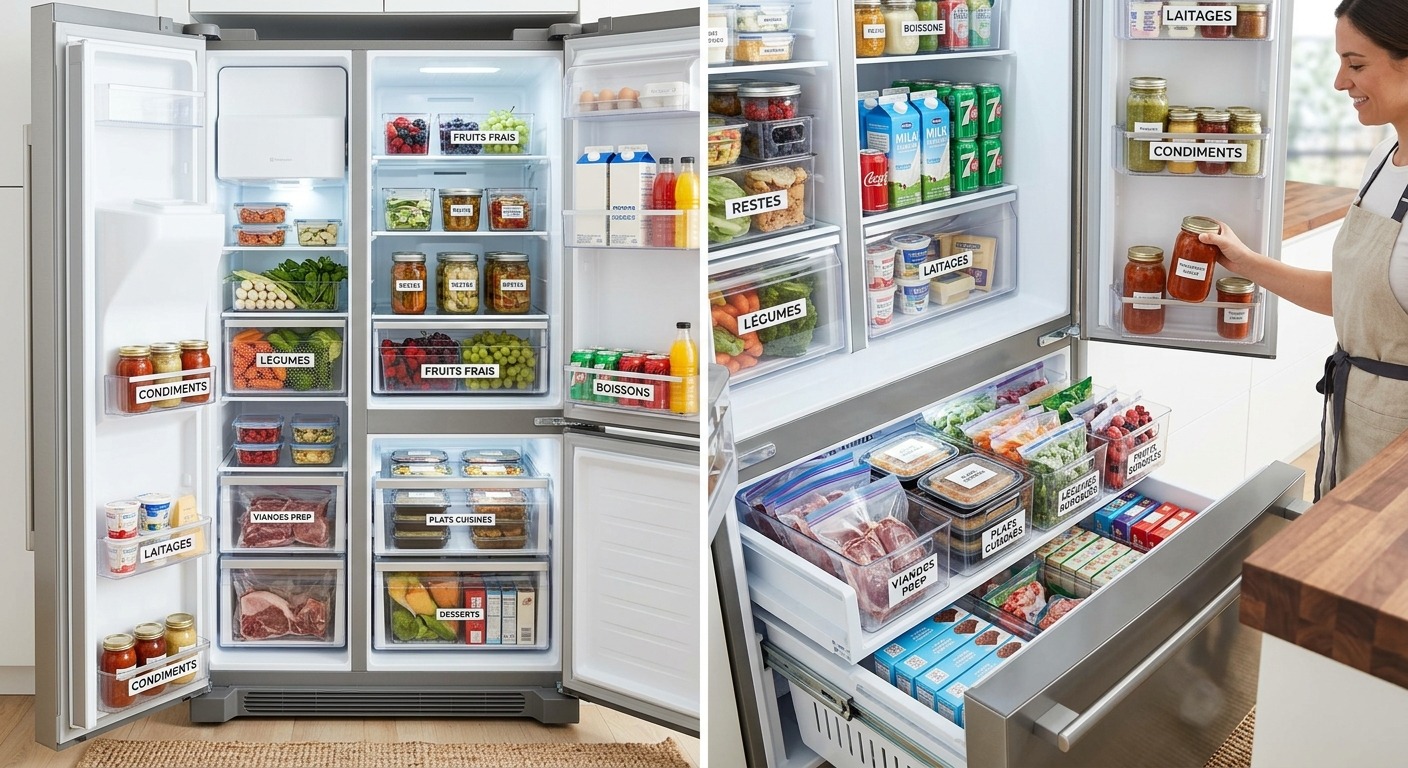
For example, keep frequently used foods together.
Keep produce grouped.
Keep condiments together.
Keep raw foods contained and separated.
That is enough structure for most kitchens.
The first time I tried creating a very detailed refrigerator system, it lasted about a week.
There were too many rules.
Eventually, nobody remembered where anything belonged.
Now I aim for something much simpler.
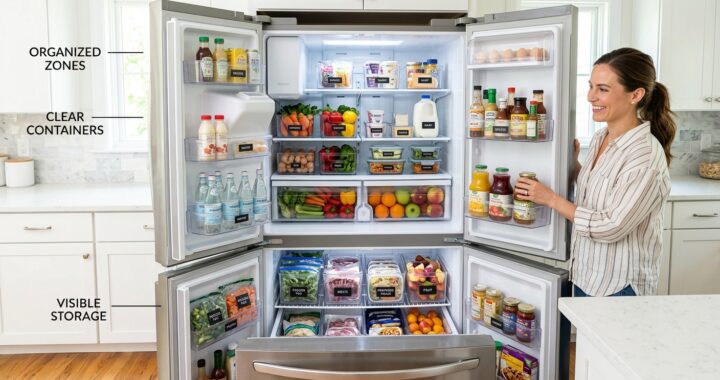
If someone opens the refrigerator and can immediately understand the layout, the system is probably working.
Make Your Refrigerator Easier to See
Visibility is one of the most underrated parts of refrigerator organization.
If food disappears behind taller containers, you eventually forget that it exists.
Then you buy more.
Then the refrigerator gets crowded.
Then something gets pushed farther into the back.
You probably know where that cycle ends.
So, keep smaller items toward the front whenever possible.
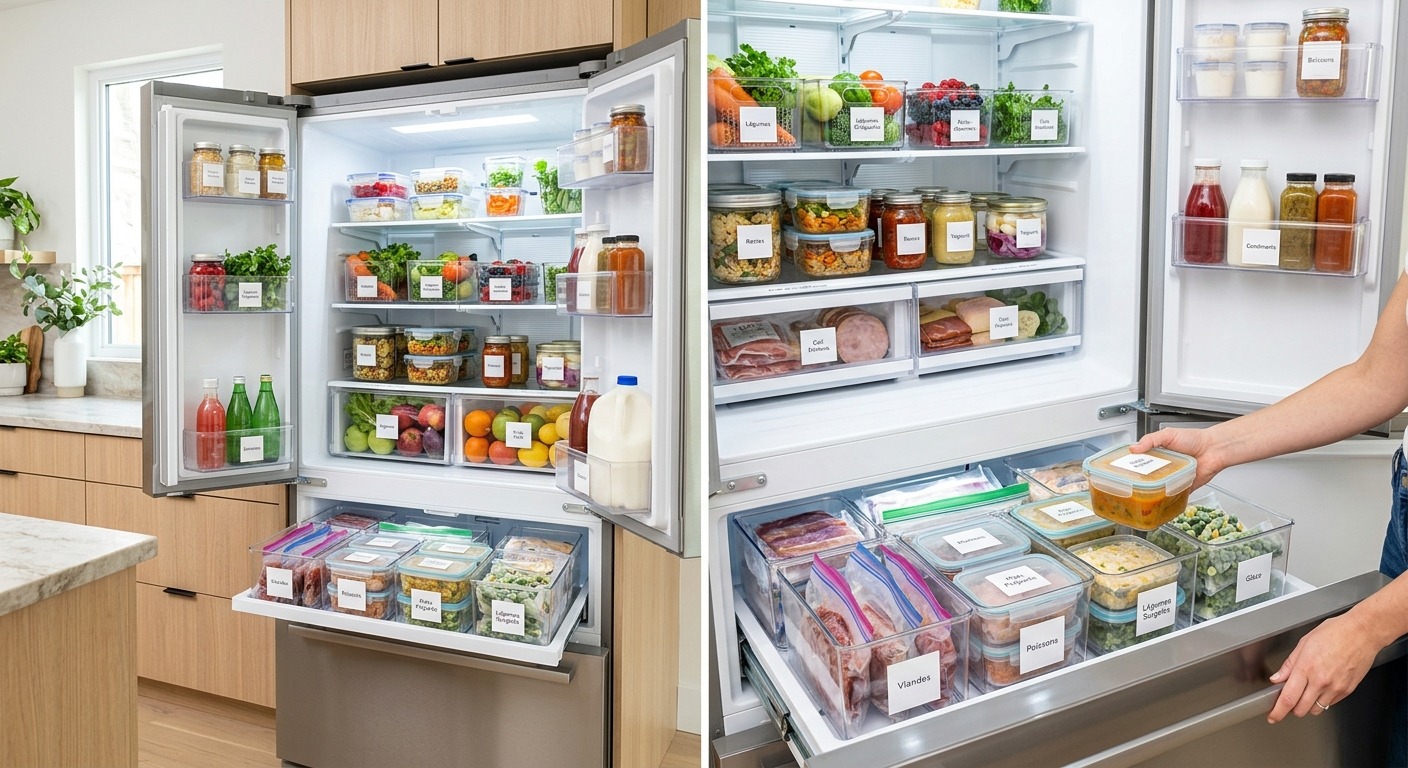
Use clear containers when they genuinely improve visibility.
And avoid stacking food so high that you cannot see what is underneath.
When I tested clear refrigerator bins, I liked them for one reason more than anything else: I could see what I had without pulling everything out.
That saved time.
However, not every refrigerator needs a collection of bins.
If a shelf already works well, leave it alone.
An organizer should solve a problem.
If it does not, it is just another thing to clean.
Choose Containers That Actually Earn Their Space
There is a temptation to buy organizers first and figure out what to do with them afterward.
I would do the opposite.
First identify the annoying problem.
Then buy the container.
For example, a bin can make sense when small packages constantly spread across a shelf.
A tray can help when bottles are difficult to keep together.
A sealed container can protect other foods from leaks.
Meanwhile, a clear freezer container can make stacked meals easier to identify.
The FDA recommends keeping refrigerated foods covered or stored in sealed bags or containers.
So, good containers can serve both organizational and food-safety purposes.
Just do not fill every container to the top.
You still need enough room to remove things without creating an avalanche.
Give Your Freezer a Better System
Freezer organization deserves its own strategy.
The biggest problem is usually not space.
It is visibility.
Food gets stacked.
Packages get buried.
Labels disappear.
Then six months later, you discover something you completely forgot about.
I prefer grouping freezer foods into broad categories.
| Freezer category | Storage approach | Label |
|---|---|---|
| Prepared meals | Stackable containers | Name and date |
| Meat and poultry | Flat packages | Item and date |
| Frozen vegetables | Upright grouping | Type |
| Baking ingredients | Dedicated section | Ingredient |
Flat packages are particularly useful because they are easier to stack and identify.
Where your freezer design allows it, vertical storage can also make packages easier to see.
The key is creating enough separation that you can find something without emptying half the freezer.
Label Food Before You Forget What It Is
Freezer labels do not need to look fancy.
They need to be readable.
Write the food name and the date.
That is usually enough.
For leftovers, I find a simple date label particularly helpful.
You do not have to remember when you cooked something three days ago.
The label does the remembering for you.
The USDA recommends using refrigerated leftovers within 3 to 4 days.
For frozen foods, storage recommendations often focus on quality rather than safety when food remains continuously frozen at 0°F.
The FDA explains that freezing at 0°F keeps food safe indefinitely, although quality can decline over longer periods.
That is why I see freezer labels as a rotation tool, not an artificial expiration system.
Put Older Food Where You Can See It
This is one of those small habits that makes the entire system work better.
When you bring home new groceries, put the older items toward the front.
Then put the newer items behind them.
Simple.
There is no app required.
There is no complicated spreadsheet.
You are simply making the next food choice easier.
My clients keep asking me how to stop food from getting lost in the back of the refrigerator.
Usually, the answer is not another organizer.
It is better rotation.
The FDA also recommends checking your refrigerator regularly and using or freezing foods before they need to be discarded.
That makes a quick weekly check surprisingly valuable.
Give Leftovers a Dedicated Home
Leftovers tend to create refrigerator chaos because they arrive unexpectedly.
One day you have an empty shelf.
The next day, you have three containers of pasta, half a casserole, and a bowl nobody remembers making.
Give leftovers a visible area.
That does not mean you need an entire shelf.
Even one clearly defined section can help.
Use shallow containers for larger quantities because the USDA recommends dividing large amounts of leftovers into shallow containers for quicker cooling.
Then label them.
That little bit of structure makes leftovers much easier to manage.
Do Not Ignore the Refrigerator Door
The refrigerator door is convenient, but convenience does not mean every food belongs there.
Use the door for items that your appliance and food-storage guidance indicate are suitable there.
Condiments and similar products are often easier to manage in door shelves.
However, avoid treating the door as your overflow area.
If you keep cramming things into it because the main shelves are full, that is usually a sign that the refrigerator needs a reset.
Take a few minutes to remove expired or unwanted items.
Then reorganize what remains.
Sometimes the solution is simply getting rid of things you no longer use.
Build a Five-Minute Weekly Reset
This is the part that keeps the whole system alive.
You do not need to empty the refrigerator every Saturday morning.
Instead, do a quick scan.
Look for forgotten food.
Move older items forward.
Check leftovers.
Wipe up spills.
Return anything that has migrated into the wrong zone.
| Weekly check | What to look for | Quick action |
|---|---|---|
| Visibility | Hidden food | Move it forward |
| Rotation | Older items | Use first |
| Cleanliness | Spills | Wipe immediately |
| Space | Crowded shelves | Remove or relocate items |
When I tested this approach last month, the weekly reset took far less time than the big cleanouts I used to do.
That is the real advantage of a good organization system.
It reduces the size of the problem before the problem becomes annoying.
Avoid These Refrigerator Organization Traps
A few habits make refrigerator organization harder than it needs to be.
First, do not buy containers before measuring your shelves.
Second, do not organize food so tightly that you cannot remove one item without moving five others.
Third, do not create categories that nobody in the household will remember.
Fourth, do not sacrifice food safety for aesthetics.
The FDA recommends keeping cold air circulating and wiping refrigerator spills promptly.
So, the perfectly packed refrigerator is not necessarily the best-organized refrigerator.
Sometimes, a little empty space is exactly what the system needs.
Make Your Freezer Easier to Maintain
Freezers need occasional attention because frozen food tends to disappear from sight.
Once a month, take a quick look at what is hiding underneath or behind everything else.
Bring older items toward the front.
Group similar foods.
Combine partially used packages when appropriate.
And label anything you know you will not immediately recognize later.
I wasted two hours on this before realizing that my freezer problem was not really a lack of space.
It was poor visibility.
Once I could see everything, the freezer suddenly felt bigger.
That is a useful lesson for almost any kitchen organization project.
Keep the System Simple Enough to Repeat
The best organization system is rarely the most impressive one.
It is the one you can maintain.
If putting groceries away takes fifteen minutes because every item has a very specific location, you may eventually stop following the system.
Instead, give yourself some flexibility.
Use broad zones.
Keep frequently used items accessible.
Label what needs labeling.
Rotate older food forward.
Clean small spills before they become bigger jobs.
That is enough.
A Simple Refrigerator & Freezer Organization Checklist
Use this quick check whenever the kitchen starts feeling cluttered:
- Check the refrigerator and freezer temperatures.
- Move older suitable foods forward.
- Label leftovers and freezer meals.
- Remove food that should no longer be kept.
- Group similar items.
- Clean visible spills.
- Check whether containers still help.
- Leave enough room for cold-air circulation.
The system should make these tasks easier, not create another project.
The Real Goal of Refrigerator Organization
A well-organized refrigerator is not about matching containers or creating an Instagram-worthy shelf.
It is about making the next decision easier.
You should be able to open the door and quickly understand what you have.
You should know where leftovers belong.
You should see what needs to be used first.
And you should be able to put groceries away without rearranging the entire refrigerator.
That is the standard I use now.
When I organize a refrigerator, I care much less about whether every container matches.
I care about whether the system still works two weeks later.
Because that is where most organization projects fail.
They look fantastic on day one.
Then real life happens.
A grocery delivery arrives.
Dinner creates leftovers.
Someone puts a bottle in the wrong place.
And suddenly the beautiful system disappears.
A better approach is simpler.
Create clear zones.
Keep food visible.
Label what matters.
Rotate older items forward.
Protect safe temperatures and food separation.
Then give the refrigerator a few minutes of attention each week.
That is how refrigerator and freezer organization becomes part of kitchen organization rather than another chore you have to keep restarting.