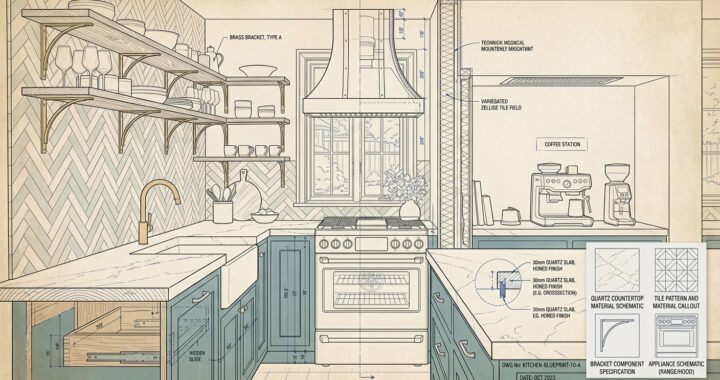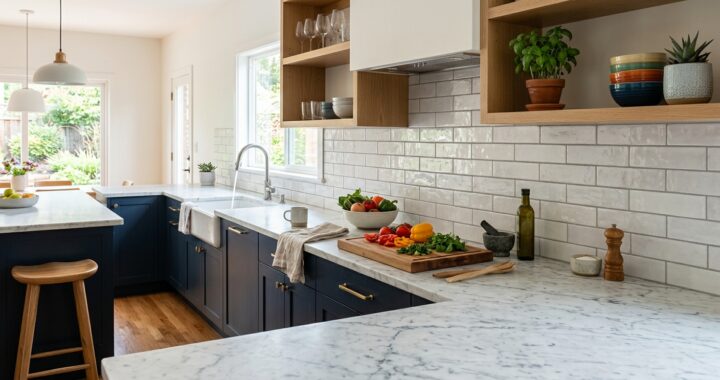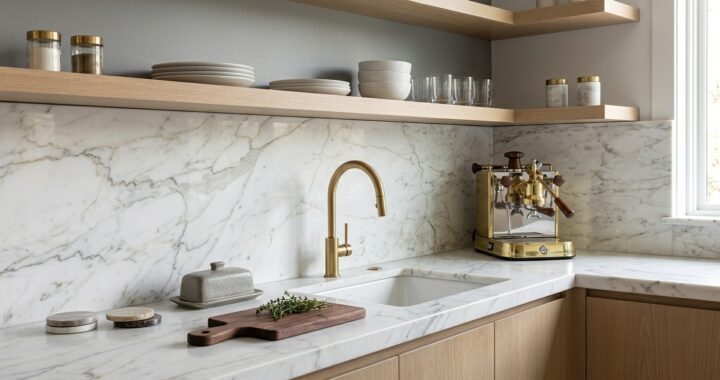
Smart Kitchen Upgrades That Look Expensive

The best countertop and backsplash decisions start with the same four checks: function, measurements, maintenance, and total installed cost.
Then, choose finishes that work together rather than shopping for each surface separately.
Countertops carry the daily workload.
Meanwhile, backsplashes protect walls and shape the kitchen’s visual character.
So, treat them as one design decision with two jobs.
According to Houzz’s 2026 U.S. Kitchen Trends Study, 91% of renovating homeowners upgraded countertops.
Meanwhile, 85% upgraded backsplashes.
Those figures come from a survey of 1,780 U.S. homeowners, so they describe surveyed renovation behavior.
When I assess a surface plan, I start with practical constraints before getting attached to colors.
That order keeps a beautiful sample from becoming an expensive mistake.
Start Strong: Audit the Kitchen Before Choosing Surfaces
First, inspect the cabinets supporting the countertop.
Then, check the walls receiving the backsplash.
Look for uneven areas, damage, awkward corners, outlets, windows, and appliance conflicts.
Also, confirm the sink and appliance models before fabrication begins.
| Check first | Why it matters | Confirm before ordering |
|---|---|---|
| Cabinet condition | Countertops need suitable support | Stability and level |
| Counter dimensions | Fabrication follows exact measurements | Final field measurements |
| Wall condition | Affects backsplash installation | Repairs and flatness |
| Sink model | Controls countertop cutout | Exact model and size |
| Appliance locations | Affect surrounding details | Final specifications |
However, rough measurements should not become final fabrication dimensions.
Instead, have the appropriate fabricator or installer confirm the measurements.
When I build a renovation checklist, measurements become the first gate.
Everything else passes through that gate afterward.
Choose a Countertop Material With Confidence
There is no universally perfect countertop material.
Instead, compare appearance, care requirements, fabrication, installation, and the manufacturer’s instructions.
Houzz’s 2025 kitchen research found engineered quartz at 39% among selected countertop materials.
Granite followed at 19%, while quartzite reached 11%, according to Houzz.
Those figures describe surveyed choices, not a ranking of material quality.
| Material | What to consider | Budget question |
|---|---|---|
| Engineered quartz | Consistent appearance and product-specific care | What is the complete installed price? |
| Granite | Natural variation and manufacturer care | Does the selected product require sealing? |
| Quartzite | Natural-stone character and maintenance | What care does this exact slab require? |
| Wood | Warm appearance and maintenance | What finish and upkeep are specified? |
| Porcelain | Product-specific fabrication requirements | Who will fabricate and install it? |
Therefore, compare exact products rather than relying on material labels alone.
Different products can carry different maintenance instructions.
My clients often ask which material is best.
I prefer a better question: which material fits the kitchen’s priorities?
That answer usually produces a sharper shortlist.
Create a Striking Island Without Overcomplicating It
An island can introduce contrast without making the whole kitchen feel busy.
However, the strongest contrast usually has a clear visual reason.
Houzz reports that 21% of renovating homeowners choose a different island countertop surface.
Among those contrasting islands, butcher block or wood slabs lead at 44%.
Engineered quartz follows at 18%, while granite reaches 12%, according to Houzz’s 2026 findings.
So, use those numbers as context rather than a design commandment.
If the perimeter countertop has dramatic movement, a quieter island can restore balance.
Conversely, a restrained perimeter can support a stronger island surface.
When I compare contrasting materials, I choose one obvious focal point.
Then, I let surrounding finishes support it.
Give the Backsplash a Powerful Job
A backsplash does more than occupy the wall between cabinets and counters.
It can protect selected areas while establishing color, texture, pattern, and rhythm.
Tile remains the leading choice.
According to Houzz’s 2025 backsplash research, 76% of renovating homeowners selected tile.
Ceramic represented 34%, while porcelain reached 17%.
Engineered quartz represented 10%, while quartzite reached 8%.
| Backsplash direction | Visual character | Planning priority |
|---|---|---|
| Ceramic tile | Flexible and familiar | Coordinate tile and grout |
| Porcelain tile | Broad design range | Confirm installation requirements |
| Quartz slab | Continuous appearance | Coordinate fabrication carefully |
| Quartzite slab | Natural variation | Confirm care requirements |
However, material is only half the decision.
You also need to decide where the backsplash begins and ends.
That choice affects quantities, labor, proportions, and transitions.
Build a Winning Countertop-and-Backsplash Pairing
Matching every finish exactly can make a kitchen feel overly uniform.
On the other hand, making every surface different can create visual noise.
Instead, let one surface lead and let the other support it.
Houzz found white countertops were selected by 41% of renovating homeowners, while off-white reached 23%.
White and off-white together accounted for 57% of selected backsplash colors, according to Houzz’s 2025 research.
Those figures describe preferences among survey respondents.
They do not prove neutral finishes are automatically superior.
When I compare samples, I check them under the room’s actual lighting.
Then, I place them beside the cabinets.
Make Grout Part of the Design
Grout changes how tile patterns read.
A contrasting grout can emphasize individual tile shapes.
Meanwhile, a similar grout color can create a quieter field.
Therefore, choose grout alongside the tile rather than afterward.
Also, follow the selected product’s instructions for joint width, cleaning, sealing, and curing.
When I compare tile combinations, I review the entire sample board together.
That makes the finished direction much easier to judge.
Unleash Drama With a Slab Backsplash
Slab backsplashes create a different visual effect from individual tiles.
Instead of repeated joints, they present a larger continuous surface.
According to Houzz’s 2026 kitchen findings, tile remained dominant at 72%, while slab-style backsplashes reached 28%.
Engineered quartz led the slab category at 39%, followed by quartzite at 33%.
So, slab surfaces are significant, but they remain less common than tile.
However, fabrication and installation require careful coordination.
Measure the wall accurately.
Then, confirm slab dimensions and outlet locations.
Next, plan corners, windows, seams, and appliance relationships.
Finally, confirm care requirements for the exact surface.
Extend Backsplash Coverage With Purpose
A backsplash can stop at the cabinets.
Alternatively, it can continue toward a range hood or ceiling.
However, extra coverage changes both material quantities and installation requirements.
According to Houzz’s 2025 Kitchen Trends Study, 67% selected coverage extending to cabinets or range hoods.
Meanwhile, 12% extended backsplashes to the ceiling.
So, ceiling-height treatment remains less common among surveyed renovations.
That does not make it unsuitable.
Instead, consider architecture, cabinet proportions, wall conditions, and the overall visual weight.
A taller backsplash can create a strong statement.
A shorter finish can keep the room visually quieter.
Crush the Budget Trap: Compare Installed Cost
Material price alone rarely tells the whole surface story.
You may also have fabrication, cutouts, edge work, delivery, installation, preparation, and modifications.
Therefore, request an installed price whenever possible.
Backsplashes have similar layers.
Consider material, wall preparation, setting materials, grout, trim, labor, and disposal where applicable.
| Cost area | Countertop | Backsplash |
|---|---|---|
| Material | Slab or surface | Tile or slab |
| Fabrication | Cutouts and edges | Cutting and fitting |
| Installation | Setting and securing | Setting and grouting |
| Preparation | Cabinet support | Wall preparation |
| Extras | Sink and appliance details | Trim and transitions |
I once spent too much time comparing surface samples before separating material from fabrication.
Since then, I compare the complete scope first.
That makes budget conversations cleaner.
Measure Like Money Depends on It
Because it does.
Countertops are fabricated around specific dimensions.
Backsplashes also contain outlets, corners, windows, appliances, and termination points.
So, do not rely only on a floor plan.
Instead, confirm field measurements through the professional handling fabrication or installation.
Also, verify sink and appliance models before countertop fabrication.
A product change can alter an opening or surrounding detail.
When I organize a surface plan, I freeze major product choices before final measurements.
Then, unnecessary revisions become easier to avoid.
Choose Countertop Edges With Quiet Confidence
The edge profile looks minor.
Yet, it changes the countertop’s overall character.
Houzz’s 2025 research found square edges selected by 38% of renovating homeowners.
Eased edges followed at 30%, while beveled edges reached 12%, according to Houzz.
Therefore, simpler profiles remain common among surveyed renovations.
Still, popularity should not make the decision for you.
Consider cabinet style, countertop thickness, room scale, and surrounding visual detail.
A dramatic backsplash may benefit from a quieter edge.
Conversely, a restrained kitchen can support more definition.
Make Maintenance a Non-Negotiable Design Filter
A countertop can look perfect in a showroom.
However, daily care matters after installation.
Ask which cleaners the manufacturer recommends.
Then, check whether the exact product requires sealing or specialized care.
Also, confirm guidance about heat, stains, cutting, and chemical exposure.
Do not replace product-specific instructions with generic internet advice.
My clients often ask whether a surface is “maintenance-free.”
I avoid that label because material care varies by product.
Instead, I ask how much maintenance fits the owner’s routine.
Create Contrast Without Creating Chaos
Contrast can make a kitchen feel intentional.
However, too many competing finishes can make the room feel restless.
Therefore, choose a limited number of major visual statements.
For example:
- Keep the countertop restrained while making the backsplash dramatic.
- Make the countertop the focal point while simplifying the backsplash.
- Contrast the island while keeping perimeter surfaces consistent.
- Repeat one accent tone through hardware or lighting.
Houzz’s 2026 research highlights warm neutrals, dramatic stone patterns, blue tones, textured finishes, and darker surfaces among current directions.
Those observations come from Houzz’s 2026 surface trends report.
Trends can provide useful inspiration.
Still, your kitchen does not need every trend at once.
I prefer one memorable detail over several competing statements.
Avoid Four Expensive Surface Mistakes
First, do not order before measurements are confirmed.
Second, do not compare material prices without fabrication and installation.
Third, do not choose backsplash coverage before checking wall conditions.
Fourth, do not ignore the manufacturer’s maintenance requirements.
Build a Surface Plan Like a Business Decision
For entrepreneurs, renovation decisions can benefit from the same disciplined thinking used elsewhere.
Start with the objective.
Then, define the constraints.
Next, compare options using consistent criteria.
Afterward, choose the material and confirm installation details.
Use this sequence
Function → Measurements → Material → Installed Cost → Maintenance → Final Decision
When I structure a renovation decision this way, every choice has a reason.
That makes changes less disruptive.
Use Trends Without Chasing Them
Kitchen trends can show which finishes are gaining attention.
However, trends should inform your choices rather than dictate them.
Houzz’s 2026 surface research identifies warm neutrals, dramatic stone patterns, blue tones, textured finishes, and darker surfaces among current directions.
Those findings come from Houzz’s 2026 countertop and surface trends report.
Meanwhile, the 2026 Houzz kitchen study reports countertop upgrades among 91% of renovating homeowners.
Backsplash upgrades reached 85%, according to Houzz’s 2026 study.
So, surface upgrades remain central to kitchen renovation planning.
Still, the strongest choice is not necessarily the newest one.
Make Every Surface Earn Its Place
Countertops and backsplashes can transform a kitchen without making every finish extravagant.
Instead, focus on coordination, measurements, maintenance, fabrication, and installed cost.
Start with the countertop.
Then, choose the backsplash around its visual weight.
Afterward, confirm measurements and installation requirements.
Finally, review the palette under real lighting.
When I pressure-test a surface plan, I ask one simple question:
Will this choice still make sense after the excitement of renovation disappears?
If yes, keep it on the shortlist.
If not, keep comparing.
The strongest combinations are not merely attractive.
They are measured correctly, carefully coordinated, realistic about maintenance, and suited to the kitchen’s daily demands.
That is where a stylish renovation becomes a smart renovation.