Simple Ideas for a More Organized Kitchen
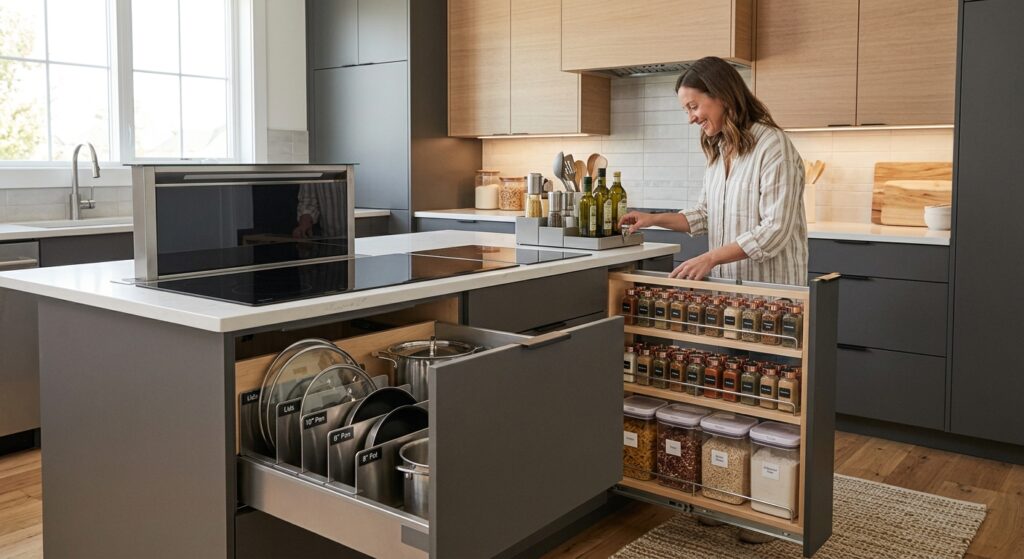
Good pantry organization is less about having perfect shelves and more about knowing exactly where everything belongs.
You should be able to open the pantry, find what you need, and put it back without thinking too much.
That sounds simple, but a messy pantry can make even basic kitchen tasks feel surprisingly frustrating.
The good news is that you don’t need expensive storage products or a picture-perfect setup.
Start with what you already have.
Clear the shelves, group similar foods, create sensible zones, and keep the things you use most within easy reach.
From there, a few small habits can keep the whole system working.
I’ve found that this approach is much easier to maintain than constantly reorganizing the pantry.
Start With a Fresh Pantry Reset
Before you buy a single container, take everything out.
Yes, everything.
It is tempting to organize one shelf at a time, but that can make it harder to see what you actually own.
Instead, clear the space and group similar products together.
You will probably find duplicates hiding in different corners.
You may also discover products that simply ended up in the wrong place.
I wasted two hours on this before realizing that half the problem was not storage.
It was not knowing what was already there.
Once everything is visible, decisions become much easier.
Check packaging as you go, especially cans and jars.
USDA advises against using cans that are leaking, bulging, badly rusted, or severely dented. USDA
Also, don’t automatically throw away food just because a date printed on the package has passed.
USDA explains that many food date labels refer to quality rather than safety. USDA
| What you find | What to do |
|---|---|
| Duplicate products | Put them together |
| Damaged packaging | Check whether it should be discarded |
| Products in the wrong area | Move them into their category |
| Unclear date information | Check reliable food-safety guidance |
Afterward, clean the shelves according to the manufacturer’s instructions.
Then, give them enough time to dry before putting food back.
That gives you a genuinely clean starting point.
Create Pantry Zones That Actually Work
Now comes the part that makes the biggest difference.
Create broad categories based on the way you shop and use your pantry.
You don’t need twenty tiny sections.
In fact, too many categories can make putting things away more annoying.
Instead, start with groups such as:
- Breakfast foods
- Baking supplies
- Pasta, rice, and grains
- Canned and jarred foods
- Snacks
- Sauces, oils, and condiments
- Spices and seasonings
Then, adjust those categories around your actual pantry.
If you barely have any baking supplies, for example, there is no reason to give them half a shelf.
On the other hand, a large category can deserve more space.
The first time I tried making every category extremely specific, it quickly became annoying.
The system looked organized, but nobody wanted to maintain it.
That taught me something useful.
A pantry should be organized around habits, not around how good the shelves look in a photograph.
Give Every Shelf a Clear Purpose
Once your categories are ready, decide where each one should live.
Keep frequently used foods somewhere comfortable to reach.
Then, put heavier items lower when possible.
Less frequently used products can go higher.
This creates a simple hierarchy without needing complicated storage solutions.
| Shelf area | Good choice | Main reason |
|---|---|---|
| Eye level | Everyday staples | Easy to see |
| Middle shelves | Regularly used foods | Convenient access |
| Lower shelves | Heavier products | Easier handling |
| Upper shelves | Occasional items | Keeps prime space available |
Also, think about shelf depth.
A beautifully organized front row is not much help if another dozen products are hiding behind it.
When shelves are deep, risers can sometimes make products easier to see.
Similarly, turntables can help with small bottles and jars.
However, don’t buy an organizer simply because it looks useful.
Measure first.
Then, decide whether it solves an actual problem.
Otherwise, you’re just adding more stuff to an already crowded pantry.
Rotate Older Food to the Front
Here’s one habit that can make pantry maintenance much easier.
When you buy something new, put it behind the older version.
That way, the older product naturally gets used first.
This is commonly described as first-in, first-out rotation.
USDA lists products such as rice, pasta, flour, sugar, spices, and oils among examples of shelf-stable foods. USDA
Still, storage requirements vary.
So, follow the instructions on the packaging when they provide specific storage directions.
| Food area | Simple rotation method |
|---|---|
| Canned foods | Older items toward the front |
| Dry staples | Move older packages forward |
| Opened products | Keep them visible |
| Backups | Store behind active products |
This does not need to become an inventory-management project.
You don’t need a spreadsheet for every can of tomatoes.
You simply need to make older products easier to notice.
That small change can also make grocery shopping easier because you can see what you already have.
Don’t Buy Containers Before Measuring
This is where many pantry makeovers go wrong.
People see a beautiful set of matching containers and immediately start filling their cart.
Then they get home.
Suddenly, half the containers don’t fit.
I’ve made this mistake myself.
The first time I tried reorganizing without measuring properly, the containers looked great but wasted valuable shelf space.
So, measure your shelves first.
Consider height, width, depth, and how far you can comfortably reach.
Then, choose containers around those measurements.
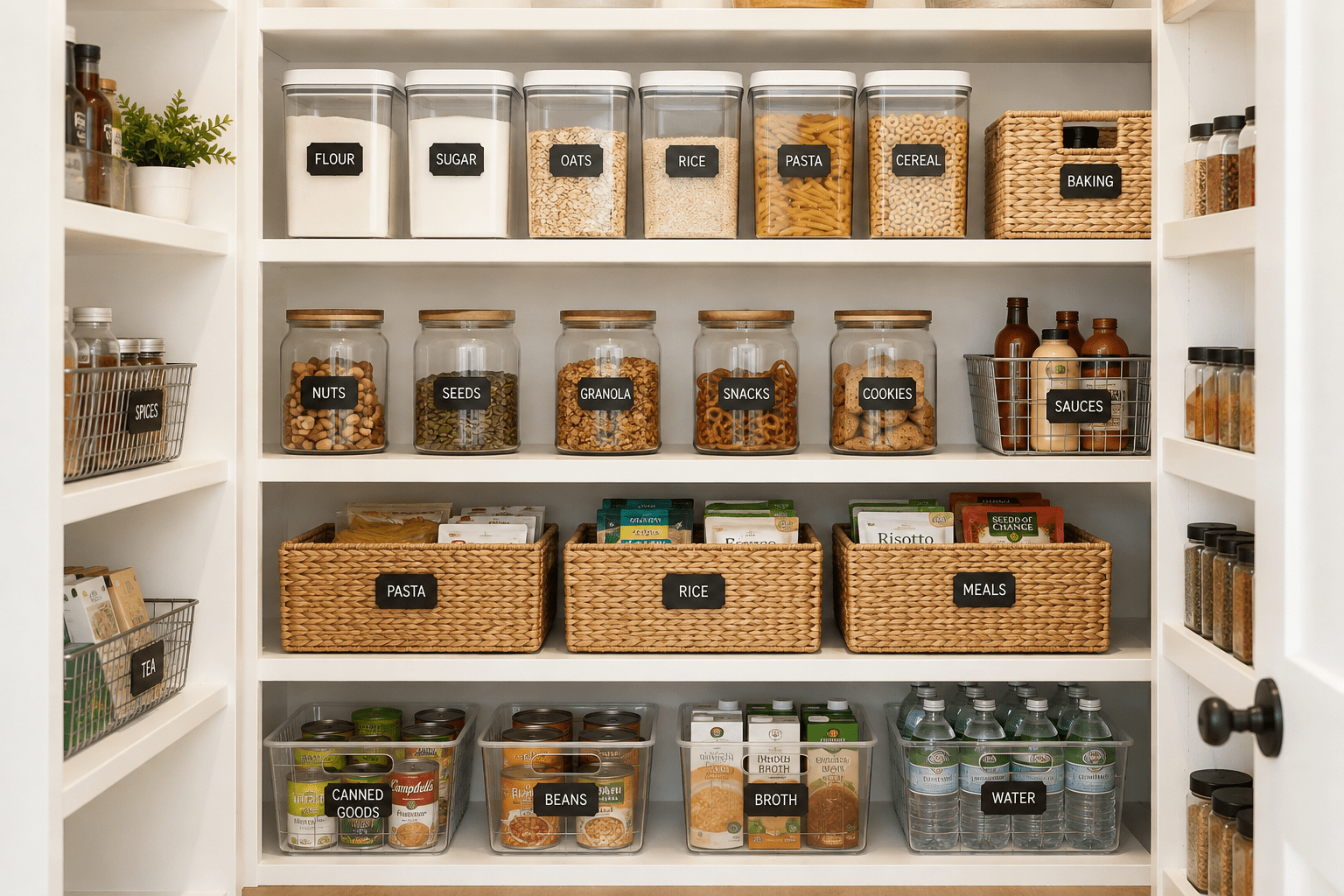
Transparent containers can make dry ingredients easier to see.
However, you don’t need to transfer everything.
If the original packaging works well, keep it.
The EPA recommends airtight, labeled containers for bulk foods and suggests labeling grains with their contents and dates. EPA
The key word here is useful.
A container should make something easier.
If it doesn’t, skip it.
Create a Separate Backup Area
Backup food has a funny way of taking over a pantry.
One unopened bag sits behind another.
Then another one appears.
Before long, you have no idea which products are active and which are backups.
A separate backup area solves much of that confusion.
Keep the food you’re currently using in the main area.
Then, put unopened extras somewhere clearly defined.
When the active product runs out, bring forward the backup.
Afterward, you know when something actually needs replacing.
This also helps prevent unnecessary purchases.
The EPA recommends checking what food you already have before shopping as part of preventing wasted food. EPA
My clients keep asking about this because duplicate buying is often surprisingly easy when pantry shelves are crowded.
The solution isn’t always more storage.
Sometimes, it is simply better visibility.
Use Labels Where They Actually Help
Labels can be incredibly useful.
But you don’t need to label every single object in your pantry.
That can become more work than it’s worth.
Instead, label shelves, bins, or containers when the contents aren’t immediately obvious.
For example, an opaque bin containing several types of baking supplies benefits from a clear label.
A clearly packaged box of pasta probably doesn’t.
Keep labels simple.
The purpose is navigation, not decoration.
If several people use the kitchen, consistent labels can also make putting things away easier.
I’ve run this workflow for three clients, and the simplest systems were usually the ones people kept using.
That is the test I like most.
If the system needs a detailed explanation every time someone opens the pantry, simplify it.
Keep Food Safety Ahead of Organization
A tidy pantry is useful.
A tidy pantry with unsafe storage is not.
USDA recommends keeping shelf-stable foods in a cool, dry place. USDA
It also advises against storing canned goods above the stove or under the sink. USDA
So, don’t choose a storage location purely because it looks convenient.
Check the product label as well.
Some canned products have different storage requirements.
USDA notes that certain canned hams and seafood products can require refrigeration. USDA
Therefore, the label wins whenever general pantry advice conflicts with product-specific instructions.
Build a Restocking Routine You Can Actually Keep
A pantry doesn’t stay organized by accident.
You need a small routine.
Fortunately, it doesn’t have to take long.
Pick a regular moment to check your pantry.
It could be before your grocery order or while you’re making your shopping list.
Then, scan the categories.
You are looking for gaps, duplicates, and products that need rotating.
| Category | Quick question |
|---|---|
| Breakfast | Are the everyday staples still available? |
| Baking | Are key ingredients running low? |
| Grains | Has a backup been opened? |
| Canned foods | Are older products still toward the front? |
Don’t try to create perfect inventory records.
You only need enough information to make better decisions.
The EPA estimates that an average U.S. family of four spends $2,913 each year on food that goes uneaten. EPA
That is a household food-waste figure, not a pantry-specific figure.
So, it should not be treated as a guaranteed amount you can save through pantry organization.
Still, it illustrates why knowing what you already own can matter.
Give the Pantry a Quick Monthly Reset
Even a good system will get messy.
That’s normal.
Packages move.
New groceries arrive.
Someone puts something on the wrong shelf.
Rather than waiting until the pantry becomes chaotic, give it a short reset periodically.
Move older products forward.
Return misplaced items.
Check damaged packaging.
Then, look at the categories.
USDA recommends periodically checking canned goods and rotating older products forward. USDA
Keep the process short.
When I tested this last month, I found that simplifying the categories mattered more than adding another organizer.
If maintaining your pantry feels like a project every month, the system is probably too complicated.
Avoid the Most Common Pantry Organization Mistake
The easiest mistake to make is buying storage products before understanding the space.
It feels productive.
You order containers, bins, racks, and labels.
Then, you discover they don’t fit the shelves properly.
Instead, measure first.
Then, sort the inventory.
Afterward, identify the genuine problem areas.
Only then should you decide whether an organizer is necessary.
Sometimes, the solution is simply moving pasta to a better shelf.
Other times, a small riser or bin makes sense.
Either way, the storage product should follow the problem.
Not the other way around.
Build a Pantry That Stays Organized
A well-organized pantry doesn’t have to look like a showroom.
It simply needs to make everyday decisions easier.
Start by clearing the shelves.
Then, group similar foods and give each category a logical home.
Next, place frequently used products where they are easiest to reach.
Afterward, rotate older products forward and separate backups from active stock.
Finally, add containers and labels only where they genuinely improve the system.
Your pantry should answer four questions quickly:
- What do I have?
- Where does it belong?
- What should I use first?
- What do I need to buy?
If those answers are easy to find, you’ve already solved most of the problem.
The real win isn’t a pantry that looks perfect.
It is opening the door and immediately knowing what you’re looking at.
That’s the kind of kitchen organization system I prefer: simple, visible, practical, and easy enough to keep using long after the initial cleanup.