The Kitchen Renovation Upgrade That Changes How the Space Works

If you are renovating a kitchen, start with the cabinets.
Cabinet layout affects storage, access, organization, and how easily the room works from one day to the next.
That is why I would sort out storage before getting too excited about cabinet colors or decorative hardware.
A new finish can make a kitchen look completely different.
A better cabinet system can make the same kitchen feel completely different.
For entrepreneurs, that distinction matters because renovation decisions have to earn their place in the budget.
So, start with what the kitchen needs to do.
Then make it look the part.
Start With a Hard Look at the Existing Cabinets
Before replacing cabinets, spend some time looking at what is already there.
Open every door.
Pull out every drawer.
Measure the spaces that matter.
Then, write down what feels awkward.
Maybe the shelves are too deep.
Perhaps the drawers are poorly arranged.
Or maybe the corner cabinet looks enormous while offering very little practical access.
Those observations are more useful than choosing a door style too early.
When I look at a cabinet plan, I want the measurements in front of me before discussing finishes.
That keeps the conversation grounded.
Cabinet Audit
| Area | What to check | Why it matters |
|---|---|---|
| Cabinet boxes | Width, depth, height, condition | Helps determine replacement needs |
| Shelves | Height, depth, adjustment | Reveals inefficient storage |
| Drawers | Size and movement | Guides drawer planning |
| Doors | Swing and clearance | Prevents conflicts |
| Corners | Opening and access | Identifies difficult storage |
Also, take photographs before demolition.
They provide a useful record of existing conditions when measurements, drawings, and contractor proposals are reviewed later.
The first time I work through a storage plan, I usually find that the smallest measurements influence the biggest decisions.
That is why I would never skip this stage.
Make Deep Cabinets Easier to Reach
A cabinet can hold plenty of items and still be frustrating.
The problem is often access.
Deep shelves are a good example.
Items at the back can become difficult to see and reach, especially when the shelf itself does not move.
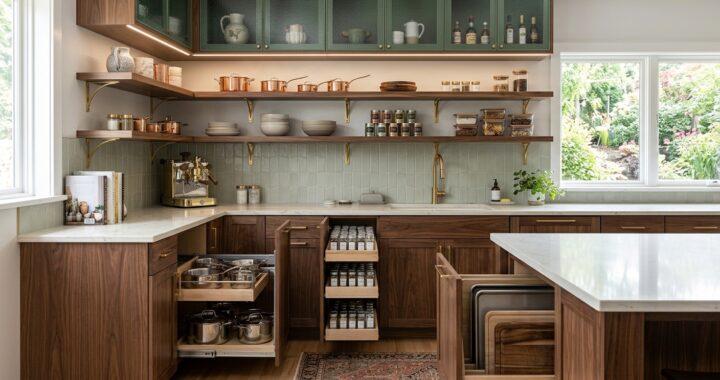
Pull-out shelves can help in suitable cabinet configurations.
Full-extension drawer hardware can also bring more of the drawer contents forward.
HUD’s residential remodeling guidance discusses full-extension drawers, pull-out shelves, pull-down shelves, and revolving storage. (HUD residential remodeling guidance)
However, the hardware has to suit the cabinet.
That means checking dimensions, clearances, mounting requirements, and manufacturer specifications first.
Match the Hardware to the Cabinet
| Problem | Possible solution | Check first |
|---|---|---|
| Deep base cabinet | Pull-out shelf | Interior depth |
| Difficult upper storage | Pull-down hardware | Mounting space |
| Awkward corner | Revolving storage | Cabinet geometry |
| Limited drawer access | Full-extension hardware | Drawer construction |
So, do not buy an accessory simply because it looks clever.
Start with the cabinet.
Then choose the hardware.
My clients often ask about “more storage,” but sometimes the better answer is simply making existing storage easier to reach.
That can be a much cleaner solution.
Give the Cabinet Interior a Smarter Layout
Once access is sorted, look at organization.
A good cabinet interior should make it easy to see where things belong.
Adjustable shelves can help when different storage heights are needed.
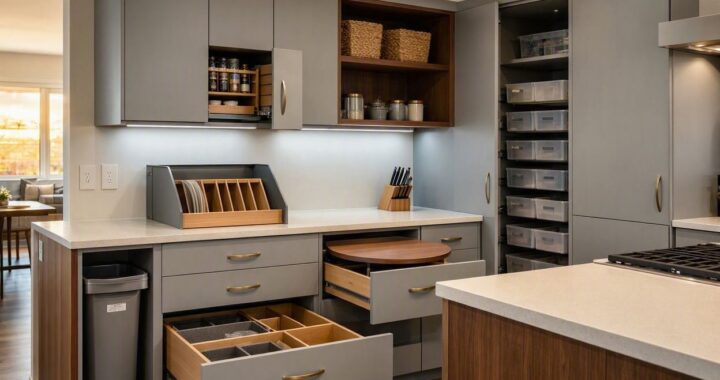
Drawer dividers can create useful separation without changing the cabinet itself.
Pull-out shelves can also make deeper areas more accessible.
However, organization can quickly become overcomplicated.
Every divider, tray, and accessory takes up some space.
Useful Interior Upgrades
| Upgrade | What it does | What to verify |
|---|---|---|
| Adjustable shelves | Changes storage height | Shelf support positions |
| Drawer dividers | Separates contents | Drawer dimensions |
| Pull-out shelves | Improves deep access | Clearance and capacity |
| Door organizers | Adds reachable storage | Door construction |
I prefer simple interiors that are easy to understand.
A cabinet does not become better because every inch contains an accessory.
Instead, leave enough room for items to move comfortably.
That small decision can make the finished kitchen feel much less crowded.
Choose Cabinet Materials Carefully
The cabinet box is easy to ignore because it sits behind the visible doors.
Still, its material matters.
In the United States, certain composite wood products are regulated under TSCA Title VI because of formaldehyde emissions.
EPA identifies hardwood plywood, MDF, and particleboard among the regulated composite wood categories. (EPA)
That does not mean every cabinet uses the same materials.
It means the specification should tell you exactly what you are buying.
If a supplier makes a compliance claim, ask for documentation.
Do not rely on broad phrases such as “green” or “eco-friendly” without supporting information.
EPA also publishes information about recognized third-party certifiers for regulated composite wood products. (EPA recognized certifiers)
That gives buyers another way to check the claim.
Material Questions Worth Asking
| Question | What you want to see |
|---|---|
| What material is specified? | Product documentation |
| Does the product fall under TSCA Title VI? | Classification information |
| Is certification required? | Compliance documentation |
| Who certified the product? | Recognized certifier information |
For projects in the United States, regulated composite wood products manufactured or imported after March 22, 2019 are subject to applicable TSCA Title VI requirements. (EPA formaldehyde standards)
If the project is elsewhere, check the rules for that market.
There is no reason to apply one country’s regulations blindly to another.
Keep Indoor-Air Claims Grounded
Formaldehyde deserves attention when discussing certain composite wood materials.
EPA explains that its federal standards are intended to reduce formaldehyde emissions from regulated composite wood products. (EPA consumer guidance)
That is useful information.
What I would avoid, however, is turning it into a dramatic promise about the health of the entire kitchen.
A compliant product does not mean the room contains no formaldehyde.
Instead, keep the claim tied to the evidence.
Find out what materials are being supplied.
Then, request the documentation that applies to those materials.
That is a much more credible way to discuss cabinet construction.
Write a Cabinet Specification People Can Actually Understand
Cabinet quotes often become confusing because the wording is too broad.
“Custom cabinetry with storage accessories” sounds good.
It also leaves plenty unanswered.
What construction?
Which accessories?
Which hardware?
What finish?
Who installs everything?
Those details should be settled before ordering.
A Clearer Cabinet Scope
| Area | Define |
|---|---|
| Construction | Cabinet materials and construction |
| Storage | Shelves, drawers, and accessories |
| Hardware | Selected products or equivalents |
| Finish | Finish type and locations |
| Installation | Included work and exclusions |
I wasted two hours once trying to reconcile cabinet information that should have been clear from the beginning.
The problem was not the design.
It was inconsistent specifications.
Since then, I prefer one clear description across the drawings, quotation, and purchase documents.
It saves time later.
Compare Cabinet Quotes Like a Business Decision
A cabinet quote is only useful when you know what the number includes.
One contractor might include interior accessories.
Another might charge for them separately.
Installation can create the same problem.
So, compare scope before comparing price.
Cabinet Quote Checklist
| Category | Compare |
|---|---|
| Construction | Materials and construction method |
| Storage | Included interior components |
| Hardware | Specified products |
| Finish | Finish and application |
| Installation | Included work and exclusions |
Ask contractors to price the same written scope whenever possible.
That gives you a much fairer comparison.
It also makes missing items easier to spot before signing anything.
For an entrepreneur, this is basic purchasing discipline.
The cheapest proposal is only the cheapest when the scopes actually match.
Make Accessibility Part of the Design
Accessibility should be considered while the cabinet layout can still change.
HUD’s remodeling guidance includes full-extension drawers, pull-out shelves, pull-down shelves, and revolving storage among possible kitchen accessibility features. (HUD)
Not every kitchen needs every feature.
Instead, choose according to the space and the people using it.
Look at shelf height.
Then, check reach.
Afterward, consider door swings, drawer movement, and clearances.
A cabinet can look excellent in a drawing and still be awkward in person.
That is why I like to review the practical movement before settling on the final design.
The visual details can be adjusted later.
Cabinet dimensions become much less forgiving once production starts.
Skip Storage Features That Do Not Earn Their Space
Showrooms are very good at making storage accessories look essential.
Some genuinely improve a cabinet.
Others simply make the invoice longer.
Before adding an accessory, ask four questions:
- Does it solve a real storage problem?
- Does it improve access?
- Does it fit the measured cabinet?
- Can the specification be verified?
If the answer is no, leave it out.
I would rather spend the money on better cabinet construction or a well-planned interior than on accessories that add little value.
The first time I tried to solve every storage issue with hardware, the design became more complicated than it needed to be.
That was a useful lesson.
More features do not automatically mean better storage.
Follow a Better Renovation Sequence
Cabinet decisions become easier when they happen in the right order.
First, measure the space.
Next, identify the storage problems.
Then, design the cabinet layout.
Afterward, specify materials, interiors, hardware, and finishes.
Finally, verify everything before ordering.
A Practical Cabinet Workflow
| Stage | Main task | Result |
|---|---|---|
| 1 | Measure | Reliable dimensions |
| 2 | Audit | Defined problems |
| 3 | Design | Cabinet layout |
| 4 | Specify | Materials and hardware |
| 5 | Verify | Final order |
When I review cabinet plans, I pay particular attention to conflicts between hardware and dimensions.
Those problems are much cheaper to solve before production.
Therefore, the final check should happen before the purchase order.
Not during installation.
Ask for Proof Behind Material Claims
If a supplier says a cabinet material meets a particular standard, ask for the evidence.
EPA’s TSCA Title VI rules establish certification requirements for regulated composite wood products. (EPA)
EPA also provides information about recognized third-party certifiers. (EPA)
For U.S. imports, EPA also describes certification requirements for regulated composite wood products and certain finished goods containing them. (EPA import requirements)
Those rules belong to the U.S. regulatory system.
Therefore, projects elsewhere should be checked against the relevant local requirements.
The principle remains the same, though.
Ask for evidence.
Then, make the decision.
Make the Cabinets Earn Their Place
A cabinet renovation should do more than make the kitchen look newer.
It should make the room easier to organize and easier to use.
That starts with measuring what you already have.
Then, identify what genuinely needs to change.
Afterward, choose the cabinet construction, interior storage, hardware, and finishes.
Finally, make sure the written specification matches the actual design.
Choose an accessory because it solves a problem.
Choose a material because its specification is clear.
Choose an organizer because it fits.
And choose the finish because it completes the design, not because it distracts from weak storage.
That is the difference between replacing cabinets and actually upgrading them.
For entrepreneurs, the payoff is clearer decision-making.
You can compare proposals properly.
You can question vague claims.
And you can avoid spending money on features that sound impressive but contribute little.
The strongest kitchen storage plans are rarely the ones with the longest feature list.
They are the ones where every shelf, drawer, cabinet, and hardware choice has a clear reason.
That is where a cabinet upgrade becomes a smarter kitchen renovation decision.