Where a Better Kitchen Renovation Really Begins
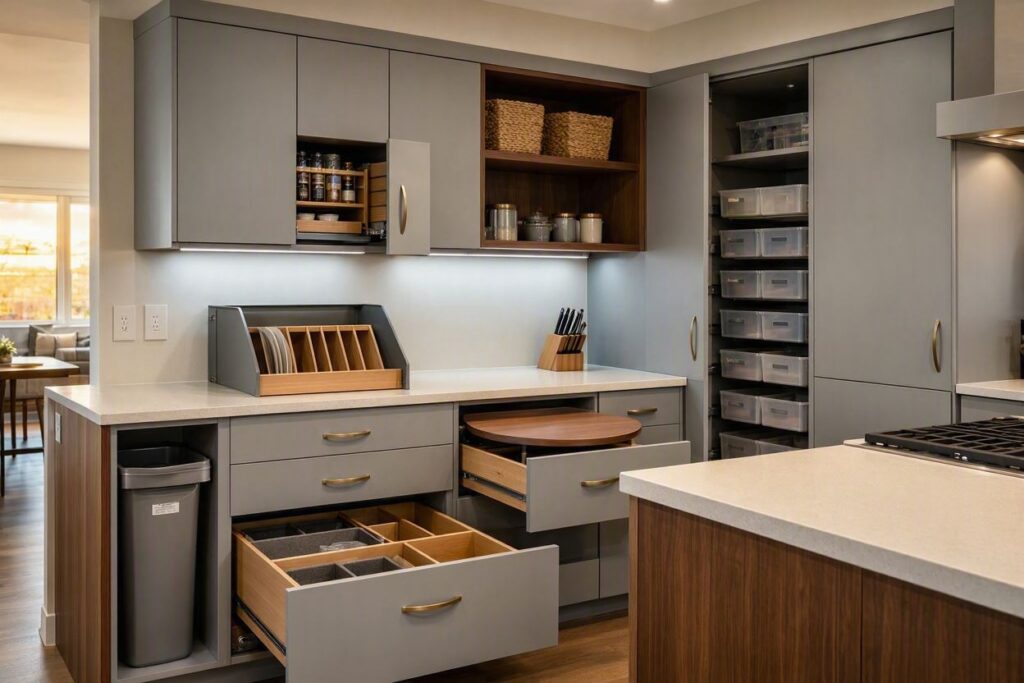
If your kitchen renovation feels stuck between “looks better” and “works better,” start with the cabinets.
Cabinets determine how much storage you have, how easily you can reach it, and how well the kitchen stays organized.
That makes storage one of the first decisions I would settle before getting carried away with finishes.
A new countertop can change the room overnight.
A smarter cabinet layout can change how the room works every single day.
That difference matters when you are trying to make sensible renovation decisions rather than simply buying everything that looks good in a showroom.
Start With the Storage Problems, Not the Cabinet Catalog
Before choosing new doors, take a good look at the cabinets already in the kitchen.
Measure them.
Photograph them.
Then, write down what is genuinely frustrating.
Maybe the shelves are too deep.
Perhaps the drawers are awkwardly arranged.
Or maybe the corner cabinet looks enormous but gives you surprisingly little usable access.
Those details are more useful than a mood board at this stage.
I like to treat the existing kitchen almost like a site inspection.
You are looking for evidence before deciding what needs changing.
A Simple Cabinet Audit
| Check | What to look for | Why it matters |
|---|---|---|
| Cabinet boxes | Size, condition, depth | Determines replacement requirements |
| Shelves | Height, depth, adjustment | Shows where space is being wasted |
| Drawers | Size and movement | Helps determine better storage |
| Doors | Swing and clearance | Prevents conflicts |
| Corners | Accessibility | Reveals difficult storage areas |
The first time I approach a renovation this way, the temptation is always to think about appearance first.
But measurements usually tell a more useful story.
Once you know what is actually wrong, choosing the right upgrade becomes much easier.
Turn Awkward Cabinets Into Easier Storage
Deep cabinets are a good example.
They can hold plenty of things, yet the back of the cabinet may remain difficult to reach.
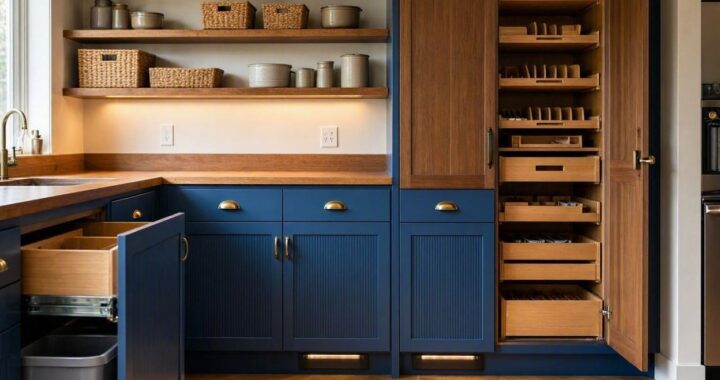
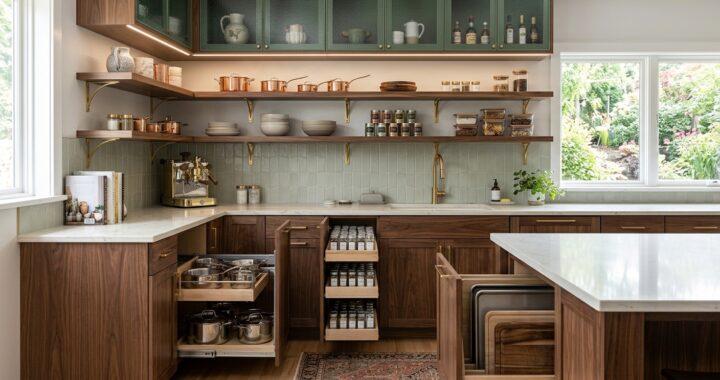
That is where pull-out shelving can make sense.
Full-extension drawer hardware can also improve access by allowing more of a drawer’s contents to come forward.
HUD’s residential remodeling guidance discusses full-extension drawers, pull-out shelves, pull-down shelves, and revolving storage as accessibility features. (HUD)
The key, however, is choosing the right feature for the actual cabinet.
There is no prize for installing the most complicated hardware.
Choose Hardware According to the Problem
| Problem | Possible direction | Check before buying |
|---|---|---|
| Deep base cabinet | Pull-out shelf | Interior depth |
| Difficult upper storage | Pull-down mechanism | Mounting space |
| Awkward corner | Revolving storage | Cabinet geometry |
| Limited drawer access | Full-extension hardware | Drawer construction |
Sometimes the simplest answer is still the best one.
A shelf may only need to move.
A drawer may simply need better organization.
And a cabinet that appears to need replacement might only need a carefully planned interior upgrade.
That is why I would never choose storage hardware before taking measurements.
Make the Inside of the Cabinet Work Harder
Good cabinet organization is not about filling every available inch.
It is about making the available space understandable.
Adjustable shelves can help because they allow the interior to change when storage requirements change.
Drawer dividers can also create clearer zones without changing the cabinet itself.
Pull-out shelves can make deep areas easier to access.
Door-mounted organizers can add storage where the cabinet construction permits them.
The trick is knowing when to stop.
An interior packed with organizers can become just as frustrating as an empty cabinet.
Useful Interior Upgrades
| Upgrade | What it changes | What to verify |
|---|---|---|
| Adjustable shelving | Vertical flexibility | Shelf support positions |
| Drawer dividers | Internal organization | Drawer dimensions |
| Pull-out shelves | Deep-cabinet access | Clearance and capacity |
| Door organizers | Accessible storage | Door construction |
I prefer to measure first and shop second.
Otherwise, it is surprisingly easy to buy an organizer that technically fits but makes the cabinet less useful.
That is money spent solving a problem you did not actually have.
Pay Attention to Cabinet Materials
Cabinet construction deserves the same attention as the visible finish.
In the United States, certain composite wood products are regulated under TSCA Title VI because of formaldehyde emissions.
EPA identifies hardwood plywood, MDF, and particleboard among the regulated composite wood categories. (EPA)
That does not mean every cabinet contains the same materials.
It does mean material descriptions should be specific enough to verify.
So, if a supplier makes a compliance or emissions claim, ask for documentation.
Do not rely entirely on phrases such as “green,” “natural,” or “eco-friendly.”
Those words can sound impressive while telling you very little about the actual product.
EPA also publishes information about recognized third-party certifiers for regulated composite wood products. (EPA)
Questions to Ask Your Supplier
| Question | What you want |
|---|---|
| What material is used? | Clear product specification |
| Is the material regulated? | Product classification |
| Does TSCA Title VI apply? | Compliance information |
| Who certified it? | Certifier information |
For U.S. projects, EPA’s rules require covered composite wood products to meet applicable TSCA Title VI emission standards and certification requirements.
The exact requirements depend on the product and its role in the supply chain.
So, ask for the documentation rather than guessing.
That is a much safer way to make material decisions.
Keep Indoor Air Claims Grounded in Facts
Formaldehyde can be emitted by certain composite wood products.
EPA’s federal standards are designed to reduce formaldehyde emissions from regulated composite wood products. (EPA)
That information is useful.
What is not useful is turning it into a sweeping claim that one cabinet choice will automatically create a healthier home.
Renovation decisions rarely deserve that kind of certainty.
Instead, focus on what you can verify.
Find out which materials are being installed.
Ask for applicable compliance information.
Then, keep the marketing language proportional to the evidence.
That approach is not only more trustworthy.
It also makes your renovation documentation much stronger.
Get Serious About the Cabinet Specification
A vague cabinet quote can cause problems long after the renovation starts.
“Custom cabinetry with storage accessories” sounds fine until you ask what that actually includes.
Which accessories?
What construction?
What hardware?
Which finish?
Who installs it?
Those questions should be answered before the order is placed.
A Better Cabinet Scope
| Area | Specify |
|---|---|
| Construction | Cabinet materials and construction |
| Storage | Shelves, drawers, and accessories |
| Hardware | Selected products or approved equivalents |
| Finish | Finish type and locations |
| Installation | Included work and exclusions |
I would rather spend an afternoon clarifying a specification than spend weeks sorting out an unclear order.
Once cabinets are manufactured, changing your mind becomes considerably more expensive.
That is especially true when several components have been designed around exact dimensions.
Compare Quotes Beyond the Bottom Line
Two cabinet proposals can have very different scopes while displaying similar-looking prices.
One might include storage accessories.
Another might price them separately.
Installation can create the same issue.
Therefore, compare the actual scope rather than choosing the lowest headline figure.
Compare These Cabinet Details
| Category | What to compare |
|---|---|
| Construction | Materials and construction method |
| Storage | Included interior components |
| Hardware | Specified products |
| Finish | Finish and application scope |
| Installation | Included responsibilities |
For entrepreneurs, this is where renovation planning starts to resemble any other purchasing decision.
You want comparable specifications.
You want clear assumptions.
And you want exclusions visible before you approve the work.
A cheaper proposal is not necessarily cheaper if several functional components appear later as extras.
Design for Easier Access From the Beginning
Accessibility is easiest to address before cabinet dimensions are finalized.
HUD’s remodeling guidance includes features such as full-extension drawers, pull-out shelves, pull-down shelves, and revolving storage. (HUD)
These features are not mandatory for every kitchen.
Instead, they provide options when reach and access are genuine design concerns.
Think about shelf height.
Think about drawer movement.
Think about door clearance.
Then think about how the hardware will actually operate.
A cabinet can look perfect on a drawing and still be annoying to use.
That is why functional review should happen before the visual design becomes final.
Be Selective With Expensive Accessories
Kitchen storage accessories are easy to oversell.
A rotating corner mechanism can look clever.
A specialized drawer insert can look luxurious.
But neither one deserves a place in the renovation simply because it photographs well.
Before approving an accessory, ask four questions:
- Does it solve a real storage problem?
- Does it improve access?
- Does it fit the measured space?
- Can its specifications be verified?
If not, keep the money.
I would rather see a renovation spend properly on the fundamentals than pile expensive accessories into mediocre cabinet design.
Good storage should feel effortless.
It should not feel like a collection of gadgets.
Follow a Clear Renovation Sequence
Cabinet decisions become much easier when they happen in the right order.
First, measure.
Then, audit.
Next, design the layout.
After that, specify the cabinet construction and interior features.
Finally, verify everything before ordering.
The Cabinet Planning Sequence
| Step | Decision | Output |
|---|---|---|
| 1 | Measure | Accurate dimensions |
| 2 | Audit | Storage problems |
| 3 | Design | Cabinet layout |
| 4 | Specify | Materials and hardware |
| 5 | Verify | Final order |
This sounds straightforward, but skipping one stage can create expensive confusion later.
I have found that most cabinet decisions become easier once the dimensions are settled.
You stop asking, “Which accessory should I buy?”
Instead, you start asking, “Which solution actually fits this cabinet?”
That is a much better question.
Make Storage the Foundation of the Kitchen Renovation
Cabinets deserve more attention than they usually receive.
They determine how the kitchen stores everyday items, how easily those items can be reached, and how organized the room feels.
Therefore, begin with the interior.
Measure what exists.
Identify what fails.
Then, specify the changes carefully.
Choose hardware because it solves a problem.
Choose materials because you can verify what you are buying.
Choose organizers because they fit the space.
And choose finishes once the functional decisions are under control.
That process produces something better than a kitchen that simply looks new.
It creates a kitchen where the storage actually makes sense.
For anyone managing a renovation budget, that is the real opportunity.
You are not simply buying new cabinets.
You are deciding how one of the most frequently used parts of the kitchen should work for years after the renovation is finished.