Before You Order Slabs
The smartest countertop and backsplash choices balance appearance, maintenance, installation, and budget before anyone orders materials.
That sounds obvious, yet this is where many kitchen renovation decisions start going sideways.
A beautiful slab can still have specific care requirements.
Likewise, a gorgeous backsplash can create an awkward visual combination when chosen without the countertop in mind.
So, I’d make the countertop the starting point.
Then, I’d use its color, movement, finish, and maintenance requirements to shape the backsplash.
That approach keeps the design focused while making the renovation easier to explain and price.
Start Strong: Choose the Countertop First
Countertops connect almost everything happening around the kitchen work area.
They meet the cabinetry, sink, appliances, walls, and backsplash.
Therefore, choosing the countertop first gives the rest of the renovation a clear direction.
Material characteristics should come before color matching.
Quartz, granite, marble, and laminate can all look impressive, but they do not require identical care.
| Material | Main characteristic | What to check |
|---|---|---|
| Quartz | Engineered, nonporous surface | Heat, scratches, and cleaning requirements |
| Granite | Natural stone with strong scratch resistance | Stone composition and care |
| Marble | Natural stone with distinctive variation | Acid sensitivity and maintenance |
| Laminate | Decorative layered surface | Heat and cutting protection |
The Natural Stone Institute describes granite as one of the harder dimension stones, with strong scratch resistance.
Still, that does not mean every granite countertop should receive identical treatment.
The exact stone, finish, fabrication, and supplier instructions matter.
That is why I avoid broad claims such as “maintenance-free.”
If the manufacturer does not support the claim, there is little reason to make it part of your sales message.
Precise language usually sounds more trustworthy anyway.
Make Quartz a Smart, Informed Choice
Quartz surfaces remain popular because engineered quartz can be nonporous and relatively easy to maintain.
However, low maintenance does not mean unlimited resistance.
For example, Caesarstone recommends routine cleaning with warm water and mild detergent.
It also recommends protecting the surface from hot cookware and sharp objects.
You can check its quartz and mineral surface care guidance for the manufacturer’s recommendations.
That distinction matters when preparing renovation specifications.
I would rather explain what the surface needs than promise that nothing can damage it.
| Quartz consideration | Question to answer |
|---|---|
| Cleaning | Which products does the manufacturer recommend? |
| Heat | What protection does the manufacturer advise? |
| Scratches | Should cutting boards be used? |
| Chemicals | Which products should be avoided? |
Caesarstone also advises caution with strong acids, alkalis, oxidizers, solvents, and other aggressive products.
Its guidance recommends testing unfamiliar cleaning products on an inconspicuous area first.
So, “easy to maintain” can be a reasonable description when properly qualified.
“Nothing can damage it” is a very different claim.
That difference may seem small, but it matters when customers expect your advice to hold up after installation.
Protect Natural Stone With Better Information
Natural stone brings natural variation that manufactured surfaces cannot completely reproduce.
Veining, mineral movement, color shifts, and other characteristics can make individual slabs visually distinctive.
At the same time, natural stone requires material-specific care.
The Natural Stone Institute explains that calcareous stone is sensitive to acidic solutions.
Marble is a familiar example of a calcareous stone.
Therefore, acidic cleaners can etch or dull sensitive stone surfaces.
The Institute recommends mild, non-acidic cleaning products for natural stone.
So, before recommending a cleaning routine, identify the actual stone.
That small step prevents generic cleaning advice from becoming an expensive mistake.
Stop Treating Sealing Like an Automatic Rule
Sealing is another subject where renovation advice often becomes too simplistic.
Some natural stones can benefit from additional stain resistance.
However, not every stone automatically needs sealing.
The Natural Stone Institute states that most granite countertops do not need sealing.
It also explains that sealing can provide additional resistance to staining.
That makes the decision more nuanced than simply telling every customer to seal granite.
| Sealing question | What to verify |
|---|---|
| Is sealing needed? | Ask the stone supplier |
| Which product? | Confirm compatibility |
| Food-preparation area? | Check product safety |
| Frequency? | Follow supplier guidance |
I prefer treating sealing as a product-specific decision.
That keeps maintenance recommendations useful instead of turning them into automatic extras.
Build a Powerful Backsplash Around the Countertop
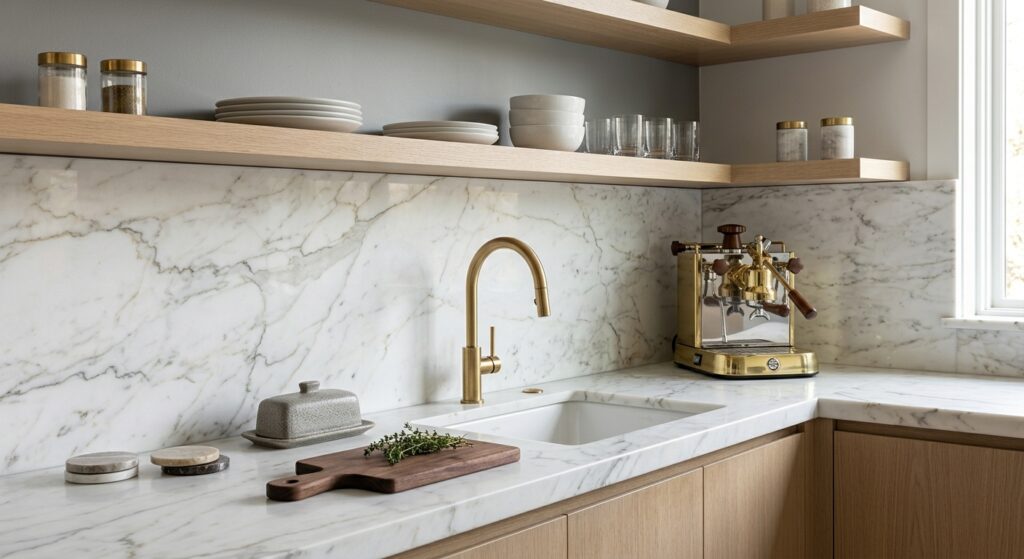
Once the countertop is selected, the backsplash becomes much easier to control.
First, look at the countertop’s movement.
Then, consider its color, finish, scale, and overall visual weight.
From there, decide whether the backsplash should quietly support it or create controlled contrast.
A strongly patterned countertop generally benefits from restraint nearby.
Meanwhile, a quieter countertop can support more texture or pattern.
I like this approach because it gives the kitchen a clear visual hierarchy.
Not every surface needs to shout.
Sometimes, the strongest design decision is simply deciding which surface gets attention.
Create Contrast Without Creating Chaos
Contrast does not require dramatic color.
Instead, it can come from texture, finish, scale, grout, or subtle tonal differences.
The trick is choosing one dominant contrast.
Then, let the other finishes support it.
| Countertop character | Backsplash direction |
|---|---|
| Strong natural movement | Restrained pattern |
| Minimal countertop pattern | Controlled texture |
| Dark countertop | Lighter supporting tone |
| Light countertop | Measured tonal contrast |
This keeps the design interesting without making every surface compete.
The backsplash should make the countertop feel intentional.
It should not make the customer wonder which material they were supposed to notice first.
Stop Judging Large Materials From Tiny Samples
Small samples are useful during the early selection process.
However, they can hide the movement that becomes obvious across an entire slab.
Natural stone presents this issue particularly clearly.
A small sample might show one quiet section while the full slab contains much stronger variation.
Therefore, review the actual slab whenever the supplier makes it available.
Then, look at areas where seams, sink cutouts, corners, and edges will appear.
The goal is not perfection.
The goal is knowing what the finished material is likely to look like.
That distinction can prevent the uncomfortable conversation that starts with, “It looked different in the showroom.”
Control the Real Cost Before Ordering
A countertop quote is rarely just the material price.
Fabrication, cutouts, edge profiles, seams, installation, and preparation can affect the final amount.
Therefore, compare complete proposals rather than comparing slab prices alone.
I prefer separating the major cost categories before making a decision.
| Quote component | What to confirm |
|---|---|
| Material | Exact product and quantity |
| Fabrication | Cutouts, edges, seams, finishing |
| Installation | Labor and site requirements |
| Backsplash | Material and installation |
| Additional work | Removal and preparation |
This makes competing quotes easier to understand.
It also helps explain why two seemingly similar countertop options can produce different installed prices.
For entrepreneurs, that clarity matters.
A cleaner proposal is easier to explain, easier to manage, and easier for the customer to approve.
Get Measurements Right Before Fabrication
Countertops are fabricated to specific dimensions.
Therefore, preliminary measurements should not automatically become final fabrication measurements.
Cabinet positions can change.
Appliance dimensions can matter.
Sink selection can matter too.
Wall conditions can also influence the final fit.
So, I’d make one responsibility completely clear before ordering: who performs the final measurement.
The timing should be documented as well.
Otherwise, everyone can assume somebody else handled it.
I’ve always preferred removing that ambiguity before fabrication rather than trying to solve it afterward.
With countertops, accuracy is not a finishing detail.
It is part of the product.
Protect the Surface From Heat and Sharp Objects
Even durable countertop materials have boundaries.
For Caesarstone surfaces, the manufacturer recommends trivets or hot pads for hot cookware.
It also recommends cutting boards because quartz surfaces can still be scratched.
You can verify those recommendations in Caesarstone’s care and maintenance guidance.
Granite has strong heat resistance as well.
However, the Natural Stone Institute recommends trivets or mats for natural stone.
The Institute also explains that localized heat can create thermal gradients capable of contributing to cracking in granite.
Those recommendations are simple enough to communicate.
More importantly, they give customers realistic expectations.
Instead of saying “extremely durable,” explain how the manufacturer expects the material to be treated.
That makes the recommendation more useful and easier to defend.
Keep Cleaning Advice Specific to the Surface
Generic cleaning advice can create unnecessary problems.
The right approach depends on the material.
The Natural Stone Institute recommends mild cleaning products for natural stone and warns that acidic products can affect acid-sensitive stones.
Caesarstone also provides specific cleaning guidance for its quartz surfaces.
It warns against several harsh chemicals and abrasive cleaning methods.
Therefore, one cleaner should not automatically become the recommendation for every countertop.
| Surface | Sensible starting point |
|---|---|
| Natural stone | Mild, non-acidic cleaner |
| Quartz | Manufacturer-approved cleaner |
| Marble | Avoid acidic cleaners |
| Specialty finish | Follow supplier instructions |
There is another detail that often gets overlooked.
Caesarstone says its Natural, Honed, Concrete, and Rough finishes require more cleaning than its Polished finishes.
That means the finish itself can change the maintenance conversation.
So, when specifying a countertop, identify the finish rather than stopping at the material name.
Make the Backsplash Practical, Not Just Beautiful
A backsplash is more than a decorative strip behind the countertop.
Its tile, finish, grout, and installation all become part of the finished surface.
Therefore, evaluate the complete assembly.
A textured tile may have different cleaning requirements from a smooth tile.
Likewise, grout becomes part of the maintenance conversation.
That does not mean avoiding texture.
Instead, understand what the selected materials require before making the final decision.
A beautiful backsplash should still make sense from a maintenance perspective.
Turn Documentation Into a Strong Marketing Advantage
Good renovation marketing does not need exaggerated promises.
Actually, careful documentation can make the sales conversation stronger.
Show customers where important recommendations come from.
Keep the relevant information organized around:
- Product specifications
- Care instructions
- Installation requirements
- Warranty information
Then, refer back to those documents when questions arise.
You are not asking the customer to accept an unsupported opinion.
Instead, you are showing the source behind the recommendation.
That creates a much stronger foundation for trust.
It also gives your team something concrete to reference when questions appear months after installation.
Build a Sharper Countertop and Backsplash Specification
A strong specification answers practical questions before installation begins.
First, identify the exact countertop product.
Next, document its care requirements and installation conditions.
Then, specify the backsplash material, finish, grout, and installation details.
Finally, compare the complete installed cost with the renovation budget.
| Final checkpoint | Question |
|---|---|
| Product | What exact material is being purchased? |
| Performance | What does the manufacturer document? |
| Maintenance | What care does the surface require? |
| Installation | What fabrication conditions apply? |
| Appearance | Has the actual material been reviewed? |
| Budget | What is the complete installed cost? |
This process is straightforward.
However, it removes assumptions from decisions that can become expensive later.
It also gives entrepreneurs a cleaner way to explain recommendations without overselling them.
Make Your Recommendation Easier to Trust
My clients often ask which countertop material is “best.”
Usually, that question needs more context.
The better question is whether the exact material fits the renovation’s requirements.
That includes appearance, maintenance, fabrication, installation, and budget.
Once you frame the decision that way, the conversation becomes much clearer.
You no longer need to declare one material the universal winner.
Instead, explain what the manufacturer documents.
Then, let the project’s priorities guide the decision.
That is a more credible position than making a blanket recommendation.
Choose Materials You Can Stand Behind
The strongest countertop and backsplash combination is not automatically the most expensive.
Instead, it is the combination whose appearance, maintenance, installation requirements, and documented characteristics fit the renovation.
Quartz can make sense when its documented care requirements suit the project.
Natural stone can also make sense when its characteristics and maintenance expectations are understood.
Neither deserves a blanket “best material” label.
That is the standard I would use when preparing a serious kitchen renovation specification.
Choose the countertop for what it can reliably deliver, then use the backsplash to sharpen the overall design.
Good renovation marketing follows the same principle.
Make the recommendation attractive.
Then, make sure the evidence can support it.