Small Storage Upgrades That Make a Kitchen Feel Brand New

Skip the full cabinet replacement. Pull-out shelves, drawer dividers, door racks, and upright pan organizers solve most everyday kitchen storage bottlenecks for a few hundred dollars and a weekend of basic DIY work.
In most kitchens, the real issue is not a lack of cabinet volume—it is dead space. Deep lower cabinets swallow anything pushed past the front row, tall shelves waste vertical clearance, and unpartitioned drawers turn lids and utensils into a daily tangle. Fixing how existing cabinets open, divide, and stack usually recovers more usable space than adding another cabinet box.
Start With an Empty-Cabinet Audit
Before buying a single bin or rack, empty your cabinets completely and sort everything on the counter or dining table into four groups:
- Daily use: Keep at waist or chest height where you can grab items without bending or reaching.
- Weekly use: Place on upper shelves or toward the outer edges of lower cabinets.
- Occasional use: Store in deep corners, high shelves, or above-cabinet bins.
- Never used: Donate duplicate spatulas, mismatched containers, and appliances that have sat untouched for a year.
Measure the inside, not the outside: Cabinet face frames, stile lips, and door hinges eat 2 to 3 inches of clearance on each side. Measure the clear interior width, depth, and height—accounting for hinge swing—before ordering any pull-out tray or insert.
Pull-Out Shelves for Deep Base Cabinets
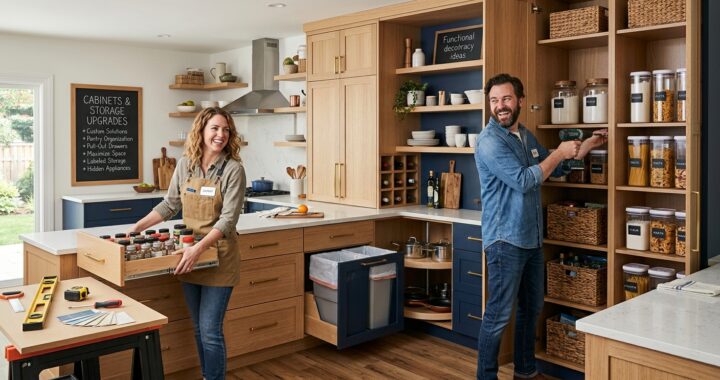
Anything stored in the back half of a standard 24-inch-deep lower cabinet disappears behind whatever sits in front of it. Retrofit pull-out trays bring the entire shelf out to you so heavy pots, dry goods, and small appliances stay visible.
| Solution | Typical Cost | Difficulty | Impact |
| Roll-out wood or wire shelf kits (DIY) | $30–$80 per shelf | Easy to moderate | High |
| Sliding wire basket organizers | $25–$60 per unit | Easy | Moderate to high |
| Custom full-extension pull-out systems | $150–$400 per cabinet | Pro install or advanced DIY | Maximum |
A practical DIY sequence takes a weekend once your kits arrive: measure every base cabinet interior first, order matching trays, mount the bottom or side rails with a drill and level, and restock by category.
Watch the weight rating: Cheap, light-duty drawer slides sag or bind once you load them with cast-iron skillets or enameled Dutch ovens. Paying roughly $15 more per tray for full-extension ball-bearing slides rated for 75 to 100 pounds prevents bent tracks later.
Drawer Dividers and Upright Pan Organizers
A cluttered utensil or pot drawer rarely needs more space—it just needs boundaries so items stop sliding into one pile every time the drawer closes.
| Drawer Type | Best Organizer | Typical Cost |
| Cutlery and cooking tools | Expandable bamboo or wood tray | $15–$35 |
| Baking sheets, cutting boards, and lids | Upright wire or wood slot dividers | $20–$50 |
| Spices | Tiered or angled in-drawer insert | $20–$45 |
| Utility / catch-all drawer | Modular interlocking bins | $10–$30 |
Standing cutting boards, sheet pans, and pot lids vertically works like a filing cabinet: you pull out the exact pan or lid you want without unstacking four others first. Deep drawers can also hold a second shallow sliding tray on top for smaller tools.
Use the Inside of Cabinet Doors
Cabinet doors provide vertical storage that usually goes completely unused. Adding slim racks keeps lightweight, flat items off your shelves and counters:
- Pot lid racks ($15–$30): Stop round lids from rolling around inside deep cabinets.
- Slim spice racks ($20–$40): Free up an entire upper shelf while keeping labels readable at a glance.
- Cutting board or foil holders ($10–$25): Keep plastic boards, parchment paper, and foil boxes upright and easy to grab.
Over-the-door hooks require zero drilling, making them ideal for rentals. Heavy-duty adhesive strips also hold up well for light loads, provided you clean the door surface with rubbing alcohol first. Keep door-mounted storage light—overloading a door with heavy glass jars puts extra strain on cabinet hinges and causes doors to sag out of alignment.
Fixing Corner Cabinets Without a Full Remodel
Blind corners and L-shaped corner cabinets swallow cookware because reaching the back requires crouching with a flashlight.
| Corner Solution | Typical Cost | Best For |
| Two-tier Lazy Susan retrofit | $40–$120 | L-shaped corner cabinets on a budget |
| Swing-out blind-corner organizer | $200–$500 | Deep blind-corner cabinets used daily |
| Diagonal pull-out corner drawers | $300–$700 | Full cabinet refacing or new builds |
For most kitchens, a sturdy two-tier Lazy Susan under $100 solves enough of the reach problem to keep mixing bowls, oils, or dry staples accessible without spending hundreds on complex hardware.
Claim Wasted Vertical Space Above and Between Shelves
Most upper cabinets leave too much air between fixed shelves—forcing you to stack plates and bowls precariously—while leaving a full foot of empty space between the cabinet tops and the ceiling.
- Wire or acrylic shelf risers ($10–$25): Double your visible shelf tiers for mugs, soup bowls, or canned goods with zero installation.
- Covered baskets above upper cabinets ($15–$40): Use the top of the cabinetry for seasonal platters, extra paper towels, or rarely used appliances. Lidded or woven bins keep grease and dust off items while keeping the room looking tidy.
Under-Sink Storage That Survives Moisture
Under-sink cabinets have to work around drain traps, supply valves, garbage disposals, and occasional drips. Standard rectangular bins rarely fit cleanly around the plumbing.
- U-shaped or stackable sink caddies ($15–$35): Wrap around the drain pipe while leaving room for sponges, dishwasher pods, and trash bags.
- Tension rod under the front lip ($5–$10): Lets you hang spray bottles by their triggers so the cabinet floor stays clear.
- Two-tier sliding under-sink baskets ($40–$90): Pull cleaning supplies out into the light instead of forcing you to reach behind pipes.
Skip unfinished wood, cardboard boxes, and raw particleboard under the sink—humidity and minor leaks cause them to swell, warp, or mildew. Stick to coated steel wire or thick washable plastic.
Where to Start on a Tight Budget
Work through these upgrades in order so you do not buy organizers for things you are about to get rid of:
| Priority | Upgrade | Estimated Cost | Effort | Impact |
| 1 | Empty-cabinet declutter and zone audit | $0 | Low | High |
| 2 | Drawer dividers and upright pan racks | $50–$100 | Low | High |
| 3 | Pull-out shelves for deep base cabinets | $150–$350 | Medium | Very high |
| 4 | Lightweight door-mounted racks | $40–$100 | Low | Medium |
| 5 | Corner Lazy Susan or pull-out | $40–$400 | Medium | High |
| 6 | Shelf risers and above-cabinet baskets | $30–$75 | Low | Medium |
Common Storage Mistakes Worth Avoiding
- Buying bins before decluttering: Measuring and buying organizers first usually means paying to neatly store clutter you should have donated.
- Paying for custom built-ins everywhere: Standard adjustable retrofit kits deliver nearly the same daily convenience at a fraction of custom millwork pricing.
- Over-relying on matching decorative jars: Decanting every pantry staple into uniform containers looks tidy on day one, but takes extra time every grocery trip and still leaves back-row items hard to reach without pull-out shelves.
Good kitchen storage comes down to two simple tests: you can see what you own without unloading half a shelf, and you can reach it with one hand. Start with the empty-cabinet audit, fix your deepest lower cabinets and busiest drawers first, and leave tricky corner hardware for last.