How to Design High-Performance Kitchen Drawers and Cabinets That Actually Fit
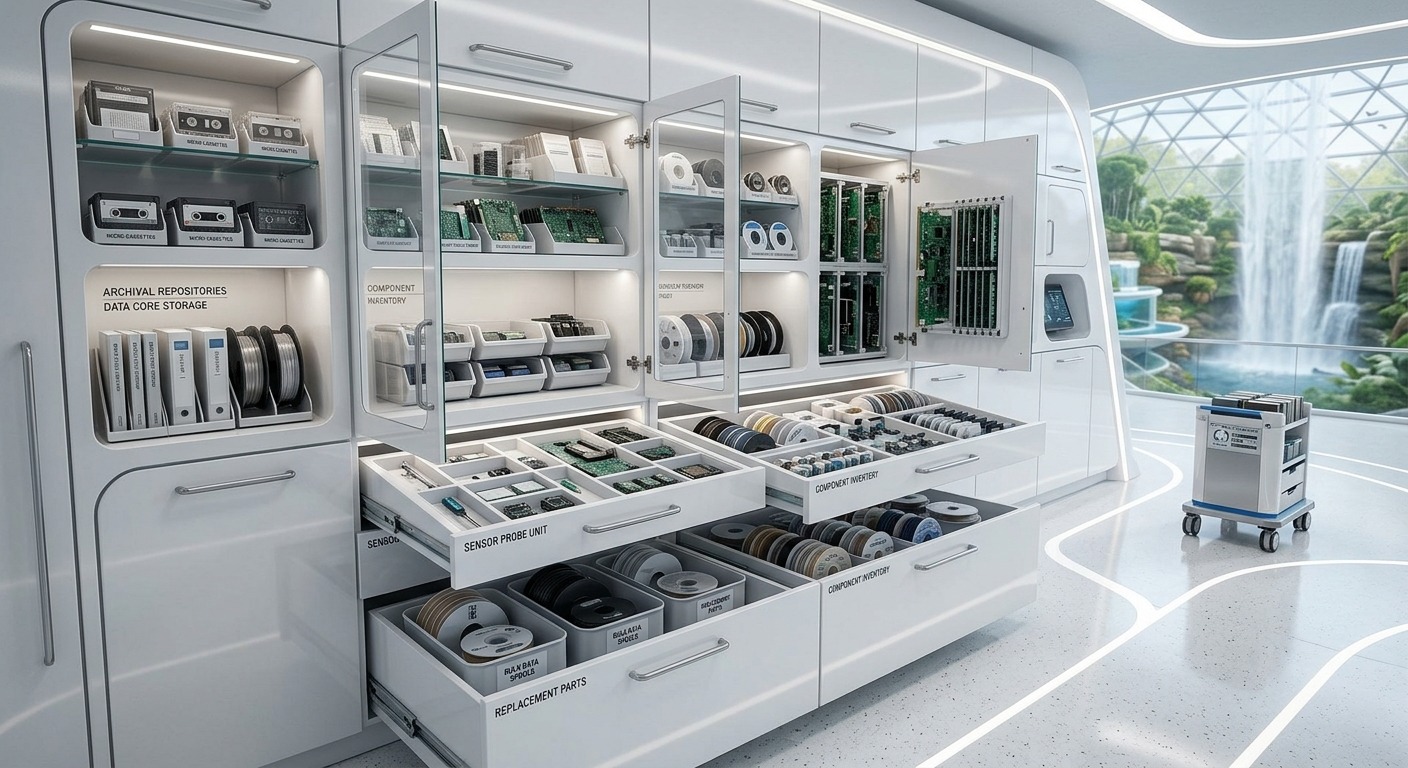
Cabinet and drawer storage works best when it is planned around real measurements, easy access, and the way the space needs to function.
That sounds obvious, but storage is often treated as the final detail of a kitchen project.
I’ve found that the opposite approach works better.
Start with the cabinet dimensions, understand the available space, and then decide which drawers, dividers, shelves, or pull-outs actually deserve a place.
For entrepreneurs selling kitchen design, cabinetry, or organization solutions, that shift creates a stronger proposition too.
You are no longer selling another accessory.
You are selling a kitchen that feels considered from the inside out.
Why Powerful Cabinet Storage Starts With Better Planning
Kitchen storage is becoming a bigger part of kitchen design rather than something added after the layout is finished.
The National Kitchen & Bath Association’s 2026 Kitchen Trends Report found that 76% of surveyed professionals expect kitchen footprints to increase over the next three years.
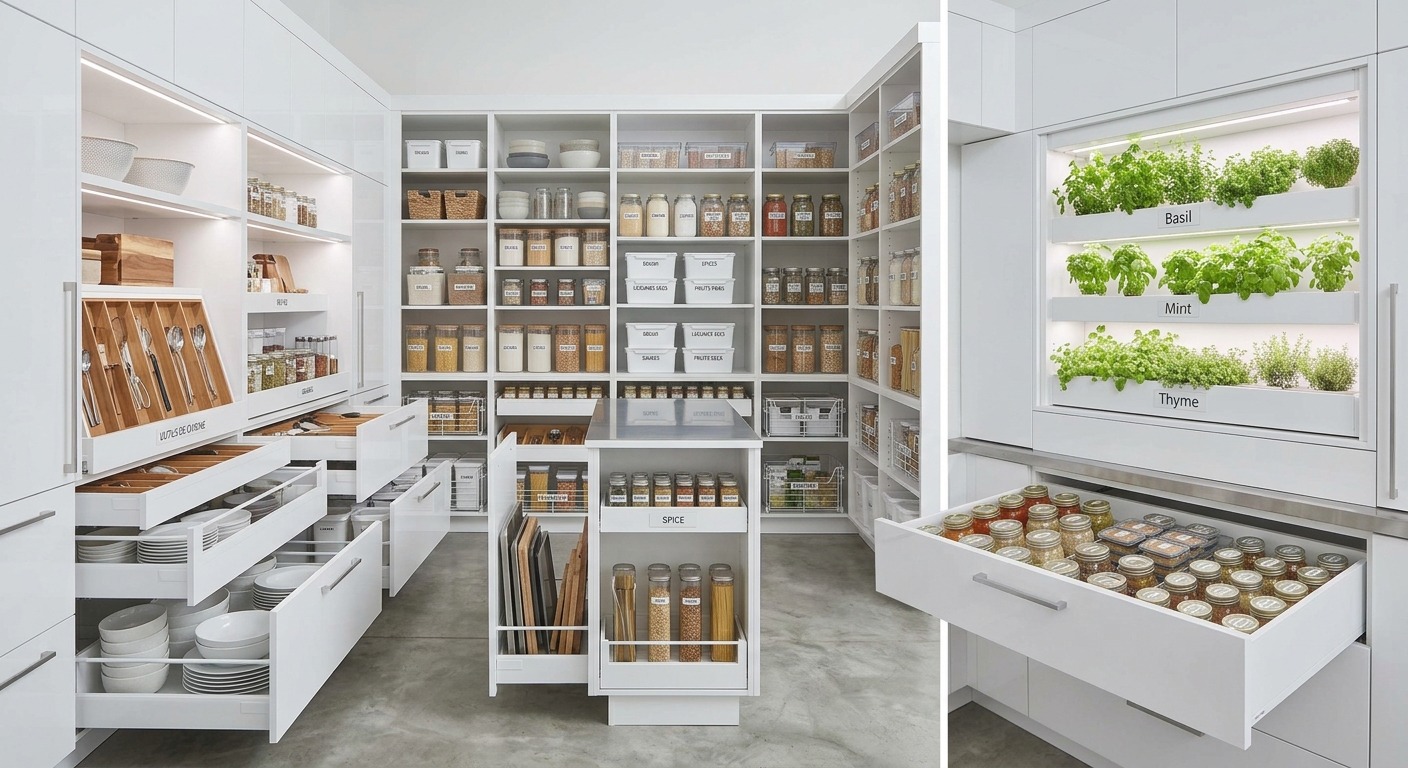
The same research also points toward smarter storage, more drawers, floor-to-ceiling cabinetry, and islands with integrated storage.
That does not mean every kitchen needs more cabinets.
Instead, it shows why the quality of the storage plan matters.
A larger cabinet does not automatically create better organization.
If the interior is difficult to access, the extra capacity may not feel particularly useful.
That is why I prefer to think about cabinet storage in three stages: measure, organize, then refine.
First, understand the physical space.
Next, decide how that space should be organized.
Finally, choose hardware and accessories that support the plan.
Start Strong: Measure the Cabinet Before Buying Accessories
The easiest storage mistake to make is buying an organizer before measuring the cabinet.
I’ve seen how quickly that can turn a simple project into a compatibility problem.
Cabinet interiors have different widths, depths, heights, and clearances.
Drawer systems also come with specific nominal lengths and load-bearing requirements.
For example, Blum’s LEGRABOX range is available in different heights, nominal lengths, and load-bearing classes.
Blum’s official LEGRABOX specifications list 40 kg and 70 kg load-bearing classes for specified configurations.
So, a storage component should never be selected simply because it looks right.
Measure first.
Then check the manufacturer’s specifications.
| Measurement | What to check | Why it matters |
|---|---|---|
| Internal width | Cabinet space from side to side | Determines compatible storage |
| Internal depth | Usable front-to-back space | Helps prevent clearance issues |
| Opening height | Available vertical space | Determines drawer positioning |
| Nominal length | Required drawer length | Must match the selected system |
This small process can save a surprising amount of frustration.
The first time I tried planning storage too quickly, I focused on the visual layout before checking the technical requirements.
That was the wrong order.
Now, dimensions come first.
Powerful Drawers: Give Everyday Storage Better Access
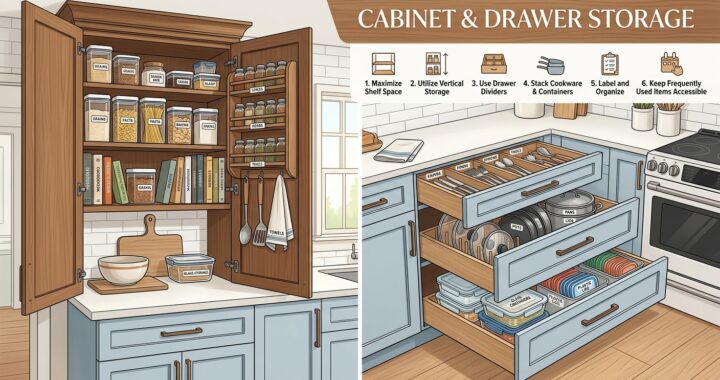
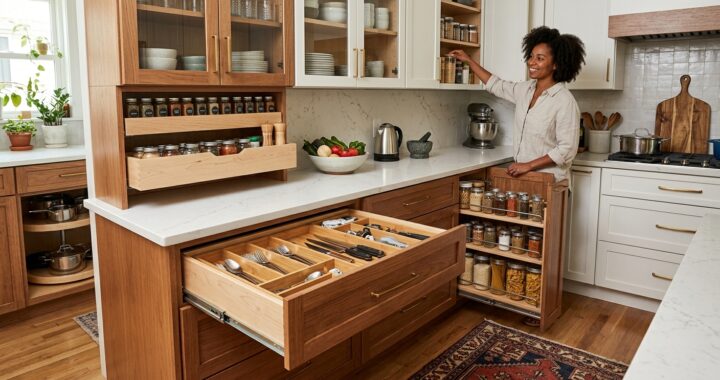
Drawers are one of the strongest tools in kitchen organization because they bring stored items forward.
That makes the interior easier to see and reach than a deep, fixed shelf in many layouts.
Still, the drawer itself is only part of the equation.
The cabinet opening, drawer dimensions, hardware, and internal organization all need to work together.
Blum’s LEGRABOX system, for example, includes standard drawers, inner drawers, high-fronted pull-outs, and inner pull-outs.
The manufacturer’s LEGRABOX product range also identifies different heights and nominal lengths.
That flexibility gives designers more options.
However, flexibility should not become an excuse to add hardware everywhere.
The strongest layouts usually have a clear reason for every drawer.
| Storage format | Main strength | Main consideration |
|---|---|---|
| Fixed shelf | Simple storage structure | Access to deeper areas |
| Standard drawer | Direct access | Width and depth |
| Inner drawer | Adds another storage level | Vertical clearance |
| Pull-out | Brings contents forward | Hardware compatibility |
So, rather than asking, “How many drawers can we add?”
Ask, “Where would a drawer make access genuinely better?”
That question produces a much cleaner design.
Smart Drawer Organization: Avoid the Accessory Trap
Drawer organizers are useful.
However, more dividers do not automatically mean better organization.
I prefer broad categories first.
Then, add separation only when it genuinely prevents items from becoming mixed together.
This keeps the drawer flexible while still giving everything a logical place.
The approach also follows a basic organizational principle recommended by Houzz.
Its kitchen cabinet and drawer organization guide recommends sorting items by category and placing them according to where they are used.
That principle is simple enough to apply during the design stage.
Instead of starting with an organizer, start with the category.
Then decide how much structure that category needs.
Keep drawer organization focused
- Group related items together.
- Separate categories that regularly become mixed.
- Leave some flexibility for changing contents.
- Remove organizers that consume space without improving access.
I wasted time once trying to make every drawer perfectly compartmentalized.
The result looked tidy, but it was less flexible.
Since then, I have preferred useful structure over visual perfection.
Breakthrough Cabinet Storage: Stop Treating Every Cabinet the Same
Every cabinet has different physical limitations.
Therefore, every cabinet does not need the same internal solution.
A tall cabinet can have completely different requirements from a shallow drawer base.
Likewise, a narrow cabinet may require different hardware from a wide one.
Blum’s product range reflects this reality.
Its LEGRABOX system includes different drawer and pull-out heights, nominal lengths, and load-bearing classes.
That means cabinet planning should happen before the final hardware selection.
| Cabinet characteristic | Better question | Avoid |
|---|---|---|
| Narrow cabinet | What hardware fits the available width? | Assuming universal compatibility |
| Deep cabinet | How will stored items remain accessible? | Ignoring rear space |
| Tall cabinet | Can the interior be divided effectively? | Leaving one oversized cavity |
| Shallow cabinet | What storage depth is actually available? | Choosing hardware by appearance |
This is where good kitchen organization becomes more technical.
The cabinet needs to dictate the storage solution.
Not the other way around.
High-Impact Pull-Outs: Bring Hidden Storage Forward
Pull-out storage can make deep cabinetry easier to access.
Yet, once again, the cabinet dimensions come first.
The selected system needs enough space for its hardware and required clearances.
Blum’s technical documentation shows that its drawer systems have specific internal-depth requirements tied to nominal lengths.
For example, Blum’s technical catalogue specifies minimum internal cabinet depth in relation to nominal drawer length for the referenced system.
That is exactly the kind of detail worth checking before making a recommendation.
A product photo cannot tell you whether the hardware will fit your cabinet.
The specification sheet can.
That is why I always prefer manufacturer documentation when a storage recommendation depends on dimensions or load ratings.
It makes the decision easier to defend.
Stronger Kitchen Organization: Design Around Access
Storage capacity gets plenty of attention.
Access deserves just as much.
A cabinet can technically hold a large amount of material while still being awkward to organize.
That is why I rank visibility and reach before maximum capacity.
Houzz’s guidance recommends grouping kitchen items by category and considering where those items are used.
That principle works especially well when planning cabinet interiors.
First, establish the category.
Next, consider the available space.
Then, choose the storage structure.
Finally, decide whether dividers or other accessories are actually necessary.
| Priority | Question |
|---|---|
| Visibility | Can the contents be identified quickly? |
| Reach | Can the contents be accessed easily? |
| Structure | Does the organization make sense? |
| Flexibility | Can the arrangement change later? |
Notice that capacity is not the first question.
That is intentional.
More storage is not automatically better if it creates more clutter inside the cabinet.
Proven Hardware: Let Specifications Do the Selling
For kitchen businesses, technical details can become a surprisingly powerful marketing tool.
Instead of calling a drawer “premium,” explain what the manufacturer actually specifies.
Blum’s LEGRABOX documentation, for example, identifies load-bearing classes of 40 kg and 70 kg for specified configurations.
Those figures should be presented exactly as the manufacturer defines them.
They should not be turned into a blanket claim about every drawer system.
The same applies to dimensions, nominal lengths, materials, and motion technologies.
Blum’s official product documentation provides these specifications for its LEGRABOX range.
That level of precision makes marketing stronger.
My clients often ask for language that sounds premium without sounding exaggerated.
My answer is usually simple: replace the adjective with the evidence.
Instead of saying:
“An exceptionally strong drawer.”
Say:
“Available in specified 40 kg and 70 kg load-bearing classes.”
The second statement is much easier to trust.
Strategic Storage: Choose Fewer Components, Better
A well-organized cabinet does not need an accessory in every corner.
In fact, too many components can make the interior harder to change later.
The better approach is to give each component a clear role.
| Component | Purpose | Check before selecting |
|---|---|---|
| Drawer divider | Creates separation | Drawer dimensions |
| Inner drawer | Adds another storage layer | Vertical clearance |
| Pull-out | Improves forward access | Cabinet depth and width |
| Fixed shelf | Provides straightforward storage | Shelf position |
This is also useful from a business perspective.
When every component has a reason, the final proposal becomes easier to explain.
You can show exactly why something belongs in the design.
That is much stronger than presenting a long list of accessories.
Powerful Storage Marketing: Sell Clarity Instead of Hype
If you are marketing kitchen cabinetry, avoid making the hardware the entire story.
Customers are rarely buying a drawer runner because they love drawer runners.
They are buying a better-organized kitchen.
So, talk about the design decisions behind the hardware.
Explain the dimensions.
Explain the configuration.
Explain the manufacturer’s specifications.
Then, explain how those decisions create a cleaner storage structure.
My clients keep asking for copy that sounds sophisticated without making risky promises.
I usually solve that by becoming more specific.
For example:
- “Designed around measured cabinet dimensions.”
- “Configured for the selected drawer system.”
- “Specified according to manufacturer requirements.”
- “Organized with purposeful internal separation.”
Those statements sound professional because they communicate something concrete.
They do not need exaggerated promises to make the product sound valuable.
A Smarter Workflow: Build Cabinet Storage From the Inside Out
The most reliable workflow is surprisingly simple.
First, measure the cabinet.
Then, define the storage structure.
Next, check compatible hardware.
Afterward, verify the manufacturer’s technical requirements.
Finally, review the layout and remove anything that does not add enough value.
When I tested this approach on storage planning, the final layouts became easier to explain.
There was less guesswork.
There were also fewer unnecessary accessories.
That is a useful lesson for anyone selling kitchen organization.
Good design does not necessarily mean adding more.
Sometimes, it means removing the things that never needed to be there.
Powerful Final Check: Does Every Component Earn Its Space?
Cabinet and drawer storage should make kitchen organization feel simpler, not more complicated.
The strongest systems begin with measurements.
Then, they use compatible hardware and purposeful internal organization.
After that, the marketing should communicate verified specifications instead of unsupported claims.
The NKBA’s 2026 research shows that smarter storage remains a significant kitchen-design direction, with more drawers, floor-to-ceiling cabinetry, pantries, and storage-focused islands appearing among the trends identified by surveyed professionals.
Read the original NKBA research.
Meanwhile, manufacturer documentation makes one point very clear: drawer systems are not interchangeable simply because they look similar.
Dimensions, nominal lengths, configurations, and load-bearing classes matter.
That is why my final test is always the same:
Does every component earn the space it occupies?
If it does, the storage plan has a strong foundation.
And if the recommendation can be supported by measurements and original specifications, the marketing becomes stronger too.
That is the real opportunity with cabinet and drawer storage.
Not more stuff.
Better decisions about the space you already have.