How to Double Your Space Without Knocking Down a Wall
Here’s the short version: reclaim vertical space with risers and wall rails, get rid of everything that doesn’t earn its drawer, add a rolling cart for mobile prep space, and zone what’s left by how often you actually use things. Done properly, most kitchens gain real usable capacity in a weekend for under $150 — no construction, no contractor, no custom anything.
I’ve spent a lot of time inside cramped kitchens — mine included — and I’ll say something that sounds contrarian until you’ve seen it proven:
Size matters way less than layout.
The best-functioning kitchen I ever worked in was tiny. One of the worst was enormous. What separated them wasn’t square footage. It was whether every inch had a job.
Yours can have a job too. Here’s where to start.
It’s Not Your Square Footage. Really.
Small kitchens fail in predictable ways, and almost none of them involve actual size.
Counters disappear under appliances nobody used since last spring. Cabinets get stuffed until nothing is findable. You buy a second peeler because the first one is buried somewhere. Every flat surface becomes storage instead of workspace.
If any of that stings — good news. All of it is fixable, cheaply, without single professional involved.
And small living isn’t going away either. US Census data shows new homes and apartments have been shrinking in many recent years. Learning to work well in a compact kitchen isn’t a compromise. It’s a skill more people need every year.
Purge First. Storage Products Come Later.
Every overstuffed kitchen owns tools that promised convenience and delivered clutter instead. The panini press. The fourth mixing bowl. The gadget drawer that never fully closes.
Resist buying anything until you’ve cut inventory down:
- One task, one tool. good knives beat seven mediocre ones.
- Duplicates go first. Count your spatulas honestly. Keep two.
- Single-use gadgets face judgment. A year unused? Donate.
- Rarely-used bulky stuff moves out of the kitchen entirely — holiday platters don’t need prime cabinet space.
I did this properly in my own galley kitchen once and filled two donation bags from cabinets alone. Three years later I haven’t missed a single item from them.
That’s the math people miss: less stuff needs less storage. Decluttering is the only free renovation out there.
Your Walls Are Wasted Square Footage
Here’s the mental shift worth making: in a small kitchen, walls and cabinet doors count as floor space.
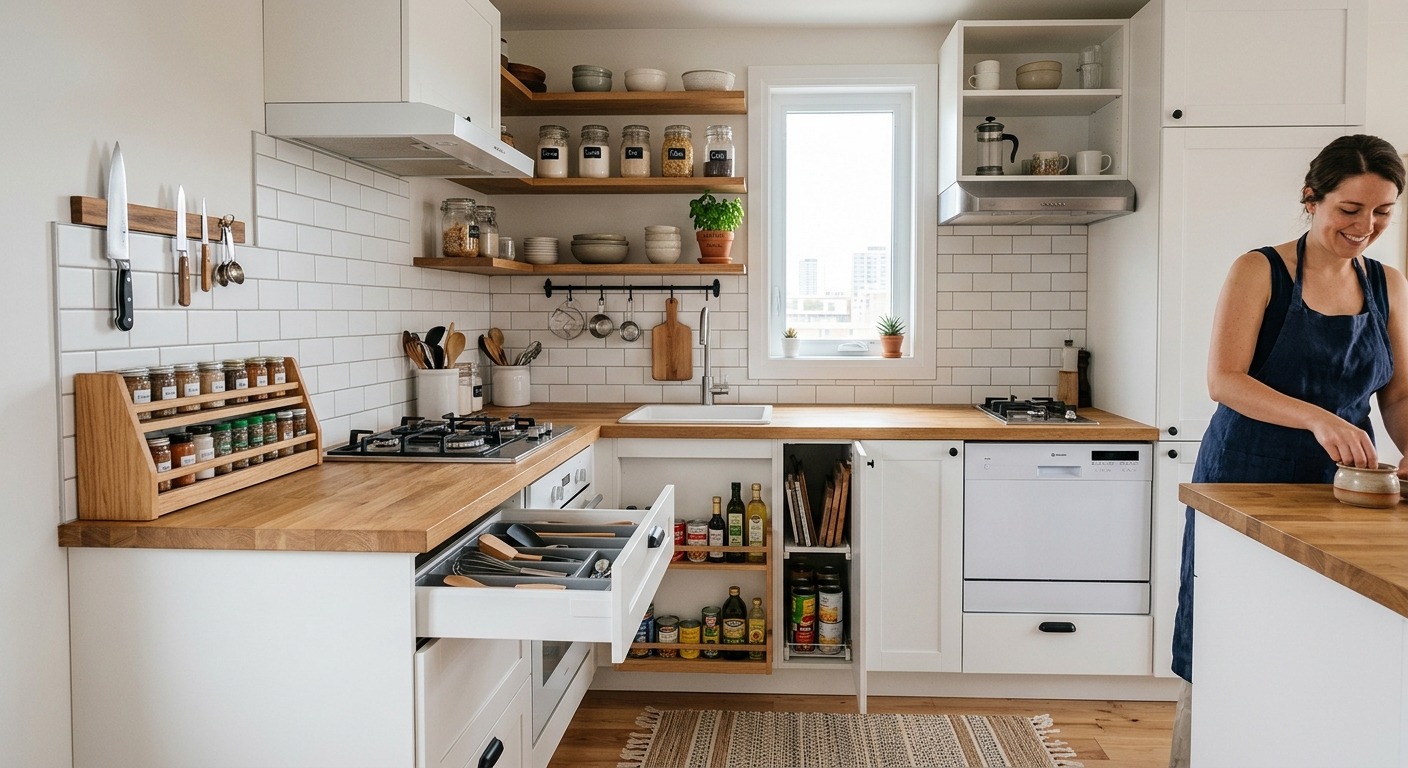
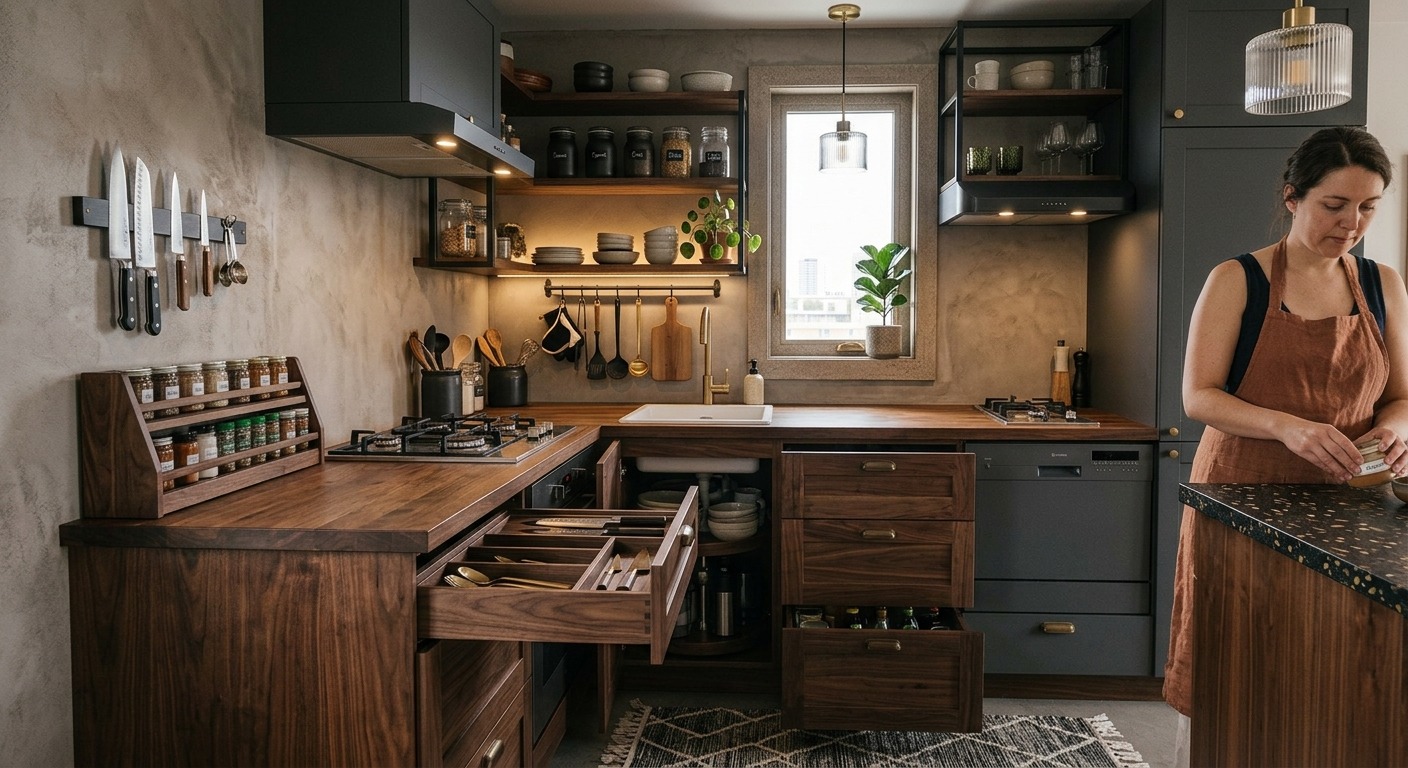
Most kitchens use maybe a third of their vertical potential. Fixing that costs almost nothing:
| Vertical Upgrade | What It Solves | Rough Cost |
|---|---|---|
| Wall rail with hooks | Utensils, m, pans off counters | 15–15–15–40 |
| Magnetic knife strip | Frees an entire drawer | 10–10–10–25 |
| Over-door racks | Boards, lids, wraps | 10–10–10–30 |
| Shelf risers | Doubles cabinet capacity | 10–10–10–30 per shelf |
| Pegboard | Fully customizable wall storage | 20–20–20–50 |
A magnetic strip was my own gateway into wall storage. One strip freed a whole drawer, which then absorbed overflow from three other drawers — all cascading from fifteen bucks.
Tight budget? Start here every time: risers inside cabinets plus one wall rail. That pair transforms function before you spend another cent.
Clear the Counter Like It’s Real Estate
Because it is now.
Counter space is oxygen when cooking. Everything parked on it steals room from actual work. So audit yours and apply one brutal test: does it get used daily?
For most households that means coffee maker plus maybe one other thing. Everything else goes in a cabinet, even if reaching it takes ten extra seconds.
Then protect that cleared surface:
- Prep over the sink basin with a board when things get tight
- Keep soap and sponges on a tray that lifts away in one motion
- Let the windowsill hold spice jars instead of mail
Fair warning from experience: the first time I kept my stand mixer on the counter “for convenience,” it mostly collected envelopes. Moving it into a cabinet added maybe fifteen seconds per use and gave back nearly two feet of workspace permanently.
Worst trade I ever made in that kitchen. Best trade I undid.
If You Buy One Thing, Make It a Rolling Cart
A slim rolling cart does double duty no cabinet can match: mobile storage and mobile workspace. Park it beside the stove while cooking, tuck it back into its gap afterwards.
Why carts earn their footprint:
- Slim profiles fit gaps as narrow as 6–8 inches beside the fridge
- Three tiers stack serious storage into negligible floor area
- Mobility means it becomes whatever the day needs — prep station, coffee corner, produce holder
- Zero installation, which renters rightly care about
We refreshed very cramped rental kitchen around exactly this formula — risers, a magnetic strip, one three-tier cart — about $90 total on a Saturday afternoon. A year later, that cart still what the owner points to first when anyone visits.
Zone Harder Than Big Kitchens Have To
Zoning matters everywhere. In tight kitchens, it’s survival — without zones, everything borrows space from everything else and cooking turns into an obstacle course.
| Zone | Essentials Stored There | Small-Kitchen Trick |
|---|---|---|
| Prep | Knives, boards, bowls | Wall rail + boards stored vertically |
| Cooking | Pans, oils, spices | Rail above stove; spices on door rack |
| Cleaning | Soap, towels, drying rack | Over-sink caddy clears the sill |
| Storage | Containers, wraps | Lid organizer + nested sets |
See the pattern running through that table? Vertical surfaces absorbing everything counters used to hold.
Honestly, that’s the whole philosophy of small-kitchen design in one sentence.
Swap Bulky for Slim (No Capability Lost)
Sometimes the fix isn’t smarter storage. Sometimes it’s just choosing a slimmer version of the same object:
| Bulky Default | Space-Saving Alternative |
|---|---|
| Full dish rack | Roll-up drying rack over the sink |
| Standard trash can | Slim bin or cabinet-door mount |
| Chunky colander | Collapsible silicone one |
| Boards stacked flat | Boards filed upright in a rack |
| Round containers | Square/nested ones that sit flush |
| Freestanding towel holder | Under-cabinet mount |
Collapsible gear sounds gimmicky until you watch one reclaim half a shelf. And nested containers deserve special praise — stacked mismatched sets waste enormous air compared to flush-fitting squares.
None of these swaps give up capability. Each trades dead volume for live inches.
Renters: You Lose Nothing Here
Rental rules kill installed shelving and hardware swaps. They don’t touch the best small-kitchen moves:
- Tension rods make instant extra shelves under sinks and inside cabinets
- Over-door organizers turn every cabinet face into storage
- Adhesive hooks and rails hold utensils, lids, mitts
- Carts deliver storage that leaves with you
- Suction caddies handle sink-side essentials
Early in my renting years I assumed “no drilling” meant “no organizing.” Wrong assumption, and a pricey delay. Modern adhesive systems hold genuine weight — respect their limits and wait the full cure time before loading them up, and they’ll serve you for years.
Everything above comes off clean at move-out. Nothing donated to the deposit.
Cheap Psychology: Light and Visual Noise
Physical space has a ceiling. Perceived space doesn — and perception shapes how cooking feels at 7 p.m. on a Tuesday.
Things that cost almost nothing:
- Clear containers read lighter than opaque bins
- Under-cabinet lighting kills shadowy corners and makes counters feel deeper
- Consistent container styles reduce visual noise
- Empty-looking counters beat any decor trick for spaciousness
Lighting surprised me most. Twenty dollars of stick-on LED strips under my cabinets changed how the whole room felt during evening hours — brighter, bigger, friendlier, right when dinner happens anyway.
Function first. But skip the cheap psychology and you’re leaving free calm on the table.
Mistakes That Shrink Kitchens Even Further
Seen these in nearly every struggling compact kitchen:
- Organizing before purging. Beautifully storing things you shouldn’t own is effortful hoarding.
- Buying products first, measuring later. Returns are nobody’s hobby.
- Ignoring vertical space while cursing the counter.
- Choosing cute over slim. A charming bulky bread box loses to a slim useful one.
- Letting gadget drawers grow one impulse buy at a time.
And the quiet killer: treating this as a one-time project. Small kitchens drift fast because strays have nowhere to hide. Ten minutes weekly keeps everything honest.
Spend in This Order
Money helps. Sequence matters more.
| Priority | Purchase | Cost | Why First |
|---|---|---|---|
| 1 | Declutter (reuse boxes you own) | $0 | Shrinks everything else needed |
| 2 | Shelf risers | 10–10–10–30 each | Biggest gain per dollar |
| 3 | Wall rail + hooks | 15–15–15–40 | Frees counters immediately |
| 4 | Rolling cart | 40–40–40–80 | Adds storage AND workspace |
| 5 | Strips, racks, small fixes | 10–10–10–30 each | Precision solves specific friction |
Spread it across two paychecks if needed — after step two alone, most kitchens already feel different.
Full roadmap total: roughly 100–100–100–200. Set that any renovation quote and it sells itself.
Give It One Hour This Weekend
Forget master plans for now. One focused hour:
Empty the counter completely. Put back only items that survived the daily-use test. Bag up the exiles and put them in the car today — not next week.
Zero dollars. Immediate payoff. You’ll cook differently tomorrow morning.
After that, momentum carries it: risers on the next shopping trip, a wall rail the week after, a cart whenever the budget allows.
Three years into my downsized kitchen, here’s what I actually tell people who ask: I don’t miss having more space. Organized well, a small kitchen beats a chaotic big one in almost every way that counts.
Less walking. Less reaching. Fewer hiding spots for clutter.
Small was never the problem. Unorganized was.