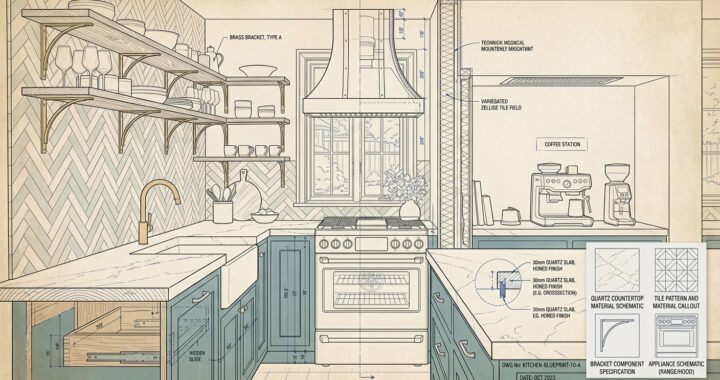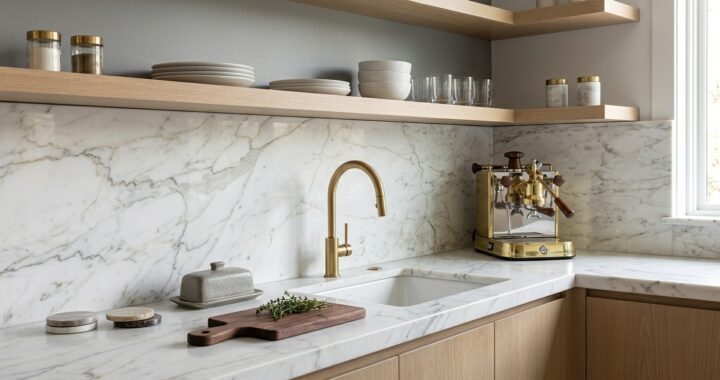
How to Make Better Kitchen Renovation Decisions
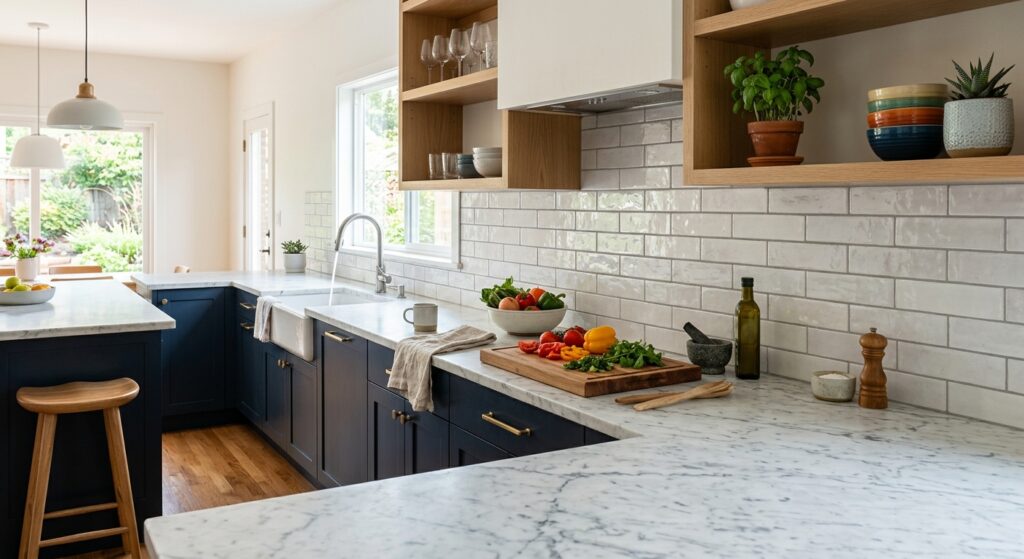
Countertops and backsplashes work best when you choose them as one design decision, not two separate purchases.
The countertop usually sets the tone.
Then, the backsplash either reinforces that direction or gives the kitchen a deliberate contrast.
For renovation entrepreneurs, that distinction makes the client conversation much easier.
Instead of presenting dozens of disconnected samples, you can guide the client toward a clear material story.
That sounds simple.
Yet, I’ve found that the simplest approach often creates the strongest result.
Start With the Countertop — Then Build the Backsplash Around It
I would start with the countertop because it usually carries more visual weight.
First, decide what the client actually wants from the surface.
Is appearance leading the decision?
Is maintenance a major concern?
Does natural variation matter?
Or does the client simply want something that feels timeless?
Houzz’s 2024 U.S. Kitchen Trends Study surveyed 3,437 homeowners about recent or planned kitchen renovations. See the original Houzz study here.
Among those homeowners, 73% identified look and feel as the top consideration when choosing countertop material.
Meanwhile, 58% considered durability, while 41% considered ease of cleaning and sanitizing. See the original Houzz findings.
Those numbers give you useful context.
However, they should not become a script you repeat to every client.
Instead, use them to understand what homeowners are already thinking about.
I’d still ask the client what matters most before recommending anything.
Narrow the Countertop Choices Quickly
Too many options can make a renovation consultation feel harder than it needs to be.
Instead, create a shortlist around the project.
| Countertop direction | What makes it appealing | What to verify |
|---|---|---|
| Engineered quartz | Consistent manufactured appearance | Exact product care and installation requirements |
| Granite | Natural variation and stone character | Sealing and maintenance guidance |
| Quartzite | Natural stone appearance | Product-specific fabrication and care |
| Marble | Distinctive veining and character | Etching, staining, finish, and maintenance |
| Porcelain or sintered surfaces | Broad design possibilities | Manufacturer fabrication requirements |
The key phrase here is product-specific.
I wouldn’t promise that every quartz, granite, or porcelain product behaves identically.
Manufacturers publish their own care and installation requirements.
Therefore, verify the actual product before making a performance claim.
That small step can separate a confident recommendation from an expensive assumption.
Use Trends as Evidence, Not Pressure
Market data can strengthen your authority.
However, there’s a big difference between informing a client and pushing a trend.
NKBA’s 2026 Kitchen Trends Report gathered responses from 634 North American industry professionals.
Read the original NKBA research information.
The report identified natural quartzite at 62% among predicted countertop materials.
It also placed natural quartzite at 61% for backsplashes. See the original NKBA findings.
That tells us something useful about professional expectations.
It does not mean quartzite is automatically the right choice.
That distinction is where good renovation marketing gets interesting.
You can say what the market is seeing without pretending the market has made the decision.
Make the Backsplash Support the Countertop
Once the countertop is settled, the backsplash becomes much easier to choose.
Instead of asking, “Which tile should we use?”
Ask, “What job should the backsplash perform visually?”
It might calm down a dramatic countertop.
Alternatively, it might add texture to a simple surface.
It could also create a stronger focal point.
The answer depends on the countertop you already selected.
Houzz reported that 86% of surveyed renovating homeowners replaced their backsplashes.
Ceramic or porcelain tile was the most popular backsplash material, at 54%.
That makes the backsplash a major renovation decision rather than an afterthought.
| Backsplash direction | Overall effect | Decision to make |
|---|---|---|
| Matching slab | Clean and continuous | Can fabrication support the layout? |
| Neutral tile | Quiet and balanced | Does it keep attention on the countertop? |
| Textured tile | Adds depth | Will the texture compete with existing movement? |
| Statement tile | Creates emphasis | Can the surrounding finishes remain controlled? |
I like giving the backsplash a clear role.
Once that role is established, material selection becomes much less chaotic.
Create Contrast Without Creating Noise
Contrast is powerful.
Still, contrast does not mean choosing completely different colors.
You can create contrast through texture.
You can also use scale, tone, finish, or pattern.
For instance, a strongly veined countertop can work beautifully with a quieter backsplash.
Conversely, a restrained countertop can leave more room for backsplash personality.
The trick is deciding which surface gets the spotlight.
Then, let the other surface support it.
That sounds obvious, but it is one of those details clients can struggle to visualize from samples alone.
Keep the Material Hierarchy Clear
I generally think of the kitchen as having a visual hierarchy.
One surface leads.
Another supports.
The remaining finishes keep everything connected.
NKBA’s 2026 research found that 96% of respondents identified neutrals as popular kitchen colors.
It also found 60% expected minimalism to remain popular over the next three years. See the original NKBA report.
Those findings don’t mean every kitchen should be white, beige, or gray.
Instead, they show that restrained palettes remain prominent in professional expectations.
I’d rather give a kitchen one memorable material moment than make every surface compete.
Think About Maintenance Before the Client Falls in Love
This is where a beautiful design can become a difficult renovation.
A client may love a surface visually.
Then, they discover that its care requirements don’t suit their expectations.
So, bring maintenance into the conversation early.
Ask what the manufacturer recommends.
Then, check whether sealing, specific cleaners, or other maintenance procedures apply.
Finally, put the relevant information into the project documentation.
| Maintenance question | What to confirm |
|---|---|
| Cleaning | Recommended products and methods |
| Sealing | Whether sealing is required |
| Staining | Manufacturer guidance for spills and stains |
| Heat | Stated limitations and precautions |
| Repairs | Manufacturer or fabricator guidance |
I wouldn’t use phrases like “maintenance-free” unless the product documentation genuinely supports that description.
Likewise, I’d avoid broad claims such as “this material never stains.”
Those statements sound persuasive until reality proves otherwise.
Good marketing should survive contact with the finished kitchen.
Get the Details Right Before Fabrication
Material selection gets most of the attention.
Yet, the small details can dramatically change the finished result.
Think about countertop edges.
Then consider seams.
After that, look at backsplash height, outlets, grout, and transitions.
These decisions should happen before fabrication.
| Detail | Confirm first | Coordinate with |
|---|---|---|
| Countertop edge | Profile and finished dimensions | Fabricator |
| Seams | Locations and expectations | Fabricator and client |
| Backsplash height | Exact finished height | Cabinet and appliance layout |
| Outlets | Position and finish | Electrician and installer |
| Grout | Color and joint specification | Tile installer |
The first time I review a renovation specification, I look for missing decisions before I look for prettier materials.
That habit saves more headaches than another hour browsing samples.
It also gives clients something they genuinely value: clarity.
Coordinate the Trades Before Problems Appear
Countertops and backsplashes do not exist in isolation.
Cabinet dimensions affect them.
Appliances affect them.
Electrical locations affect them.
Even wall conditions can affect the final installation.
Therefore, coordination needs to happen before the material arrives.
Field measurements should follow the fabricator’s requirements.
Appliance locations should also be confirmed before final fabrication.
And, never assume an existing wall is perfectly straight.
Likewise, don’t assume an outlet will automatically land where you want it after the backsplash is installed.
Ask the relevant trade.
Confirm the measurement.
Document the decision.
That workflow might feel slower initially.
However, it is far better than discovering a coordination issue after an expensive slab has already been fabricated.
Control the Budget Without Sacrificing the Design
A smaller budget does not automatically mean a less interesting kitchen.
Instead, look at where the visual impact comes from.
Maybe the countertop carries the design.
Then, a simpler backsplash can support it.
Alternatively, the backsplash might become the focal point while the countertop stays restrained.
The key is deciding where the money and visual attention should go.
| Budget lever | Possible adjustment | Protect first |
|---|---|---|
| Countertop | Compare suitable material options | Required product characteristics |
| Backsplash | Simplify pattern or material | Installation quality |
| Edge profile | Choose a simpler profile | Finished workmanship |
| Pattern | Reduce competing movement | Overall visual balance |
I wouldn’t call a material “cheap” simply because it costs less.
Instead, explain the trade-off.
The client may be changing the material.
Or perhaps they are changing the coverage.
Maybe they are simplifying fabrication.
That conversation feels much more professional than simply announcing that the budget is too high.
Don’t Forget What Happens Above the Countertop
There’s another kitchen-renovation decision that deserves attention: ventilation.
The EPA states that cooking can increase indoor particulate matter.
Read the EPA’s original guidance on indoor particulate matter.
The agency recommends using a range hood while cooking and venting it outdoors when possible.
See the EPA’s cooking and indoor-air-quality guidance.
That matters during renovation planning.
However, don’t turn this into a claim that one countertop or backsplash improves indoor air quality.
The evidence does not support that shortcut.
Instead, keep ventilation claims connected to the hood, ducting, and applicable installation guidance.
That is a much safer and more credible message.
Use Current Trends Without Chasing Them
Trends are useful.
But chasing every trend can leave a renovation looking dated surprisingly quickly.
NKBA reported that 75% of surveyed professionals expected slab or solid-surface backsplashes to gain popularity.
The same report identified transitional or timeless design at 72%.
Read the original NKBA 2026 findings.
That combination is interesting.
It suggests that professional expectations are not simply moving toward louder design.
Instead, cleaner surfaces and lasting design remain strong themes.
For an entrepreneur, that gives you a better marketing angle.
Don’t sell “the hottest trend.”
Sell a kitchen with a clear design reason behind every major surface.
That message has a much longer shelf life.
Build a Simple Selection Process
I’ve found that clients make better decisions when the process feels organized.
So, keep the workflow straightforward.
First, define the overall style.
Then, establish the countertop requirements.
Next, narrow the countertop choices.
Afterward, select the backsplash around the countertop.
Finally, confirm fabrication, maintenance, and installation requirements.
I’d also keep the client-facing selection process short:
- Establish the visual priority.
- Narrow the material choices.
- Compare documented product characteristics.
- Confirm fabrication and installation details.
That is enough structure without turning a design consultation into homework.
Build Authority With Sources You Can Defend
Renovation marketing becomes much stronger when every important claim has a credible source behind it.
Use Houzz for homeowner renovation preferences.
Use NKBA for professional trend research.
Use manufacturer documentation for product-specific performance and care.
Use EPA guidance for cooking-related indoor-air-quality information.
That separation matters.
A statistic about homeowner preferences is not proof of product performance.
Likewise, a trend forecast is not proof that a particular finish will increase a home’s value.
I’d rather publish fewer claims and stand behind every one.
That approach feels more trustworthy to clients.
It also makes your website sound like it was written by someone who actually understands renovation decisions.
Turn Two Surfaces Into One Strong Strategy
Countertops and backsplashes can completely change the personality of a kitchen.
However, the best results rarely come from choosing them independently.
Start with the countertop.
Then, decide what the backsplash should contribute.
Afterward, balance color, pattern, texture, scale, and finish.
Next, verify maintenance and fabrication requirements.
Finally, coordinate the details before installation.
That process gives the client a clearer path from inspiration to approval.
For renovation entrepreneurs, it also creates a better sales conversation.
You are no longer selling a slab.
You are not simply selling tile.
You are selling a thoughtful material strategy that can be explained, documented, and delivered.
And honestly, that is the part clients remember.