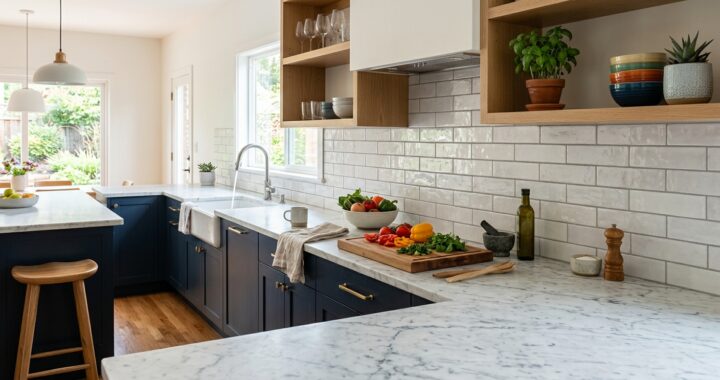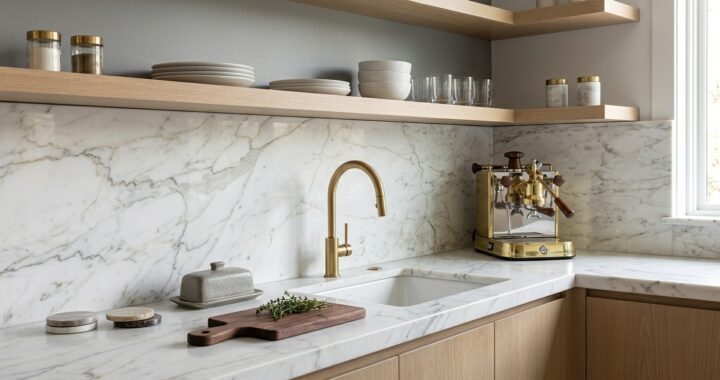
Beyond the Slab
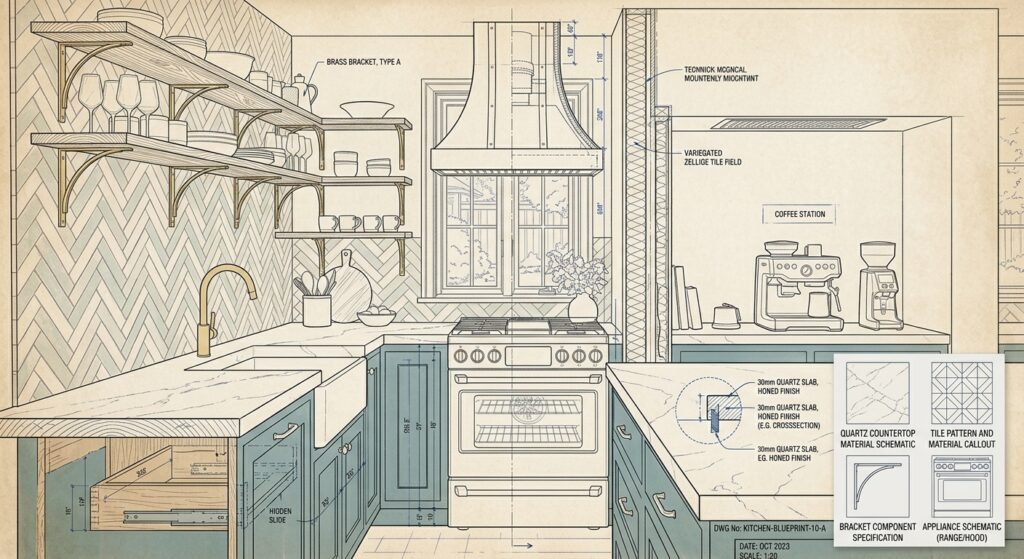
The best countertop and backsplash choices balance looks, maintenance, installation, and the realities of the renovation.
I’ve found that the expensive mistakes usually happen before installation even starts.
Someone falls in love with a slab, picks a backsplash afterward, and then discovers the two materials need very different care.
A better approach is simple: choose the countertop first, understand its requirements, and build the backsplash around it.
That keeps the design focused and makes the renovation easier to manage.
Start Strong: Choose the Countertop First
Countertops connect several parts of a kitchen at once.
They meet the cabinets, sink, appliances, walls, and backsplash.
Because of that, I prefer treating the countertop as the starting point rather than an afterthought.
Material choice should come before color matching.
Quartz, granite, marble, and laminate can look completely different while also requiring different care.
| Material | What stands out | What to check |
|---|---|---|
| Quartz | Nonporous manufactured surface | Heat, scratches, and cleaning products |
| Granite | Natural stone with strong scratch resistance | Stone type and care recommendations |
| Marble | Distinctive natural appearance | Acid sensitivity and maintenance |
| Laminate | Wide range of designs | Heat and surface protection |
The Natural Stone Institute explains that granite is a hard dimension stone with strong scratch resistance, making it suitable for heavily used surfaces.
Still, that does not mean every granite slab should be treated exactly the same.
The stone’s composition, finish, fabrication, and supplier instructions all matter.
That is why I avoid broad claims like “this material is maintenance-free.”
They sound good in marketing, but they are difficult to defend without a specific product behind them.
Make Quartz a Deliberate Choice
Quartz remains attractive because many engineered quartz surfaces are nonporous and relatively simple to maintain.
However, “easy to maintain” does not mean “nothing can damage it.”
Caesarstone recommends warm water and mild detergent for routine cleaning while advising protection from hot cookware and sharp objects.
You can check its current quartz and mineral surface care guidance here.
That distinction matters when writing renovation specifications.
I would rather tell a client exactly how a surface should be treated than promise that it can handle anything.
| Quartz consideration | Practical question |
|---|---|
| Cleaning | Which products does the manufacturer approve? |
| Heat | Are trivets or hot pads required? |
| Scratches | Should cutting boards be used? |
| Chemicals | Which cleaners should be avoided? |
| Warranty | What product-specific limitations apply? |
Caesarstone also advises caution with strong acids, alkalis, and other aggressive chemicals.
Its guidance recommends checking unfamiliar cleaning products on an inconspicuous area first.
That is the kind of detail I want in a renovation specification.
It gives the owner something concrete to follow instead of vague promises about durability.
Give Natural Stone the Attention It Deserves
Natural stone has something manufactured materials cannot completely reproduce: natural variation.
Veining, mineral movement, color shifts, and small geological characteristics make each slab visually different.
At the same time, those characteristics can affect maintenance.
The Natural Stone Institute explains that calcareous stones are sensitive to acidic solutions.
Marble is a familiar example.
Acidic cleaners can dull or etch sensitive stone surfaces, so a generic kitchen cleaner is not automatically appropriate.
The Institute recommends mild, non-acidic cleaning products for natural stone.
Therefore, I would always check the stone classification before recommending a cleaning routine.
Be Careful With Sealing Advice
Sealing is another topic where renovation advice can become unnecessarily broad.
Some natural stones benefit from additional stain resistance, while others may not require sealing.
The Natural Stone Institute says many granite countertops do not need sealing, although sealing can provide additional resistance to staining.
That is a much more useful answer than saying every granite countertop needs annual sealing.
The exact stone and product should guide the decision.
| Sealing question | What to verify |
|---|---|
| Is sealing needed? | Ask the stone supplier |
| Which product? | Confirm compatibility |
| Food-preparation area? | Check product safety guidance |
| How often? | Follow manufacturer recommendations |
I treat sealing as a documented maintenance decision.
That approach keeps the renovation honest and prevents unnecessary maintenance from becoming part of the sales pitch.
Build the Backsplash Around the Countertop
Once the countertop is selected, the backsplash becomes much easier to choose.
Start by looking at the countertop’s movement, color, finish, and overall visual weight.
Then decide whether the backsplash should quietly support it or provide controlled contrast.
A heavily patterned countertop usually needs restraint around it.
Meanwhile, a simple countertop can handle more texture or visual interest nearby.
I like this approach because it keeps the kitchen from looking like every surface is competing for attention.
Create Contrast Without Creating Chaos
Contrast does not have to mean dramatic color.
It can come from texture, finish, scale, grout, or a subtle shift in tone.
The trick is choosing one dominant idea.
| Countertop style | Backsplash direction |
|---|---|
| Strong natural movement | Keep the backsplash restrained |
| Minimal countertop pattern | Add controlled texture |
| Dark countertop | Consider a lighter supporting tone |
| Light countertop | Introduce measured contrast |
The goal is not to make the backsplash disappear.
Instead, it should make the countertop look more intentional.
That small distinction can completely change how the finished kitchen feels.
Stop Choosing From Tiny Samples
Small samples can be useful, but they can also hide important details.
Natural stone is especially difficult to judge from a tiny piece because larger slabs reveal movement that samples cannot show.
I prefer seeing the actual slab whenever the supplier makes that possible.
Then, I look at the areas where seams, sink cutouts, corners, and edges will appear.
The material may look perfect in isolation but behave differently once fabricated.
This is one of those renovation details that costs little to check and can prevent a major visual disappointment.
For entrepreneurs managing renovation projects, that is a useful habit.
Review the actual product before committing whenever practical.
Control the Real Cost, Not Just the Material Price
A countertop quote is rarely just the price of the slab.
Fabrication, cutouts, edge profiles, seams, installation, and related preparation can affect the final figure.
Therefore, compare complete proposals rather than comparing material prices alone.
I like asking suppliers to separate the major components.
| Quote area | What to confirm |
|---|---|
| Material | Exact product and quantity |
| Fabrication | Cutouts, edges, seams, finishing |
| Installation | Labor and site requirements |
| Backsplash | Material and installation |
| Extra work | Removal, preparation, or adjustments |
This makes competing quotes easier to understand.
It also helps prevent the classic problem where the “cheaper” option becomes more expensive after missing items appear.
A clean quote is not just easier for accounting.
It also gives the customer more confidence in the renovation plan.
Get Measurements Right Before Fabrication
Countertops are fabricated to specific dimensions.
So, preliminary measurements should not automatically be treated as final fabrication measurements.
Cabinet positioning, appliance dimensions, sink selection, wall conditions, and installation changes can affect the final result.
I always want the renovation process to make one thing clear: who performs the final measurement and when it happens.
That responsibility should be documented before fabrication begins.
Otherwise, everyone can end up assuming someone else checked the dimensions.
I learned quickly that “close enough” is not a useful phrase when a countertop is being fabricated.
For countertops, accuracy is not a finishing detail.
It is part of the product.
Protect the Surface From Heat and Sharp Objects
Even durable countertops have limits.
Quartz manufacturers, for example, recommend using trivets or hot pads rather than placing hot cookware directly on the surface.
Caesarstone also recommends cutting boards and warns that sharp objects can damage the finish.
Its care guidance explains these precautions directly.
Granite has strong heat resistance as well, but the Natural Stone Institute warns against localized heat because thermal gradients can contribute to cracking.
These recommendations are easy to follow.
They also show how honest renovation marketing should work.
Instead of saying “extremely durable,” explain what the manufacturer actually recommends.
That is more useful to the customer and easier for you to defend.
Keep Cleaning Advice Material-Specific
Cleaning instructions should follow the material rather than a generic kitchen checklist.
The Natural Stone Institute recommends mild cleaning methods for natural stone and warns that acidic products can affect acid-sensitive stones.
Caesarstone likewise provides specific guidance for its quartz surfaces, including avoiding certain harsh chemicals.
That means a cleaner suitable for one countertop should not automatically be recommended for another.
| Surface | Safer starting point |
|---|---|
| Natural stone | Mild, non-acidic cleaner |
| Quartz | Manufacturer-approved cleaner |
| Marble | Avoid acidic cleaning products |
| Specialty finish | Follow the supplier’s instructions |
I would also avoid promising that a surface is “maintenance-free.”
Even products marketed as very easy to maintain still come with care instructions.
Clear expectations are better marketing because customers know exactly what they are buying.
Make the Backsplash Practical Too
The backsplash is not just a decorative strip behind the counter.
Its tile, finish, grout, and installation all become part of the finished surface.
Therefore, I would review the complete assembly rather than judging the tile by itself.
A textured tile may look excellent but require different cleaning than a smooth finish.
Likewise, grout selection can affect the overall maintenance routine.
The answer is not to avoid texture or grout.
Instead, make the decision with the actual maintenance requirements in front of you.
That gives the customer a realistic picture before installation.
Turn Documentation Into a Marketing Advantage
Good renovation marketing does not need exaggerated promises.
Actually, the opposite can be more persuasive.
Show customers the manufacturer’s specifications, maintenance guidance, and warranty information behind important recommendations.
That creates a clear connection between your advice and the product documentation.
For a renovation business, that can become a genuine trust signal.
Keep records for:
- Product specifications
- Care instructions
- Installation requirements
- Warranty information
Then, reference those documents when discussing maintenance or product limitations.
You are not asking the customer to simply trust your opinion.
You are showing them where the information comes from.
Build a Better Countertop and Backsplash Specification
A strong specification should answer practical questions before the work begins.
First, identify the exact countertop product.
Next, document its care requirements and installation conditions.
Then, specify the backsplash material, finish, grout, and installation details.
Finally, compare the complete installed price with the renovation budget.
| Final check | Question to answer |
|---|---|
| Product | What exact material is being purchased? |
| Performance | What does the manufacturer document? |
| Maintenance | What care does the surface require? |
| Installation | What fabrication conditions apply? |
| Appearance | Has the actual material been reviewed? |
| Budget | What is the complete installed cost? |
That process is not complicated.
It simply removes assumptions from decisions that can become expensive later.
Choose Materials You Can Stand Behind
The best countertop and backsplash combination is not necessarily the most expensive one.
It is the combination whose appearance, maintenance, installation requirements, and documented characteristics fit the renovation.
Quartz may make sense when its care requirements match the project.
Natural stone may make sense when its appearance and maintenance expectations are understood.
Neither deserves a blanket “best material” label.
That is the point I would emphasize to any renovation business owner.
Choose the surface for what it can reliably deliver, then use the backsplash to make the whole kitchen feel intentional.
Good renovation marketing works the same way.
Make the promise attractive, but make sure the evidence can support it.