Smarter Way to Organize Your Kitchen
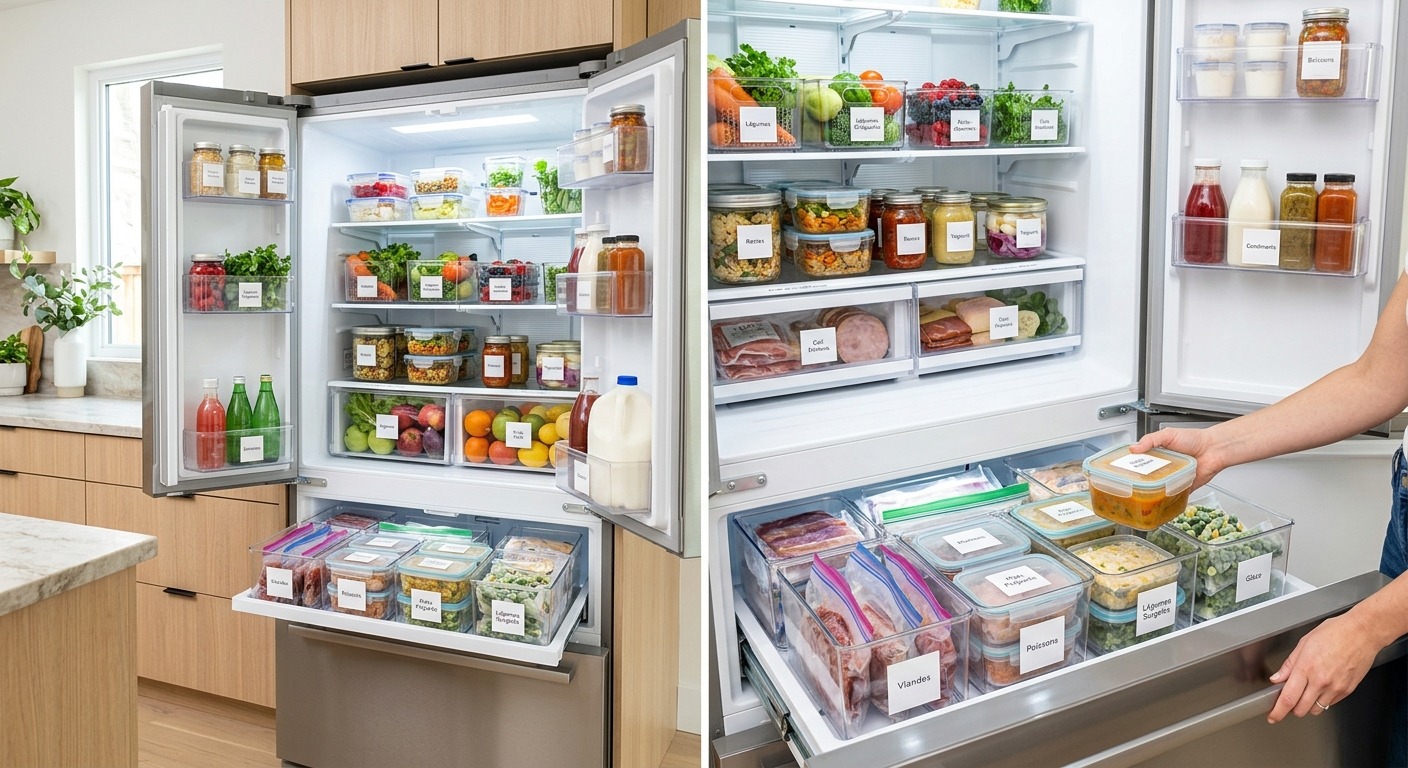
A well-organized refrigerator and freezer should make your kitchen easier to run, not give you another system to maintain.
The trick is not buying a dozen matching containers or making every shelf look perfect.
Instead, give your food a logical place, keep the things you use most within reach, and make older food easy to spot.
That sounds simple because it is.
After trying different organization methods, I’ve found that the systems that last are usually the least fussy.
You want to open the refrigerator and immediately know where something belongs.
You also want to see what needs using before you buy another version of it.
That is the real goal of refrigerator and freezer organization.
🔥 Start With the Basics Before Rearranging Everything
Before you move a single container, check the temperature.
The FDA recommends keeping a refrigerator at 40°F (4°C) or below and a freezer at 0°F (-18°C). FDA refrigerator thermometer guidance
If your appliance does not show an accurate internal temperature, an appliance thermometer gives you a better way to check it.
Once that is sorted, look at how much food is actually inside.
An overstuffed refrigerator is difficult to organize because cold air needs room to circulate around the food. FDA food-storage guidance
So, before buying another storage bin, remove anything you no longer need.
You might be surprised by how much space appears.
⚡ Give Every Part of the Refrigerator a Job
I used to think the easiest approach was simply putting things wherever there was room.
It worked for about three days.
Then somebody moved a container, another item disappeared behind it, and suddenly the refrigerator looked like a game of Tetris.
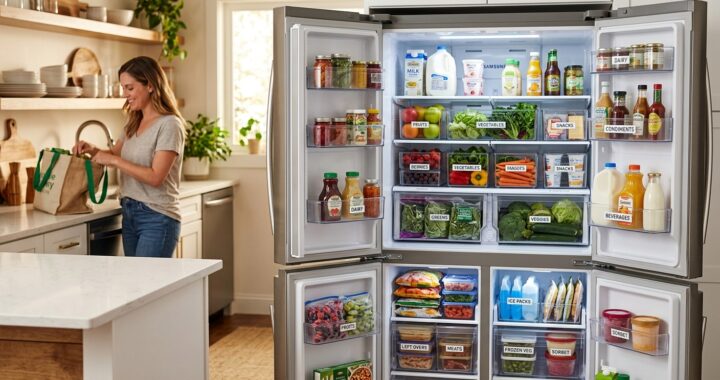
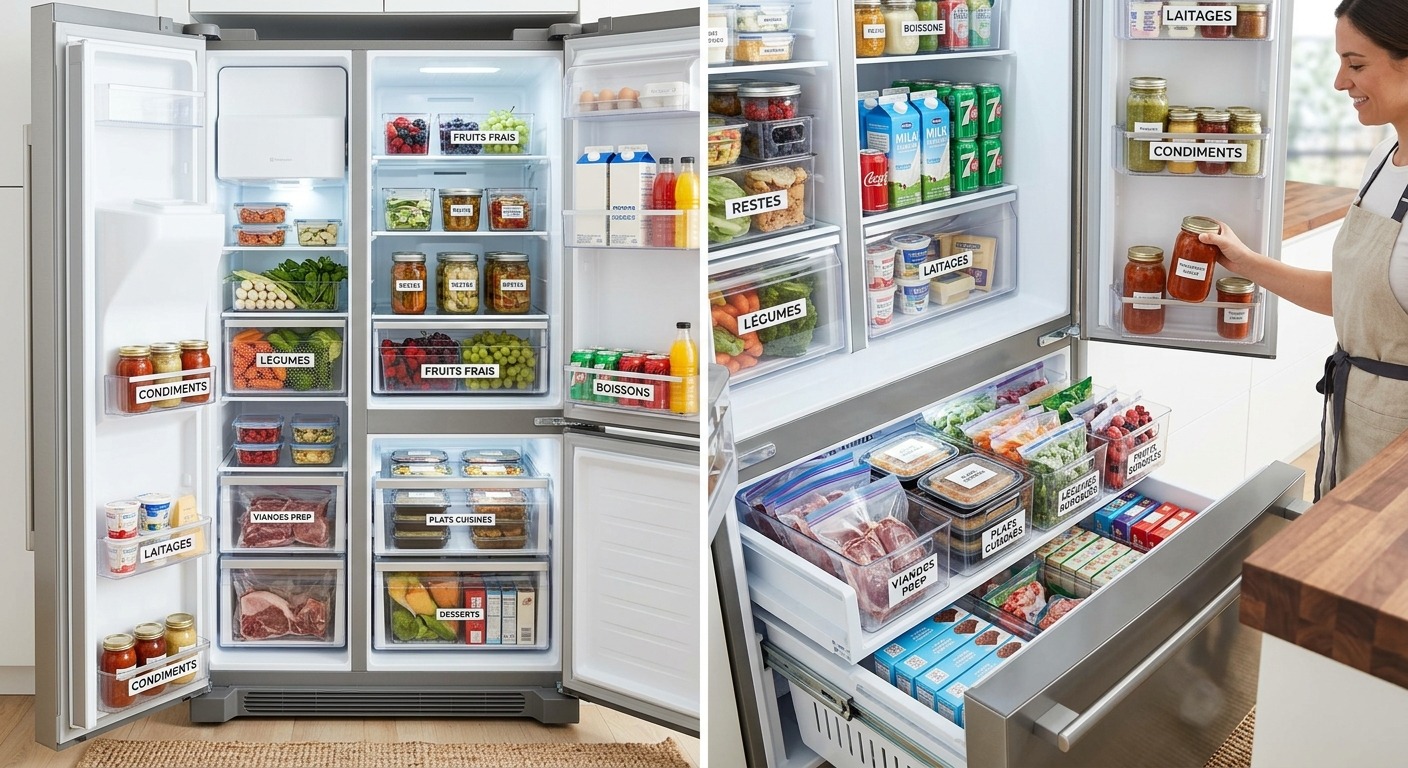
A better approach is to give broad areas a purpose.
| Area | What to keep there | Simple rule |
|---|---|---|
| Upper shelves | Ready-to-eat foods and prepared items | Keep frequently used foods visible |
| Middle shelves | Dairy and everyday foods | Group similar foods together |
| Lower shelves | Foods needing extra separation | Keep packages sealed |
| Drawers | Produce and designated chilled foods | Keep categories together |
You do not have to copy this layout exactly.
Refrigerators vary, so work with the shelves and drawers you already have.
The important part is consistency.
When everyone puts similar foods back in roughly the same place, finding something becomes much easier.
🚀 Stop Hiding Food Behind Other Food
Here is one of the simplest improvements you can make: make your food visible.
A container hidden behind three other containers is easy to forget.
Then you buy more food because you cannot remember what is already there.
Clear containers can help, especially for leftovers and smaller items.
However, I would not fill your refrigerator with containers just because they look good in photographs.
Use them where they genuinely make things easier.
For example, a clear bin can keep small packages together without allowing them to spread across an entire shelf.
Likewise, a clear container can make leftovers much easier to identify.
The goal is visibility, not perfection.
💡 Create a Small “Eat First” Area
This is one of my favorite ideas because it requires almost no equipment.
Choose one small area for food that should be used soon.
It could be a shelf, a corner, or a small container.
When something needs attention, move it there.
Suddenly, you have a visual reminder every time you open the door.
You do not need an app.
You do not need a spreadsheet.
You simply need a place that says, without any explanation, use this first.
For leftovers, timing still matters. USDA guidance recommends using many refrigerated leftovers within 3 to 4 days. USDA leftover-storage guidance
Food-specific guidance can differ, though, so do not treat that timeframe as a universal rule for every item.
🧊 Make Your Freezer Easier to See
Freezers have a special talent for hiding things.
A bag gets pushed toward the back.
Another bag lands on top.
Three months later, you discover something you completely forgot existed.
The solution is not necessarily a bigger freezer.
Usually, it is better grouping.
Think in broad categories instead of creating a complicated filing system.
| Category | Keep together | Organization tip |
|---|---|---|
| Prepared meals | Frozen cooked foods | Group portions together |
| Frozen vegetables | Vegetable packages | Keep labels visible |
| Meat and seafood | Similar protein packages | Keep securely packaged |
| Ingredients | Items used for cooking | Group by type |
| Older items | Food that should be used first | Keep toward the front |
When I tested a similar setup, vertical storage made a surprisingly big difference.
Instead of stacking everything into one frozen mountain, I could see more packages at once.
Of course, not every freezer allows this.
Drawers, shelves, baskets, and compartments all work differently.
So, adapt the idea rather than forcing your freezer to copy someone else’s setup.
🔥 Use the “Older First” Rule
You do not need an elaborate inventory system to rotate food.
When new food comes in, place it behind older food whenever practical.
Then, when you need something, reach for the older item first.
It is a small habit, but it prevents the classic freezer problem: forgetting what you already have.
For frozen foods, there is another useful distinction.
FDA guidance says food kept continuously at 0°F (-18°C) remains safe indefinitely, while recommended freezer storage periods generally relate to quality rather than safety. FDA freezer-storage guidance
In other words, “safe” and “best quality” are not always the same thing.
That distinction is easy to miss.
🛡️ Keep Organization From Getting in the Way of Food Safety
A beautiful refrigerator is not automatically a safe refrigerator.
Organization should support food safety rather than compete with it.
Raw meat, poultry, and seafood deserve particular care because their juices can contaminate other foods.
Keep them sealed and separate from ready-to-eat foods. FDA food-safety guidance recommends preventing raw-food juices from contaminating other foods. FDA safe food handling guidance
That is one reason I prefer simple containers over complicated refrigerator accessories.
You want something that contains a leak, not something that looks impressive on Instagram.
⚠️ Remember the Two-Hour Rule
Perishable foods, prepared foods, and leftovers should not sit at room temperature indefinitely.
The FDA recommends refrigerating or freezing them within two hours.
If the surrounding temperature is above 90°F, the recommended window drops to one hour. FDA safe-handling guidance
This is also why I would not leave groceries sitting around while reorganizing the entire refrigerator.
Get the food into safe storage first.
You can organize afterward.
💥 Keep the Refrigerator Airy, Not Packed
One of the easiest mistakes is filling every empty space.
An empty shelf can feel like wasted space.
It is not.
Some breathing room makes it easier to see food and allows cold air to circulate properly.
So, resist the temptation to squeeze one more container into every gap.
When the refrigerator starts feeling difficult to navigate, take that as a signal.
You may not need another organizer.
You may simply have too much inside.
🧽 Deal With Spills Immediately
This sounds boring, but it makes the next cleanup dramatically easier.
A small spill is simple to wipe.
A forgotten spill that sits underneath containers is another story.
The FDA recommends cleaning refrigerator spills promptly, particularly when raw foods are involved. FDA refrigerator guidance
Keep the cleanup simple.
Wipe the area, clean the affected surface appropriately, and put everything back.
There is no prize for turning refrigerator maintenance into a major household project.
⚙️ Build a Reset That Takes Minutes
The best organization system is one you will still use next month.
That means your reset should be quick.
After grocery shopping, take a few minutes to put everything into its category.
Move older items forward.
Check the “eat first” area.
Deal with obvious spills.
Then stop.
| Reset | What to check | Why it matters |
|---|---|---|
| Quick scan | Forgotten or misplaced food | Keeps inventory visible |
| After shopping | Categories and older items | Prevents new food from hiding old food |
| Spill check | Shelves and drawers | Keeps cleanup manageable |
| Temperature check | Refrigerator and freezer | Confirms storage conditions |
I learned this the annoying way.
I once created a much more detailed organization system, complete with specific containers for nearly everything.
It looked fantastic.
It also took too long to maintain.
Within a short time, the system was being ignored.
That taught me something useful: organization has to be easier than disorganization.
📋 Keep Labels Simple
Labels can be useful, especially in a freezer.
They are particularly helpful when containers look identical or frozen food becomes difficult to identify.
Still, you do not need to label every single thing.
A short label can be enough.
You might include the food name and date, particularly when you are storing homemade meals.
I once tried a much more detailed labeling system, and it became a job of its own.
That was the point when I stopped labeling anything that was already obvious.
A good system should remove work, not create more of it.
🚀 Think Like an Entrepreneur: Build a System That Repeats
There is a useful business lesson hiding inside refrigerator organization.
Good systems reduce repeated decisions.
Your kitchen can work the same way.
Instead of deciding where every item belongs every time you open the refrigerator, create a few simple rules.
Shop → Store → Rotate → Use → Reset
That is enough.
My clients often ask how to make household systems easier to maintain.
My answer is usually the same: remove unnecessary decisions.
If everyone knows where dairy goes, where leftovers go, and where food needing attention belongs, the refrigerator largely organizes itself.
That is much more valuable than having matching containers.
📊 Keep the System Simple Enough to Survive Busy Weeks
Your refrigerator does not need a perfect system.
It needs a dependable one.
| If this keeps happening | Try this instead |
|---|---|
| Food disappears behind containers | Use fewer, clearer categories |
| Leftovers get forgotten | Create an “eat first” area |
| Freezer packages become buried | Group similar foods together |
| Resetting takes too long | Reduce the number of storage rules |
Notice the pattern.
Every solution makes the system simpler.
That is deliberate.
A complicated organization system can work beautifully for a few days.
A simple system can keep working for months.
✨ Your Refrigerator Does Not Need to Look Perfect
Pinterest-worthy refrigerators are attractive.
However, your refrigerator has a different job.
It needs to store food safely while making your everyday routine easier.
Start with temperature.
Then, create broad zones.
Keep food visible.
Separate foods appropriately.
Rotate older items forward.
Finally, create a quick reset that does not feel like another chore.
You do not need expensive organizers to make that happen.
In fact, some of the most useful changes cost nothing.
Move similar foods together.
Stop burying leftovers.
Give older items priority.
Remove things you no longer need.
Leave enough space for cold air to circulate.
That is refrigerator organization at its most useful.
And honestly, that is the approach I prefer: less fuss, fewer decisions, better visibility, and a system you can actually keep using.